
solo per uso di ricerca
Regorafenib Hydrochloride VEGFR Inibitore
N. Cat.: S4947
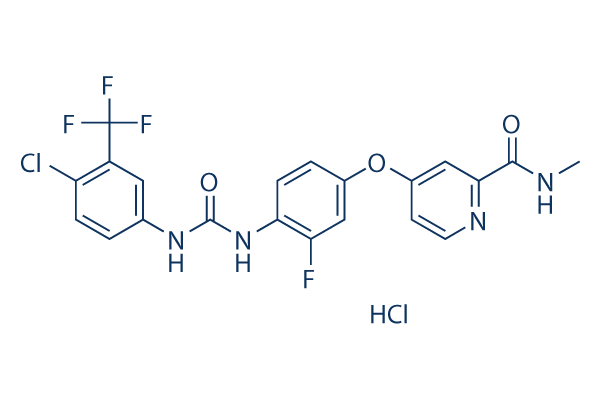
Struttura chimica
Peso molecolare: 519.28
Controllo Qualità (Quality Control)
| Target correlati | EGFR FGFR PDGFR c-Met Src MEK CSF-1R FLT3 HER2 c-Kit |
|---|---|
| Altro VEGFR Inibitori | SAR131675 SU 5402 Cediranib (AZD2171) Vatalanib (PTK787) 2HCl Anlotinib (AL3818) Dihydrochloride Linifanib (ABT-869) Apatinib (YN968D1) Apatinib (YN968D1) mesylate Ki8751 Semaxanib (SU5416) |
Informazioni chimiche, conservazione e stabilità (Chemical Information, Storage & Stability)
| Peso molecolare | 519.28 | Formula | C21H16Cl2F4N4O3 |
Conservazione (Dalla data di ricezione) | 3 years -20°C powder |
|---|---|---|---|---|---|
| N. CAS | 835621-07-3 | -- | Conservazione delle soluzioni stock |
|
|
| Sinonimi | Stivarga, BAY 73-4506 hydrochloride | Smiles | Cl.CNC(=O)C1=NC=CC(=C1)OC2=CC(=C(NC(=O)NC3=CC(=C(Cl)C=C3)C(F)(F)F)C=C2)F | ||
Solubilità (Solubility)
|
In vitro |
DMSO
: 100 mg/mL
(192.57 mM)
Water : Insoluble Ethanol : Insoluble |
Calcolatore di Molarità
|
In vivo |
|||||
Calcolatore di formulazione in vivo (Soluzione chiara)
Passo 1: Inserire le informazioni di seguito (Consigliato: Un animale aggiuntivo per tenere conto della perdita durante l'esperimento)
Passo 2: Inserire la formulazione in vivo (Questo è solo il calcolatore, non la formulazione. Contattateci prima se non c'è una formulazione in vivo nella sezione Solubilità.)
Risultati del calcolo:
Concentrazione di lavoro: mg/ml;
Metodo per preparare il liquido master di DMSO: mg farmaco predissolto in μL DMSO ( Concentrazione del liquido master mg/mL, Vi preghiamo di contattarci prima se la concentrazione supera la solubilità del DMSO del lotto del farmaco. )
Metodo per preparare la formulazione in vivo: Prendere μL DMSO liquido master, quindi aggiungereμL PEG300, mescolare e chiarire, quindi aggiungereμL Tween 80, mescolare e chiarire, quindi aggiungere μL ddH2O, mescolare e chiarire.
Metodo per preparare la formulazione in vivo: Prendere μL DMSO liquido master, quindi aggiungere μL Olio di mais, mescolare e chiarire.
Nota: 1. Si prega di assicurarsi che il liquido sia limpido prima di aggiungere il solvente successivo.
2. Assicurarsi di aggiungere il/i solvente/i in ordine. È necessario assicurarsi che la soluzione ottenuta, nell'aggiunta precedente, sia una soluzione limpida prima di procedere all'aggiunta del solvente successivo. Metodi fisici come il vortex, gli ultrasuoni o il bagno d'acqua calda possono essere utilizzati per facilitare la dissoluzione.
Meccanismo d'azione (Mechanism of Action)
| Targets/IC50/Ki |
RET
(Cell-free assay) 1.5 nM
Raf-1
(Cell-free assay) 2.5 nM
Murine VEGFR2
(Cell-free assay) 4.2 nM
Kit
(Cell-free assay) 7 nM
VEGFR1
(Cell-free assay) 13 nM
PDGFRβ
(Cell-free assay) 22 nM
Murine VEGFR3
(Cell-free assay) 46 nM
|
|---|---|
| In vitro |
Regorafenib strongly prevents VEGFR2 autophosphorylation in NIH-3T3/VEGFR2 cells with IC50 of 3 nM. In HAoSMCs, regorafenib suppresses PDGFR-β autophosphorylation after stimulation with PDGF-BB, with an IC50 of 90 nM. Regorafenib also inhibits FGFR signaling in MCF-7 breast cancer (BC) cells stimulated with FGF10. Regorafenib very potently inhibited the mutant receptors KITK642E and RETC634W, with IC50 of approximately 20 nM and 10 nM, respectively. Regorafenib inhibits the proliferation of VEGF165-stimulated HUVECs, with an IC50 of approximately 3 nM. Regorafenib prevents the proliferation of FGF2-stimulated HUVECs and of PDGF-BB-stimulated HAoSMCs with IC50 of 127 nM and 146 nM, respectively. Regorafenib targets both tumor cell proliferation and tumor vasculature through inhibition of receptors of tyrosine kinases (VEGFR, KIT, RET, FGFR, and PDGFR) and serine/threonine kinases (Raf and p38MAPK). Regorafenib suppresses growth of human Hep3B, PLC/PRF/5 and HepG2 cells in a concentration- and time-dependent manner. |
| Saggio chinasico |
Saggi chinasici
|
|
Vengono eseguiti saggi in vitro utilizzando i domini chinasici ricombinanti di VEGFR2 (murino aa785–aa1367), VEGFR3 (murino aa818–aa1363), PDGFRβ (aa561–aa1106), Raf-1 (aa305–aa648) e BRafV600E (aa409–aa765). Il profilo iniziale dell'inibizione chinasica in vitro viene eseguito a una concentrazione fissa di 1 μM di Regorafenib. I valori della concentrazione inibitoria del 50% (IC50) vengono determinati da chinasi selezionate che rispondono, ad esempio, VEGFR1 e RET. L'inibizione della chinasi TIE2 viene misurata con un saggio di fluorescenza risolta nel tempo omogenea (HTRF) utilizzando una proteina di fusione ricombinante di glutatione-S-transferasi, il dominio intracellulare di TIE2 e il peptide biotina-Ahx-EPKDDAYPLYSDFG come substrato.
|
|
| In vivo |
Regorafenib reveals potent dose-dependent TGI in various preclinical human xenograft models in mice, with tumor shrinkages in breast MDA-MB-231 and renal 786-O carcinoma models. Regorafenib prevents not only the growth of syngeneic primary 4T1 breast tumors growing orthotopically in the fat pad, but also suppresses the formation of tumor metastasis in the lung. |
Riferimenti |
|
Informazioni sullo studio clinico (Clinical Trial Information)
(dati da https://clinicaltrials.gov, aggiornato il 2024-05-22)
| Numero NCT | Reclutamento | Condizioni | Sponsor/Collaboratori | Data di inizio | Fasi |
|---|---|---|---|---|---|
| NCT03386825 | Completed | Colorectal Neoplasms |
Bayer |
2018-01-31 | -- |
| NCT01959269 | Completed | Colorectal Neoplasm |
Bayer |
2013-10-31 | -- |
| NCT01002378 | Completed | Dietary Fats|Pharmacokinetics |
Bayer |
2009-10 | Phase 1 |
| NCT01003015 | Completed | Carcinoma Hepatocellular |
Bayer |
2009-09 | Phase 2 |

I prodotti sono solo per uso di ricerca. Non per uso umano. Non vendiamo a pazienti.
©Copyright 2013 Selleck Chemicals. Tutti i diritti riservati.