
solo per uso di ricerca
Anlotinib (AL3818) Dihydrochloride Inibitore di VEGFR2
N. Cat.S8726
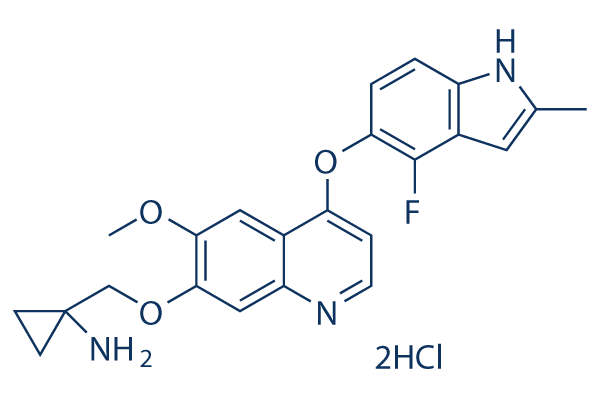
Struttura chimica
Peso molecolare: 480.36
Vai a
Controllo Qualità
Lotto:
Purezza:
99.93%
99.93
| Target correlati | EGFR PDGFR FGFR c-Met Src MEK CSF-1R FLT3 HER2 c-Kit |
|---|---|
| Altro VEGFR Inibitori | SAR131675 SU 5402 Cediranib (AZD2171) Vatalanib (PTK787) 2HCl Linifanib (ABT-869) Apatinib (YN968D1) Apatinib (YN968D1) mesylate Ki8751 ZM 323881 HCl Semaxanib (SU5416) |
Coltura cellulare, trattamento e concentrazione di lavoro
| Linee cellulari | Tipo di saggio | Concentrazione | Tempo di incubazione | Formulazione | Descrizione dellattività | PMID |
|---|---|---|---|---|---|---|
| U-87MG | Function assay | 0.01, 0.1, 1, 10 and 100 μM | 1.5 h | inhibited PDGF-BB-stimulated phosphorylation of PDGFRβ, AKT and ERK in U-87MG cells | 29446853 | |
| Mo7e | Function assay | 0.01, 0.1, 1, 10 and 100 μM | 1.5 h | Anlotinib inhibited SCF‐1‐stimulated phosphorylation of c‐Kit, AKT and ERK in Mo7e cells | 29446853 | |
| HUVEC | Function assay | 0.01, 0.1, 1, 10 and 100 μM | 1.5 h | anlotinib inhibited VEGF‐stimulated intracellular phosphorylation of VEGFR2 in a concentration‐dependent way in HUVEC with a subnanomolar IC50 value | 29446853 | |
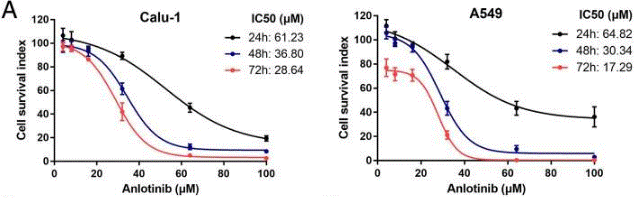
| A549 | Cell viability assay | 24, 48 and 72 h | IC50=64.82 μM(t=24 h); IC50=30.34 μM(t=48 h); IC50=17.29 μM(t=72 h) | 30755242 | ||
| NCI-H1975 | Cell viability assay | 8 μg/ml | 24 h | Cell viability was decreased remarkably | 30871526 | |
| Calu-1 | Cell viability assay | 24, 48 and 72 h | IC50=61.23 μM(t=24 h); IC50=36.8 μM(t=48 h); IC50=28.64 μM(t=72 h) | 30755242 | ||
| Clicca per visualizzare più dati sperimentali sulle linee cellulari | ||||||
Informazioni chimiche, conservazione e stabilità
| Peso molecolare | 480.36 | Formula | C23H22FN3O3.2HCl |
Conservazione (Dalla data di ricezione) | 3 years -20°C powder |
|---|---|---|---|---|---|
| N. CAS | 1360460-82-7 | -- | Conservazione delle soluzioni stock |
|
|
| Sinonimi | N/A | Smiles | CC1=CC2=C(N1)C=CC(=C2F)OC3=C4C=C(C(=CC4=NC=C3)OCC5(CC5)N)OC.Cl.Cl | ||
Solubilità
|
In vitro |
Water : 96 mg/mL
DMSO
: 48 mg/mL
(99.92 mM)
Ethanol : Insoluble |
Calcolatore di Molarità
Calcolatore di Diluizione
Calcolatore del Peso Molecolare
|
In vivo |
|||||
Calcolatore di formulazione in vivo (Soluzione chiara)
Passo 1: Inserire le informazioni di seguito (Consigliato: Un animale aggiuntivo per tenere conto della perdita durante lesperimento)
mg/kg
g
μL
Passo 2: Inserire la formulazione in vivo (Questo è solo il calcolatore, non la formulazione. Contattateci prima se non cè una formulazione in vivo nella sezione Solubilità.)
% DMSO
%
% Tween 80
% ddH2O
%DMSO
%
Risultati del calcolo:
Concentrazione di lavoro: mg/ml;
Metodo per preparare il liquido master di DMSO: mg farmaco predissolto in μL DMSO ( Concentrazione del liquido master mg/mL, Vi preghiamo di contattarci prima se la concentrazione supera la solubilità del DMSO del lotto del farmaco. )
Metodo per preparare la formulazione in vivo: Prendere μL DMSO liquido master, quindi aggiungereμL PEG300, mescolare e chiarire, quindi aggiungereμL Tween 80, mescolare e chiarire, quindi aggiungere μL ddH2O, mescolare e chiarire.
Metodo per preparare la formulazione in vivo: Prendere μL DMSO liquido master, quindi aggiungere μL Olio di mais, mescolare e chiarire.
Nota: 1. Si prega di assicurarsi che il liquido sia limpido prima di aggiungere il solvente successivo.
2. Assicurarsi di aggiungere il/i solvente/i in ordine. È necessario assicurarsi che la soluzione ottenuta, nellaggiunta precedente, sia una soluzione limpida prima di procedere allaggiunta del solvente successivo. Metodi fisici come il vortex, gli ultrasuoni o il bagno dacqua calda possono essere utilizzati per facilitare la dissoluzione.
Meccanismo dazione
| Targets/IC50/Ki |
VEGFR2
(Cell-free assay) 0.2 nM
VEGFR3
(Cell-free assay) 0.7 nM
c-Kit
(Cell-free assay) 14.8 nM
c-Kit
(Cell-free assay) 14.8 nM
c-Kit
(Cell-free assay) 14.8 nM
|
|---|---|
| In vitro |
Anlotinib occupa la tasca di legame dell'ATP della VEGFR2 Protein Tyrosine Kinase e mostra elevata selettività e potenza inibitoria (IC50 <1 nmol/L) per VEGFR2 rispetto ad altre Protein Tyrosine Kinases. Anlotinib inibisce VEGFR2 e VEGFR3 con valori di IC50 rispettivamente di 0,2 e 0,7 nmol/L. La potenza inibitoria di anlotinib contro VEGFR1 è inferiore, con un valore di IC50 di 26,9 nmol/L. I valori di IC50 di anlotinib per l'inibizione delle Protein Tyrosine Kinases correlate a PDGFR c-Kit e PDGFRβ sono rispettivamente 14,8 e 115,0 nmol/L. Anlotinib ha scarso effetto sull'attività di altre Protein Tyrosine Kinases, inclusi c-Met, c-Src, EGFR ed HER2, anche a una concentrazione di 2000 nmol/L. Anlotinib inibisce la segnalazione indotta da VEGF e la proliferazione cellulare nelle HUVEC con valori di IC50 picomolari. Tuttavia, sono necessarie concentrazioni micromolari di anlotinib per inibire direttamente la proliferazione delle cellule tumorali in vitro. Anlotinib inibisce significativamente la migrazione e la formazione di tubi delle HUVEC; inibisce anche la crescita dei microvasi da espianti di aorta di ratto in vitro.
|
| Saggio chinasico |
Saggio immunoassorbente legato ad enzima (ELISA)
|
|
L'attività inibitoria di anlotinib contro le Protein Tyrosine Kinases è stata determinata utilizzando ELISA. La reazione dell'ATP con la Protein Tyrosine Kinase è stata avviata in tampone di reazione (50 mmol/L HEPES pH 7,4, 50 mmol/L MgCl2, 0,5 mmol/L MnCl2, 0,2 mmol/L Na3VO4, 1 mmol/L DTT) e incubata per 1 ora a 37°C in piastre a 96 pozzetti pre-rivestite con 20 μg/mL di Poly(Glu,Tyr)4:1. La piastra è stata incubata con anticorpo PY99 e poi con IgG anti-topo coniugata con HRP. Dopo la reazione con la soluzione di o-fenilendiammina e la successiva terminazione con l'aggiunta di 2N H2SO4, l'assorbanza è stata misurata a 490 nm utilizzando un lettore Synergy H4 Hybrid.
|
|
| In vivo |
Anlotinib diminuisce la densità vascolare nel tessuto tumorale in vivo. Rispetto al noto inibitore della Protein Tyrosine Kinase sunitinib, la dose orale giornaliera di anlotinib mostra un'efficacia antitumorale in vivo più ampia e forte e, in alcuni modelli, provoca la regressione tumorale in topi nudi. È ben tollerato nei topi. Anlotinib è efficace a dosi (1,5-6 mg/kg al giorno) significativamente inferiori rispetto alle dosi efficaci di altri TKI, che richiedono dosi di 20-100 mg/kg per ottenere una significativa inibizione della crescita tumorale nei topi. In vivo, anlotinib ha mostrato un'ampia attività contro modelli di xenotrapianto di tumori umani del colon (SW-620), ovarici (SK-OV-3), epatici (SMMC-7721), renali (Caki-1), di glioma (U87MG) e polmonari non a piccole cellule (Calu-3) durante il periodo di dosaggio. Nei ratti Sprague-Dawley e nei cani beagle, anlotinib viene rapidamente assorbito dal tratto gastrointestinale dopo somministrazione orale. La biodisponibilità orale è del 23-45% nei ratti e del 47-74% nei cani. Anlotinib presenta un grande volume di distribuzione in entrambe le specie. Nei ratti, i tessuti primari, come polmoni, reni, fegato e cuore, mostrano livelli di esposizione ad anlotinib significativamente più elevati rispetto a quelli nel plasma. Il livello di esposizione nel cervello è paragonabile al corrispondente livello plasmatico. Nei topi portatori di tumore, anlotinib si concentra 2,4-2,6 volte di più nel tessuto tumorale che nel plasma. Nell'uomo, anlotinib presenta un t1/2 (96 ± 17 h) piuttosto lungo, che sembrava essere indipendente dalla dose. L'emivita terminale di anlotinib nei cani (22,8±11,0 h) è più lunga rispetto a quella nei ratti (5,1±1,6 h). Questa differenza sembra essere principalmente associata a una differenza interspecie nella clearance plasmatica totale (ratti, 5,35±1,31 L/h/kg; cani, 0,40±0,06 L/h/kg). Nel plasma umano, anlotinib è prevalentemente legato all'albumina e alle lipoproteine, piuttosto che alla glicoproteina acida α1 o alle γ-globuline.
|
Riferimenti |
|
Applicazioni
| Metodi | Biomarcatori | Immagini | PMID |
|---|---|---|---|
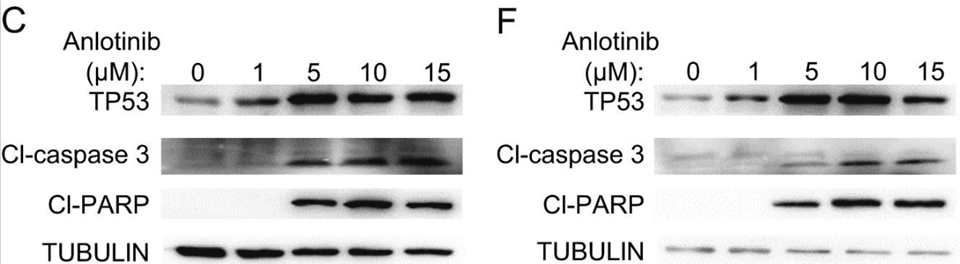
| Western blot | TP53 / Cleaved-caspase 3 / Cleaved PARP Beclin-1 / LC3-I / LC3-II Akt / p-Akt / mTOR / p-mTOR |
|
30139768 |
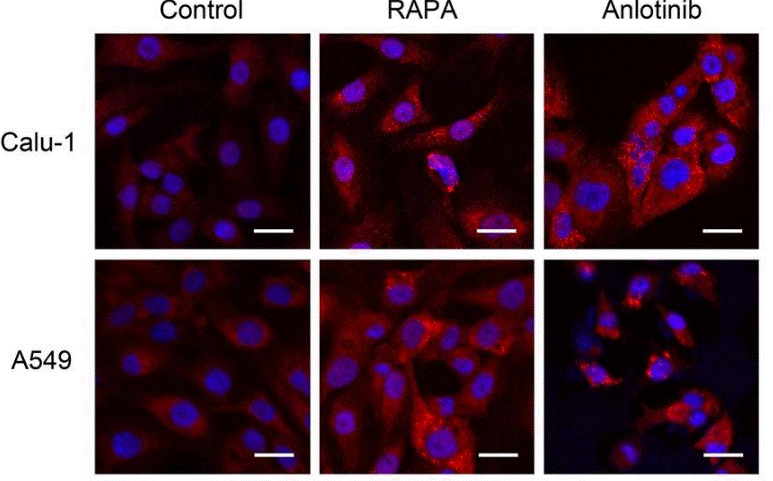
| Immunofluorescence | LC3-II |
|
30755242 |
| Growth inhibition assay | Cell viability |
|
30755242 |
Informazioni sullo studio clinico
(dati da https://clinicaltrials.gov, aggiornato il 2024-05-22)
| Numero NCT | Reclutamento | Condizioni | Sponsor/Collaboratori | Data di inizio | Fasi |
|---|---|---|---|---|---|
| NCT06331169 | Not yet recruiting | Breast Cancer |
Fudan University |
April 1 2024 | Phase 1 |
| NCT06015061 | Recruiting | Pheochromocytoma Metastatic|Ultrasonography|Paraganglioma Malignant|Pheochromocytoma Malignant |
Peking Union Medical College Hospital |
March 1 2023 | -- |
| NCT05816499 | Recruiting | NSCLC Stage IV|NSCLC Stage IIIB|NSCLC Stage IIIC |
Shanghai Chest Hospital|The Affiliated Hospital of Qingdao University|Anhui Provincial Hospital|Zhejiang University |
February 16 2023 | Phase 1|Phase 2 |
| NCT05883085 | Recruiting | Pheochromocytoma|Paraganglioma |
Peking Union Medical College Hospital |
May 1 2022 | Phase 2 |
| NCT05301764 | Recruiting | Soft Tissue Sarcoma |
Lyvgen Biopharma Holdings Limited |
May 25 2022 | Phase 1|Phase 2 |
Supporto tecnico
Istruzioni per la manipolazione
Tel: +1-832-582-8158 Ext:3
Per qualsiasi altra domanda, si prega di lasciare un messaggio.

I prodotti sono solo per uso di ricerca. Non per uso umano. Non vendiamo a pazienti.
©Copyright 2013 Selleck Chemicals. Tutti i diritti riservati.