MEK is a member of kinases in MAPK signal pathway which can activates p38 MAPK and JNK when MEK is ACTIVATED by TNF-alpha, GPCR and so on. MEK could be regulated by MEKKs or RAF. The Raf / MEK / ERK signal transduction is involved in cell growth, cell proliferation and cell survival. [show the full text]

MEK inibitori (MEK Inhibitors)
| N. Cat. | Nome del prodotto | Informazioni | Citazioni di utilizzo del prodotto | Validazioni del prodotto |
|---|---|---|---|---|
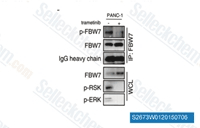
| S2673 | Trametinib (GSK1120212) | Trametinib (GSK1120212, JTP-74057) è un inibitore MEK1/2 altamente specifico e potente con IC50 di 0,92 nM/1,8 nM in saggi senza cellule, e non inibisce le attività chinasiche di c-Raf, B-Raf, ERK1/2. Questo composto attiva l'autophagy e induce l'apoptosis. |
|
|
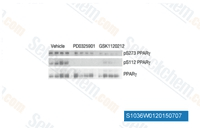
| S1036 | PD0325901 (Mirdametinib) | Mirdametinib (PD0325901) è un inibitore selettivo e non competitivo dell'MEK con un IC50 di 0,33 nM in saggi acellulari, circa 500 volte più potente di CI-1040 sulla fosforilazione di ERK1 ed ERK2. Fase 2. |
|
|
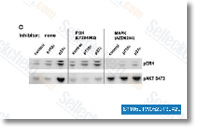
| S1008 | AZD6244 (Selumetinib) | Selumetinib (AZD6244, ARRY-142886) è un potente e altamente selettivo inibitore di MEK con IC50 di 14 nM per MEK1 e valore di Kd di 530 nM per MEK2. Inoltre, inibisce la fosforilazione di ERK1/2 con IC50 di 10 nM, senza inibizione di p38α, MKK6, EGFR, ErbB2, ERK2, B-Raf, ecc. Selumetinib sopprime la proliferazione cellulare, la migrazione e innesca l'apoptosi. Fase 3. |
|
|
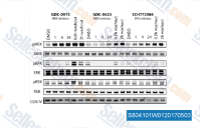
| S8041 | Cobimetinib (GDC-0973) | Cobimetinib (GDC-0973, RG7420) è un potente e altamente selettivo inibitore di MEK1 con IC50 di 4,2 nM, non mostrando alcuna inibizione significativa quando testato contro un pannello di oltre 100 chinasi serina-treonina e tirosina. Questo composto induce l'apoptosis. Fase 3. |
|
|
| S7170 | Avutometinib (Ro5126766, CH5126766) | Avutometinib(RO5126766,CH5126766,VS 6766, CKI-27, R-7304, RG-7304) è un doppio inibitore di RAF/MEK con IC50 di 8,2 nM, 19 nM, 56 nM e 160 nM per BRAF V600E, BRAF, CRAF e MEK1, rispettivamente. Fase 1. |
|
|
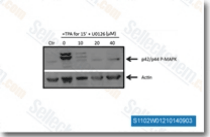
| S1102 | U0126-EtOH | U0126-EtOH è un inibitore altamente selettivo di MEK1/2 con IC50 di 0,07 μM/0,06 μM in saggi senza cellule, affinità 100 volte superiore per ΔN3-S218E/S222D MEK rispetto a PD98059. U0126 inibisce l'autophagy e la mitophagy con attività antivirale. |
|
|
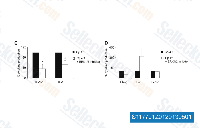
| S1177 | PD 98059 | PD98059 è un inibitore di MEK non competitivo con ATP con IC50 di 2 μM in un saggio senza cellule, inibisce specificamente l'attivazione di MAPK mediata da MEK-1; non inibisce direttamente ERK1 o ERK2. PD98059 è un ligando per il recettore degli idrocarburi arilici (AHR) e funziona come antagonista di AHR. |
|
|
| S1020 | PD184352 (CI-1040) | PD184352 (CI-1040) è un inibitore non competitivo di ATP di MEK1/2 con IC50 di 17 nM in saggi basati su cellule, 100 volte più selettivo per MEK1/2 rispetto a MEK5. Questo composto induce selettivamente l'apoptosi. |
|

|
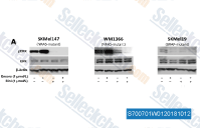
| S7007 | MEK162 (Binimetinib, ARRY-162) | Binimetinib (MEK162, ARRY-162, ARRY-438162) è un potente inibitore di MEK1/2 con una IC50 di 12 nM in un saggio senza cellule. Binimetinib induce l'arresto del ciclo cellulare in fase G1 e l'apoptosi nelle linee cellulari NSCLC umane e induce l'autophagy. Fase 3. |
|
|
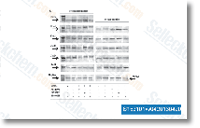
| S1531 | BIX 02189 | BIX02189 è un inibitore selettivo di MEK5 con una IC50 di 1,5 nM, inibisce anche l'attività catalitica di ERK5 con una IC50 di 59 nM in saggi senza cellule e non inibisce le chinasi strettamente correlate MEK1, MEK2, ERK2 e JNK2. |
|
|
In the mitogen-activated protein kinase (MAPK) pathway, receptor tyrosine kinase activation results in adaptor proteins phosphorylating RAS. This results in the activation of the RAF-MEK-ERK kinase signalling pathway, and consequently leads to the activation of several downstream substrates that affect a number of transcription factors. The knock-on effect is that a myriad of cellular processes such as cell proliferation, survival, transformation, translational control and cytoskeletal rearrangement. In oncology, the MAPK pathway is a key contributor to tumor progression, angiogenesis, and metastasis.
In the RAS-RAF-MEK-ERK pathway, MEK has been the target of oncology research. The MEK kinase is expressed from MEK1 and MEK2 – two genes that share ~80% structural homology – that display slightly different isoforms of MEK to produce potentially different functions. Both MEK1 and MEK2 kinases are implicated in ~30% of all human cancers where MAPK signalling pathway is involved.[1] These dual-specificity kinases phosphorylate both tyrosine and threonine residues; MEK1 and MEK2 sequentially phosphorylate ERK1 at 185Tyr and then at 183Thr. MEK exists just downstream of RAF in the classical MAPK pathway known as RAS-RAF-MEK-ERK pathway. Phosphorylation of MEK by RAF results in the phosphorylation of ERK1 and ERK2. MEK kinases show very high specificity for ERK, in fact it is the only known substrate for MEK. Therefore, constitutive phosphorylation of MEK in the RAF-MEK-ERK kinase pathway occurs by either the overexpression or mutation of receptor tyrosine kinases, and/or mutations of RAS and RAF (A-RAF and B-RAF).[2]
The MEK enzyme itself consists of hydrophobic allosteric pockets adjacent to the ATP-binding site that facilitates the design of highly selective allosteric inhibitors. This is in contRASt to the many kinases for which there is no allosteric-binding site. Consequently, this feature is recognized by many pharmaceutical companies as a characteristic that facilitates more selective inhibitor design since the more conserved ATP-binding site is not directly targeted. MEK1 and MEK2 are positioned at the focal point of many mitogenic signaling pathways that integrates into the ERK pathway. Characteristics such as unusually restricted and unique substrate specificities, plus the integrating role of mitogenic signaling pathways demonstrates the benefits of developing a MEK inhibitor against the ERK pathway.[3]
The utility of targeting MEK inhibition is likely to be best realized among tumors where the MEK pathway is constitutively activated. Such a scenario includes activating mutations of BRAF that results in tumors that are dependent to MEK signaling, and consequently very sensitive to MEK inhibition.[4] This is likely to be the case among a sub-population of BRAF mutations observed in melanoma and thyroid cancers. Currently, MEK inhibition is likely to prove most effective when used in a combination strategy. This is because there is cross-talk involved between RAS-RAF-MEK-ERK and the PI3K-AKT pathway. As a consequence, inhibition of one pathway leads to constitutive signalling in the other. This is a reflection of the complexity of the kinase signalling pathways implicated in cancer.[2]
Aside from anti-tumor potential, MEK inhibition may play a role where inflammation is concerned. Several key protein downstream of MEK are involved in inflammatory responses including TNF, IL-1, and other cytokines. MEK signaling directly impacts both the expression of cytokines and subsequent activation pathways. Therefore, MEK inhibitors –particularly orally bioavailable compounds – may be suitable agents for the treatment of inflammatory disease. In addition, it should be noted that anaphylatoxins utilize the MEK kinase cascade to initiate disease processes such as arthritis.[2]

I prodotti sono solo per uso di ricerca. Non per uso umano. Non vendiamo a pazienti.
©Copyright 2013 Selleck Chemicals. Tutti i diritti riservati.