
solo per uso di ricerca
Cediranib (AZD2171) VEGFR Inibitore
N. Cat.: S1017
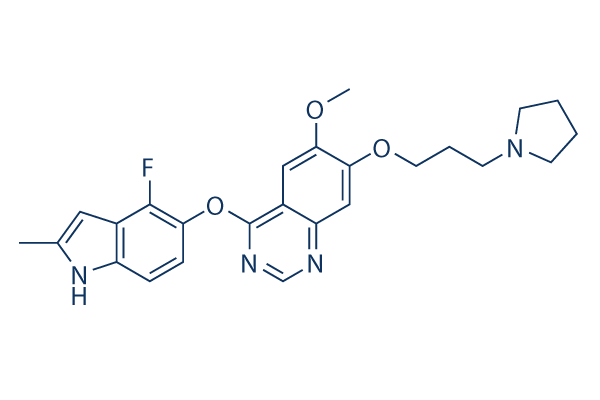
Struttura chimica
Peso molecolare: 450.51
Controllo Qualità (Quality Control)
| Target correlati | EGFR FGFR PDGFR c-Met Src MEK CSF-1R FLT3 HER2 c-Kit |
|---|---|
| Altro VEGFR Inibitori | SAR131675 SU 5402 Vatalanib (PTK787) 2HCl Anlotinib (AL3818) Dihydrochloride Linifanib (ABT-869) Apatinib (YN968D1) Apatinib (YN968D1) mesylate Ki8751 Semaxanib (SU5416) ZM 323881 HCl |
Coltura cellulare, trattamento e concentrazione di lavoro
(Cell Culture, Treatment & Working Concentration)
| Linee cellulari | Tipo di saggio | Concentrazione | Tempo di incubazione | Formulazione | Descrizione dell'attività | PMID |
|---|---|---|---|---|---|---|
| HUVEC cell | Proliferation assay | 3 days | Inhibition of VEGF-stimulated HUVEC cell proliferation treated before 2 hrs of VEGF challenge assessed after 3 days by [3H]thymidine incorporation assay, ED50=12 nM | 19101155 | ||
| HeLa | Function assay | 4.5 hrs | Inhibition of Ebolavirus glycoprotein/matrix protein VP40 entry in human HeLa cells after 4.5 hrs beta-lactamase reporter assay, IC50=7.67μM | 29624387 | ||
| DAOY | qHTS assay | qHTS of pediatric cancer cell lines to identify multiple opportunities for drug repurposing: Primary screen for DAOY cells | 29435139 | |||
| SJ-GBM2 | qHTS assay | qHTS of pediatric cancer cell lines to identify multiple opportunities for drug repurposing: Primary screen for SJ-GBM2 cells | 29435139 | |||
| A673 | qHTS assay | qHTS of pediatric cancer cell lines to identify multiple opportunities for drug repurposing: Primary screen for A673 cells | 29435139 | |||
| BT-37 | qHTS assay | qHTS of pediatric cancer cell lines to identify multiple opportunities for drug repurposing: Primary screen for BT-37 cells | 29435139 | |||
| NB-EBc1 | qHTS assay | qHTS of pediatric cancer cell lines to identify multiple opportunities for drug repurposing: Primary screen for NB-EBc1 cells | 29435139 | |||
| Saos-2 | qHTS assay | qHTS of pediatric cancer cell lines to identify multiple opportunities for drug repurposing: Primary screen for Saos-2 cells | 29435139 | |||
| SK-N-SH | qHTS assay | qHTS of pediatric cancer cell lines to identify multiple opportunities for drug repurposing: Primary screen for SK-N-SH cells | 29435139 | |||
| LAN-5 | qHTS assay | qHTS of pediatric cancer cell lines to identify multiple opportunities for drug repurposing: Primary screen for LAN-5 cells | 29435139 | |||
| BT-12 | qHTS assay | qHTS of pediatric cancer cell lines to identify multiple opportunities for drug repurposing: Primary screen for BT-12 cells | 29435139 | |||
| Rh18 | qHTS assay | qHTS of pediatric cancer cell lines to identify multiple opportunities for drug repurposing: Primary screen for Rh18 cells | 29435139 | |||
| OHS-50 | qHTS assay | qHTS of pediatric cancer cell lines to identify multiple opportunities for drug repurposing: Primary screen for OHS-50 cells | 29435139 | |||
| RD | qHTS assay | qHTS of pediatric cancer cell lines to identify multiple opportunities for drug repurposing: Primary screen for RD cells | 29435139 | |||
| MG 63 (6-TG R) | qHTS assay | qHTS of pediatric cancer cell lines to identify multiple opportunities for drug repurposing: Primary screen for MG 63 (6-TG R) cells | 29435139 | |||
| fibroblast cells | qHTS assay | qHTS of pediatric cancer cell lines to identify multiple opportunities for drug repurposing: Primary screen for control Hh wild type fibroblast cells | 29435139 | |||
| Rh30 | qHTS assay | qHTS of pediatric cancer cell lines to identify multiple opportunities for drug repurposing: Primary screen for Rh30 cells | 29435139 | |||
| Rh41 | qHTS assay | qHTS of pediatric cancer cell lines to identify multiple opportunities for drug repurposing: Primary screen for Rh41 cells | 29435139 | |||
| Clicca per visualizzare più dati sperimentali sulle linee cellulari | ||||||
Informazioni chimiche, conservazione e stabilità (Chemical Information, Storage & Stability)
| Peso molecolare | 450.51 | Formula | C25H27FN4O3 |
Conservazione (Dalla data di ricezione) | |
|---|---|---|---|---|---|
| N. CAS | 288383-20-0 | Scarica SDF | Conservazione delle soluzioni stock |
|
|
| Sinonimi | NSC-732208 | Smiles | CC1=CC2=C(N1)C=CC(=C2F)OC3=NC=NC4=CC(=C(C=C43)OC)OCCCN5CCCC5 | ||
Solubilità (Solubility)
|
In vitro |
DMSO
: 90 mg/mL
(199.77 mM)
Ethanol : 6 mg/mL Water : Insoluble |
Calcolatore di Molarità
|
In vivo |
|||||
Calcolatore di formulazione in vivo (Soluzione chiara)
Passo 1: Inserire le informazioni di seguito (Consigliato: Un animale aggiuntivo per tenere conto della perdita durante l'esperimento)
Passo 2: Inserire la formulazione in vivo (Questo è solo il calcolatore, non la formulazione. Contattateci prima se non c'è una formulazione in vivo nella sezione Solubilità.)
Risultati del calcolo:
Concentrazione di lavoro: mg/ml;
Metodo per preparare il liquido master di DMSO: mg farmaco predissolto in μL DMSO ( Concentrazione del liquido master mg/mL, Vi preghiamo di contattarci prima se la concentrazione supera la solubilità del DMSO del lotto del farmaco. )
Metodo per preparare la formulazione in vivo: Prendere μL DMSO liquido master, quindi aggiungereμL PEG300, mescolare e chiarire, quindi aggiungereμL Tween 80, mescolare e chiarire, quindi aggiungere μL ddH2O, mescolare e chiarire.
Metodo per preparare la formulazione in vivo: Prendere μL DMSO liquido master, quindi aggiungere μL Olio di mais, mescolare e chiarire.
Nota: 1. Si prega di assicurarsi che il liquido sia limpido prima di aggiungere il solvente successivo.
2. Assicurarsi di aggiungere il/i solvente/i in ordine. È necessario assicurarsi che la soluzione ottenuta, nell'aggiunta precedente, sia una soluzione limpida prima di procedere all'aggiunta del solvente successivo. Metodi fisici come il vortex, gli ultrasuoni o il bagno d'acqua calda possono essere utilizzati per facilitare la dissoluzione.
Meccanismo d'azione (Mechanism of Action)
| Targets/IC50/Ki |
VEGFR2/KDR
(HUVECs) 0.5 nM
c-Kit
(HUVECs) 2 nM
VEGFR3/FLT4
(HUVECs) <=3 nM
VEGFR1/FLT1
(HUVECs) 5 nM
PDGFRβ
(HUVECs) 5 nM
FGFR1
(HUVECs) 26 nM
PDGFRα
(HUVECs) 36 nM
|
|---|---|
| In vitro |
Cediranib (AZD2171) inhibits VEGF-stimulated proliferation with IC50 of 0.4 nM and suppresses PDGF-AA with IC50 of 0.04 μM in MG63 cell lines. It has been shown to block Flt1-associated kinase with IC50 of 5 nM and VEGF-C and VEGF-D receptor Flt-4 with IC50 less than 3 nM. In addition, the IC50 values for inhibition of c-Kit and PDGFRβ tyrosine kinase are 2 nM and 5 nM respectively. Furthermore, no inhibition of enzyme activity is observed when 10 μM of this compound is assayed with 100 μM ATP against AMPK, Chk1 Akt/PKB and others. Micromolar concentrations are needed to prevent tumor cell proliferation in vitro.
|
| Saggio chinasico |
Inibizione della chinasi
|
|
Cediranib (AZD2171) viene sciolto in DMSO a una concentrazione di 10 mM. Tutti i saggi enzimatici vengono eseguiti a, o appena al di sotto, della rispettiva Km per l'ATP (0,2 - 30 μM). L'attività inibitoria di questo composto viene determinata contro una serie di Protein Tyrosine Kinase ricombinanti [KDR, Flt-1, Flt-4, c-Kit, PDGFRα, PDGFRβ, CSF-1R, Flt-3, FGFR1, Src, Abl, recettore del fattore di crescita epidermico (EGFR), ErbB2, Aurora A e Aurora B] mediante ELISA. La selettività rispetto alle chinasi serina/treonina CDK2 e CDK4 viene esaminata utilizzando saggi di prossimità per scintillazione con un substrato del retinoblastoma e [γ-33P]ATP. La sua attività viene confrontata con la chinasi MAPK (MEK), che mostra doppia specificità. Viene determinata utilizzando un substrato MAPK, [γ-33P]ATP e cattura su carta/conteggio per scintillazione.
|
|
| In vivo |
Cediranib (AZD2171) even suppresses tubule sprouting at subnanomolar concentrations and inhibits VEGF-induced angiogenesis. This compound causes hypertrophy in bone growth plate and prevents luteal development in ovary. These are physiological processes that are dependent upon angiogenesis. It shows broad spectrum activity in human tumor models at doses that are well tolerated. Besides, it causes regression of vascular tissues in human lung tumor xenografts.
|
Riferimenti |
|
Applicazioni (Applications)
| Metodi | Biomarcatori | Immagini | PMID |
|---|---|---|---|
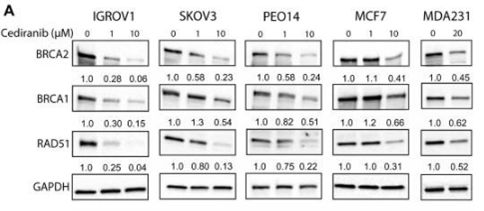
| Western blot | BRCA2 / BRCA1 / RAD51 p-VEGFR1 / p-VEGFR3 / p-AKT / p-ERK |
|
31092693 |
Informazioni sullo studio clinico (Clinical Trial Information)
(dati da https://clinicaltrials.gov, aggiornato il 2026-03-05)
| Numero NCT | Reclutamento | Condizioni | Sponsor/Collaboratori | Data di inizio | Fasi |
|---|---|---|---|---|---|
| NCT04090567 | RECRUITING | Advanced Breast Carcinoma; Anatomic Stage III Breast Cancer AJCC v8; Anatomic Stage IIIA Breast Cancer AJCC v8; Anatomic Stage IIIB Breast Cancer AJCC v8; Anatomic Stage IIIC Breast Cancer AJCC v8; Anatomic Stage IV Breast Cancer AJCC v8; Germline BRCA1 Gene Mutation; Germline BRCA2 Gene Mutation; HER2/Neu Negative; Metastatic Breast Carcinoma; Prognostic Stage III Breast Cancer AJCC v8; Prognostic Stage IIIA Breast Cancer AJCC v8; Prognostic Stage IIIB Breast Cancer AJCC v8; Prognostic Stage IIIC Breast Cancer AJCC v8; Prognostic Stage IV Breast Cancer AJCC v8 |
M.D. Anderson Cancer Center |
2020-07-28 | PHASE2 |
| NCT02484404 | ACTIVE_NOT_RECRUITING | Colorectal Neoplasms; Breast Neoplasms |
National Cancer Institute (NCI) |
2015-06-29 | PHASE1; PHASE2 |
| NCT03851614 | ACTIVE_NOT_RECRUITING | Mismatch Repair Proficient Colorectal Cancer; Pancreatic Adenocarcinoma; Leiomyosarcoma |
University Health Network, Toronto |
2019-04-08 | PHASE2 |
| NCT03741426 | UNKNOWN | Renal Cell Cancer |
CCTU- Cancer Theme |
2020-07-27 | PHASE2 |
| NCT04487587 | ACTIVE_NOT_RECRUITING | Cervical Cancer |
The Clatterbridge Cancer Centre NHS Foundation Trust |
2018-10-09 | PHASE2 |
| NCT07648745 | COMPLETED | Bowel Obstruction; Ovarian Cancer; Fallopian Tube Cancer; Primary Peritoneal Cancer |
Prof Gordon Jayson |
2018-05-14 | PHASE2 |

I prodotti sono solo per uso di ricerca. Non per uso umano. Non vendiamo a pazienti.
©Copyright 2013 Selleck Chemicals. Tutti i diritti riservati.