
solo per uso di ricerca
Prexasertib (LY2606368) Dihydrochloride Inibitore CHK1
N. Cat.S7178
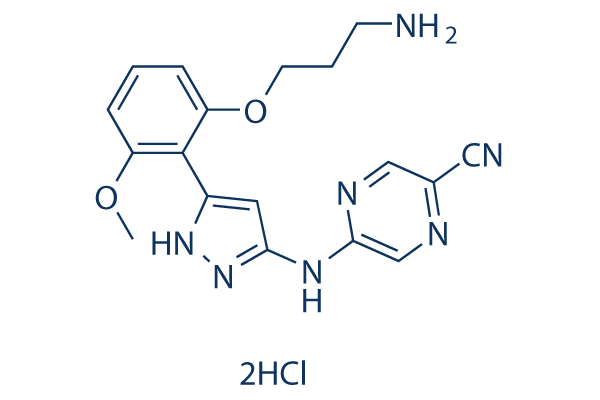
Struttura chimica
Peso molecolare: 438.31
Controllo Qualità
Prodotti spesso usati con Prexasertib (LY2606368) Dihydrochloride
Coltura cellulare, trattamento e concentrazione di lavoro
| Linee cellulari | Tipo di saggio | Concentrazione | Tempo di incubazione | Formulazione | Descrizione dellattività | PMID |
|---|---|---|---|---|---|---|
| HeLa cells | Function assay | 33 or 100 nmol/L | 7 hours | by 7 hours, a subpopulation of cells stained strongly for DSB by both TUNEL and pH2AX | 26141948 | |
| U-2 OS cells | Function assay | 4 nmol/L | 24 h | a large shift in cell-cycle populations from G1 and G2–M to S-phase with an accompanied induction of H2AX phosphorylation. | 26141948 | |
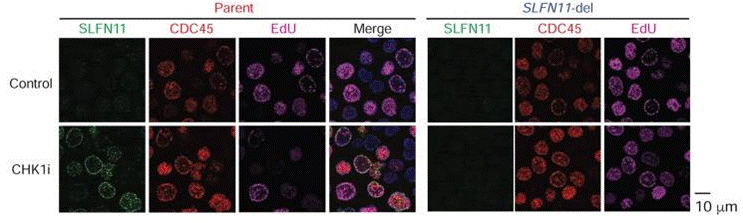
| CCRF-CEM parental cells | Function assay | 10 nM | 4 h | induced SLFN11 binding to chromatin and increased the chromatin binding of CDC45 | 29395061 | |
| SLFN11-del cells | Function assay | 10 nM | 4 h | induced SLFN11 binding to chromatin and increased the chromatin binding of CDC45 | 29395061 | |
| K562-WT | Function assay | 100 nM | 2 h | SLFN11, CDC45 and PCNA were enriched on nascent DNA | 29395061 | |
| K562-E669Q | Function assay | 100 nM | 2 h | SLFN11, CDC45 and PCNA were enriched on nascent DNA | 29395061 | |
| CCRF-CEM parental cells | Function assay | 100 nM | 2 h | SLFN11, CDC45 and PCNA were enriched on nascent DNA | 29395061 | |
| HCT-116 cells | Function assay | 10 days | inhibited both FANCD2 ubiquitination and increased Rad51 levels, significantly increased sensitivity of HCT-116 cells to F10 | 30439567 | ||
| U937 cells | Function assay | 3 nM | enhanced the cytotoxicity of CPX-351 at low nanomolar concentrations | 30837643 | ||
| KB-3-1 | Function assay | P-glycoprotein substrates identified in KB-3-1 adenocarcinoma cell line, qHTS therapeutic library screen | 31515284 | |||
| KB-8-5-11 | Function assay | P-glycoprotein substrates identified in KB-8-5-11 adenocarcinoma cell line, qHTS therapeutic library screen, Potency = 1.2995 μM. | 31515284 | |||
| Clicca per visualizzare più dati sperimentali sulle linee cellulari | ||||||
Informazioni chimiche, conservazione e stabilità
| Peso molecolare | 438.31 | Formula | C18H19N7O2.2HCl |
Conservazione (Dalla data di ricezione) | |
|---|---|---|---|---|---|
| N. CAS | 1234015-54-3 | Scarica SDF | Conservazione delle soluzioni stock |
|
|
| Sinonimi | N/A | Smiles | COC1=C(C(=CC=C1)OCCCN)C2=CC(=NN2)NC3=NC=C(N=C3)C#N.Cl.Cl | ||
Solubilità
|
In vitro |
DMSO
: 17 mg/mL
(38.78 mM)
Water : Insoluble Ethanol : Insoluble |
Calcolatore di Molarità
|
In vivo |
|||||
Calcolatore di formulazione in vivo (Soluzione chiara)
Passo 1: Inserire le informazioni di seguito (Consigliato: Un animale aggiuntivo per tenere conto della perdita durante lesperimento)
Passo 2: Inserire la formulazione in vivo (Questo è solo il calcolatore, non la formulazione. Contattateci prima se non cè una formulazione in vivo nella sezione Solubilità.)
Risultati del calcolo:
Concentrazione di lavoro: mg/ml;
Metodo per preparare il liquido master di DMSO: mg farmaco predissolto in μL DMSO ( Concentrazione del liquido master mg/mL, Vi preghiamo di contattarci prima se la concentrazione supera la solubilità del DMSO del lotto del farmaco. )
Metodo per preparare la formulazione in vivo: Prendere μL DMSO liquido master, quindi aggiungereμL PEG300, mescolare e chiarire, quindi aggiungereμL Tween 80, mescolare e chiarire, quindi aggiungere μL ddH2O, mescolare e chiarire.
Metodo per preparare la formulazione in vivo: Prendere μL DMSO liquido master, quindi aggiungere μL Olio di mais, mescolare e chiarire.
Nota: 1. Si prega di assicurarsi che il liquido sia limpido prima di aggiungere il solvente successivo.
2. Assicurarsi di aggiungere il/i solvente/i in ordine. È necessario assicurarsi che la soluzione ottenuta, nellaggiunta precedente, sia una soluzione limpida prima di procedere allaggiunta del solvente successivo. Metodi fisici come il vortex, gli ultrasuoni o il bagno dacqua calda possono essere utilizzati per facilitare la dissoluzione.
Meccanismo dazione
| Targets/IC50/Ki |
Chk1
(Cell-free assay) 0.9 nM(Ki)
Chk2
(Cell-free assay) 8 nM
RSK
(Cell-free assay) 9 nM
|
|---|---|
| In vitro |
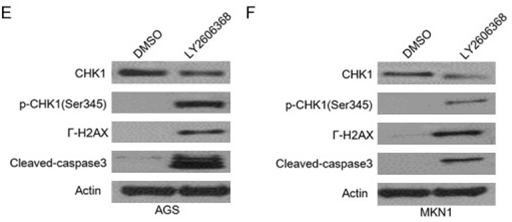
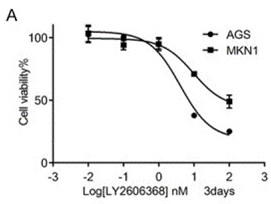
In studi non clinici, Prexasertib HCl (LY2606368) ha indotto danni al DNA misurati dalla catastrofe di replicazione e dagli aumenti di pH2A.X, un marcatore di rotture del DNA a doppio filamento. Il trattamento delle cellule con questo composto determina la rapida comparsa di rotture del DNA a doppio filamento positive al TUNEL e a pH2AX nella popolazione cellulare in fase S. In un saggio funzionale, ha potentemente abrogato il checkpoint G2-M attivato dalla doxorubicina in cellule HeLa p53-deficienti con un EC50 di 9 nmol/L. Era ampiamente antiproliferativo con valori IC50 tipicamente <50 nmol/L nelle linee cellulari più sensibili, con una minoranza di linee cellulari che mostravano una notevole resistenza con IC50's >1.000 nmol/L. Questo composto richiede CDC25A e CDK2 per causare danni al DNA. |
| In vivo |
Prexasertib HCl (LY2606368) ha inibito la crescita tumorale negli xenotrapianti di cancro come monoterapia e in combinazione con altri agenti. In un modello di cancro ovarico ortotopico SKOV3, ha dimostrato di inibire la crescita dei tumori primari e di ridurre significativamente l'incidenza di metastasi e l'accumulo di ascite. Questo composto ha anche dimostrato efficacia in un modello ortotopico di cancro pancreatico SW1990, con un'inibizione del 92% della crescita del tumore primario e l'eliminazione delle metastasi ai linfonodi, alla milza e all'intestino. |
Riferimenti |
|
Applicazioni
| Metodi | Biomarcatori | Immagini | PMID |
|---|---|---|---|
| Western blot | CHK1 / p-CHK1(Ser345) / γH2AX / Cleaved caspase3 pS6 (S235/236) / pS6 (S240/244) |
|
28401005 |
| Immunofluorescence | SLFN11 / CDC45 / EdU |
|
29395061 |
| Growth inhibition assay | Cell viability IC50 |
|
28401005 |
Informazioni sullo studio clinico
(dati da https://clinicaltrials.gov, aggiornato il 2024-05-22)
| Numero NCT | Reclutamento | Condizioni | Sponsor/Collaboratori | Data di inizio | Fasi |
|---|---|---|---|---|---|
| NCT04095221 | Active not recruiting | Desmoplastic Small Round Cell Tumor|Rhabdomyosarcoma |
Memorial Sloan Kettering Cancer Center |
September 17 2019 | Phase 1|Phase 2 |
| NCT03495323 | Completed | Cancer |
Dana-Farber Cancer Institute|Eli Lilly and Company |
May 16 2018 | Phase 1 |
| NCT03414047 | Completed | Ovarian Cancer |
Eli Lilly and Company |
April 10 2018 | Phase 2 |
| NCT03057145 | Completed | Solid Tumor |
Geoffrey Shapiro MD PhD|Eli Lilly and Company|AstraZeneca|Dana-Farber Cancer Institute |
March 10 2017 | Phase 1 |
Supporto tecnico
Istruzioni per la manipolazione
Tel: +1-832-582-8158 Ext:3
Per qualsiasi altra domanda, si prega di lasciare un messaggio.
Domande Frequenti
Domanda 1:
Would you please suggest a suitable vehicle to dissolve it for in vivo use?
Risposta:
It can be dissolved in a vehicle: 5% DMSO+40%PEG 300+5%Tween80+ddH2O for in vivo use in mice (i.p.). This stock concentration reaches 10mg/ml, and can be prepared for work solution as 0.5mg/ml, stable for no longer than 30min.
Domanda 2:
What is the solubility of it in 20% Captisol?
Risposta:
It is a suspension in 20% Captisol, which is fine for oral gavage. You can dissolve this compound in this vehicle to the concentration you need as long as the suspension is homogeneous.

I prodotti sono solo per uso di ricerca. Non per uso umano. Non vendiamo a pazienti.
©Copyright 2013 Selleck Chemicals. Tutti i diritti riservati.