
solo per uso di ricerca
PF-477736 Chk inibitore
N. Cat.S2904
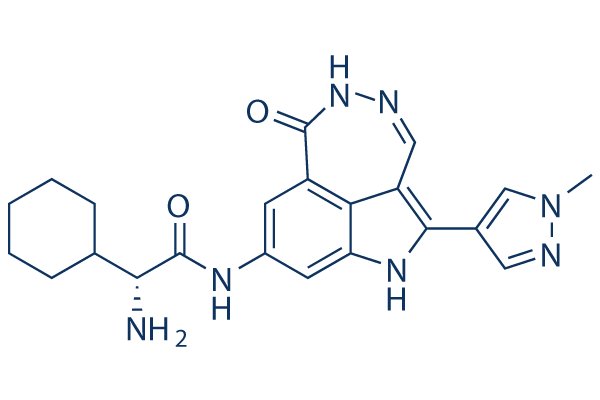
Struttura chimica
Peso molecolare: 419.48
Controllo Qualità
Coltura cellulare, trattamento e concentrazione di lavoro
| Linee cellulari | Tipo di saggio | Concentrazione | Tempo di incubazione | Formulazione | Descrizione dellattività | PMID |
|---|---|---|---|---|---|---|
| TC32 | qHTS assay | qHTS of pediatric cancer cell lines to identify multiple opportunities for drug repurposing: Primary screen for TC32 cells | 29435139 | |||
| U-2 OS | qHTS assay | qHTS of pediatric cancer cell lines to identify multiple opportunities for drug repurposing: Primary screen for U-2 OS cells | 29435139 | |||
| A673 | qHTS assay | qHTS of pediatric cancer cell lines to identify multiple opportunities for drug repurposing: Primary screen for A673 cells | 29435139 | |||
| Saos-2 | qHTS assay | qHTS of pediatric cancer cell lines to identify multiple opportunities for drug repurposing: Primary screen for Saos-2 cells | 29435139 | |||
| RD | qHTS assay | qHTS of pediatric cancer cell lines to identify multiple opportunities for drug repurposing: Primary screen for RD cells | 29435139 | |||
| SK-N-SH | qHTS assay | qHTS of pediatric cancer cell lines to identify multiple opportunities for drug repurposing: Primary screen for SK-N-SH cells | 29435139 | |||
| OHS-50 | qHTS assay | qHTS of pediatric cancer cell lines to identify multiple opportunities for drug repurposing: Primary screen for OHS-50 cells | 29435139 | |||
| SJ-GBM2 | qHTS assay | qHTS of pediatric cancer cell lines to identify multiple opportunities for drug repurposing: Primary screen for SJ-GBM2 cells | 29435139 | |||
| SK-N-MC | qHTS assay | qHTS of pediatric cancer cell lines to identify multiple opportunities for drug repurposing: Primary screen for SK-N-MC cells | 29435139 | |||
| NB-EBc1 | qHTS assay | qHTS of pediatric cancer cell lines to identify multiple opportunities for drug repurposing: Primary screen for NB-EBc1 cells | 29435139 | |||
| LAN-5 | qHTS assay | qHTS of pediatric cancer cell lines to identify multiple opportunities for drug repurposing: Primary screen for LAN-5 cells | 29435139 | |||
| Clicca per visualizzare più dati sperimentali sulle linee cellulari | ||||||
Informazioni chimiche, conservazione e stabilità
| Peso molecolare | 419.48 | Formula | C22H25N7O2 |
Conservazione (Dalla data di ricezione) | |
|---|---|---|---|---|---|
| N. CAS | 952021-60-2 | Scarica SDF | Conservazione delle soluzioni stock |
|
|
| Sinonimi | PF-736, PF-00477736 | Smiles | CN1C=C(C=N1)C2=C3C=NNC(=O)C4=C3C(=CC(=C4)NC(=O)C(C5CCCCC5)N)N2 | ||
Solubilità
|
In vitro |
DMSO
: 84 mg/mL
(200.24 mM)
Water : Insoluble Ethanol : Insoluble |
Calcolatore di Molarità
|
In vivo |
|||||
Calcolatore di formulazione in vivo (Soluzione chiara)
Passo 1: Inserire le informazioni di seguito (Consigliato: Un animale aggiuntivo per tenere conto della perdita durante lesperimento)
Passo 2: Inserire la formulazione in vivo (Questo è solo il calcolatore, non la formulazione. Contattateci prima se non cè una formulazione in vivo nella sezione Solubilità.)
Risultati del calcolo:
Concentrazione di lavoro: mg/ml;
Metodo per preparare il liquido master di DMSO: mg farmaco predissolto in μL DMSO ( Concentrazione del liquido master mg/mL, Vi preghiamo di contattarci prima se la concentrazione supera la solubilità del DMSO del lotto del farmaco. )
Metodo per preparare la formulazione in vivo: Prendere μL DMSO liquido master, quindi aggiungereμL PEG300, mescolare e chiarire, quindi aggiungereμL Tween 80, mescolare e chiarire, quindi aggiungere μL ddH2O, mescolare e chiarire.
Metodo per preparare la formulazione in vivo: Prendere μL DMSO liquido master, quindi aggiungere μL Olio di mais, mescolare e chiarire.
Nota: 1. Si prega di assicurarsi che il liquido sia limpido prima di aggiungere il solvente successivo.
2. Assicurarsi di aggiungere il/i solvente/i in ordine. È necessario assicurarsi che la soluzione ottenuta, nellaggiunta precedente, sia una soluzione limpida prima di procedere allaggiunta del solvente successivo. Metodi fisici come il vortex, gli ultrasuoni o il bagno dacqua calda possono essere utilizzati per facilitare la dissoluzione.
Meccanismo dazione
| Targets/IC50/Ki |
Chk1
(Cell-free assay) 0.49 nM(Ki)
VEGFR2
(Cell-free assay) 8 nM(Ki)
Fms
(Cell-free assay) 10 nM(Ki)
YES
(Cell-free assay) 14 nM(Ki)
Chk2
(Cell-free assay) 47 nM(Ki)
|
|---|---|
| In vitro |
PF-477736 (128 nM) abroga il checkpoint del danno al DNA indotto dalla camptotecina in modo dose-dipendente nelle cellule CA46 e HeLa. Questo composto abroga efficacemente l'arresto della fase S indotto da con un corrispondente aumento delle popolazioni di cellule apoptotiche nelle cellule HT29. Questa sostanza chimica (540 nM) aumenta la citotossicità indotta da in modo tempo- e dose-dipendente nelle cellule HT29. Potenzia l'attività inibitoria della crescita di un panel di agenti chemioterapici in un ampio spettro di linee cellulari tumorali umane deficienti di p53 nel saggio MTT. L'aggiunta di questo composto (360 nM) alle cellule arrestate da induce un aumento drammatico dell'intensità della fosforilazione di H2AX, riflettendo un maggior numero di molecole di γ-H2AX vicino ai siti di danno al DNA. Questa sostanza chimica (0,5 nM) blocca selettivamente la fosforilazione di p73 e P53 in presenza di curcumina nelle cellule HL-60. Esso (360 nM) sopprime la fosforilazione indotta da dell'istone H3 (Ser10) e di Cdc25C (Ser216) e potenzia l'apoptosi nelle cellule COLO205. Questo composto (250 nM) combinato con MK-1775 ha una marcata attività citotossica sinergica nelle cellule OVCAR-5. Esso (250 nM) combinato con MK-1775 provoca l'accumulo di cellule con un contenuto di DNA tra 2N e 4N nelle cellule OVCAR-5. Questa sostanza chimica (250 nM) combinata con MK-1775 provoca una mitosi prematura prima della fine della replicazione del DNA, con DNA danneggiato che porta alla morte cellulare apoptotica nelle cellule OVCAR-5. |
| Saggio chinasico |
Saggio di legame
|
|
Il saggio viene eseguito in una piastra a 96 pozzetti per 20 minuti a 30℃ in 0,1 mL di tampone di saggio contenente 50 mM TRIS pH 7,5, 0,4 M NaCl, 4 mM PEP, 0,15 mM NADH, 28 unità di lattato deidrogenasi/mL, 16 unità di piruvato chinasi/mL, 3 mM DTT, 0,125 mM Syntide-2, 0,15 mM ATP e 25 mM di cloruro di magnesio. I saggi vengono iniziati con 1 nM del dominio chinasi CHK1. L'inibizione dell'attività di CHK1 è determinata misurando le velocità iniziali in presenza di concentrazioni variabili di questo composto. I dati vengono analizzati utilizzando il software Enzyme Kinetic ed Excel e adattati a un modello cinetico per l'inibizione competitiva per ottenere un valore di Ki. La selettività chinasi di questa sostanza chimica viene valutata mediante screening a 1 μM o 10 μM contro un panel di circa 100 proteine chinasi.
|
|
| In vivo |
PF-477736 (4 mg/kg e.v.) determina un'emivita terminale (T1/2) di 2,9 ore, un'AUC di 5,72 μg×hr/mL e un CLp di 11,8 mL/min/kg nei ratti. Questo composto potenzia in modo dose-dipendente l'attività antitumorale di una dose massima tollerata nel modello murino di xenotrapianto Colo205. Questa sostanza chimica (12 mg/kg) induce un aumento della fosforilazione dell'istone H3 (Ser10) e della fosfo-istone H2AX nel modello murino di xenotrapianto Colo205. Questo composto (15 mg/kg i.p.) potenzia l'inibizione della crescita tumorale indotta e il ritardo della crescita tumorale nei modelli di xenotrapianto COLO205 e MDA-MB-231. Questa sostanza chimica (10 mg/kg una volta al giorno i.p.) combinata con MK-1775 (30 mg/kg due volte al giorno per via orale) porta a una maggiore inibizione della crescita tumorale nei topi portatori di xenotrapianti OVCAR-5. |
Riferimenti |
|
Applicazioni
| Metodi | Biomarcatori | Immagini | PMID |
|---|---|---|---|
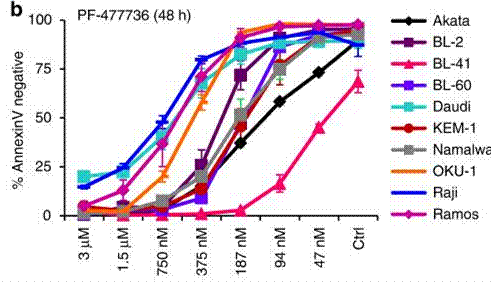
| Growth inhibition assay | Cell viability |
|
29167438 |
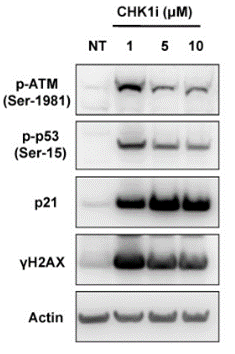
| Western blot | p-ATM / γ-H2AX p-53 / p-p53 / p21 / MDM2 |
|
31362335 |
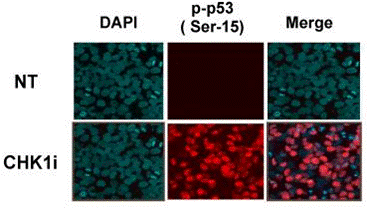
| Immunofluorescence | p-p53 |
|
31362335 |
Informazioni sullo studio clinico
(dati da https://clinicaltrials.gov, aggiornato il 2024-05-22)
| Numero NCT | Reclutamento | Condizioni | Sponsor/Collaboratori | Data di inizio | Fasi |
|---|---|---|---|---|---|
| NCT00437203 | Terminated | Neoplasms |
Pfizer |
December 2006 | Phase 1 |
Supporto tecnico
Istruzioni per la manipolazione
Tel: +1-832-582-8158 Ext:3
Per qualsiasi altra domanda, si prega di lasciare un messaggio.
Domande Frequenti
Domanda 1:
Can you advise the vehicle suggested for S2904: 2% DMSO/40% PEG 300 at 5mg/ml, is it a suspension or clear solution? I wanted to know how to dissolve it for an i.p. injection in mice.
Risposta:
It can dissolve in 2% DMSO/40% PEG 300 at 5mg/ml as a clear solution. If you are going to use this kind of vehicle, please dissolve this compound in DMSO clearly first, then add PEG300, then water.

I prodotti sono solo per uso di ricerca. Non per uso umano. Non vendiamo a pazienti.
©Copyright 2013 Selleck Chemicals. Tutti i diritti riservati.