
solo per uso di ricerca
Rabusertib (LY2603618) Inibitore CHK1
N. Cat.S2626
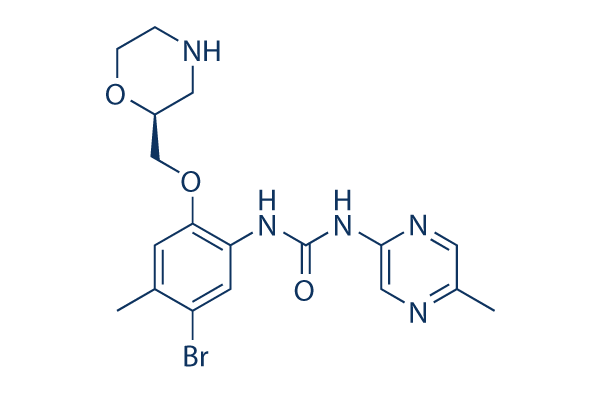
Struttura chimica
Peso molecolare: 436.3
Controllo Qualità
Coltura cellulare, trattamento e concentrazione di lavoro
| Linee cellulari | Tipo di saggio | Concentrazione | Tempo di incubazione | Formulazione | Descrizione dellattività | PMID |
|---|---|---|---|---|---|---|
| BT474 | Kinase assay | 1 μM | DMSO | inhibits P-CHK1 levels | 23917378 | |
| MCF7 | Kinase assay | 1 μM | DMSO | inhibits P-CHK1 levels | 23917378 | |
| Hela | Kinase assay | 3300 nM | DMSO | inhibits Chk1 activity | 24114124 | |
| Calu6 | Kinase assay | 3300 nM | DMSO | inhibits Chk1 activity | 24114124 | |
| A549 | Function assay | ~10 μM | DMSO | induces cell cycle arrest | 24928205 | |
| H1299 | Function assay | ~10 μM | DMSO | induces cell cycle arrest | 24928205 | |
| A549 | Function assay | ~20 μM | DMSO | activates DNA damage sensor kinases | 24928205 | |
| H1299 | Function assay | ~20 μM | DMSO | activates DNA damage sensor kinases | 24928205 | |
| A549 | Apoptosis assay | ~20 μM | DMSO | induces apoptosis | 24928205 | |
| H1299 | Apoptosis assay | ~20 μM | DMSO | induces apoptosis | 24928205 | |
| A549 | Cytoxicity assay | ~20 μM | DMSO | induces autophagy | 24928205 | |
| H1299 | Cytoxicity assay | ~20 μM | DMSO | induces autophagy | 24928205 | |
| A549 | Function assay | ~20 μM | DMSO | increases JNK and p38 MAPK phosphorylation | 24928205 | |
| H1299 | Function assay | ~20 μM | DMSO | increases JNK and p38 MAPK phosphorylation | 24928205 | |
| OHS-50 | qHTS assay | qHTS of pediatric cancer cell lines to identify multiple opportunities for drug repurposing: Primary screen for OHS-50 cells | 29435139 | |||
| SJ-GBM2 | qHTS assay | qHTS of pediatric cancer cell lines to identify multiple opportunities for drug repurposing: Primary screen for SJ-GBM2 cells | 29435139 | |||
| SK-N-MC | qHTS assay | qHTS of pediatric cancer cell lines to identify multiple opportunities for drug repurposing: Primary screen for SK-N-MC cells | 29435139 | |||
| NB-EBc1 | qHTS assay | qHTS of pediatric cancer cell lines to identify multiple opportunities for drug repurposing: Primary screen for NB-EBc1 cells | 29435139 | |||
| LAN-5 | qHTS assay | qHTS of pediatric cancer cell lines to identify multiple opportunities for drug repurposing: Primary screen for LAN-5 cells | 29435139 | |||
| Clicca per visualizzare più dati sperimentali sulle linee cellulari | ||||||
Informazioni chimiche, conservazione e stabilità
| Peso molecolare | 436.3 | Formula | C18H22BrN5O3 |
Conservazione (Dalla data di ricezione) | |
|---|---|---|---|---|---|
| N. CAS | 911222-45-2 | Scarica SDF | Conservazione delle soluzioni stock |
|
|
| Sinonimi | IC-83 | Smiles | CC1=CC(=C(C=C1Br)NC(=O)NC2=NC=C(N=C2)C)OCC3CNCCO3 | ||
Solubilità
|
In vitro |
DMSO
: 22 mg/mL
(50.42 mM)
Water : Insoluble Ethanol : Insoluble |
Calcolatore di Molarità
|
In vivo |
|||||
Calcolatore di formulazione in vivo (Soluzione chiara)
Passo 1: Inserire le informazioni di seguito (Consigliato: Un animale aggiuntivo per tenere conto della perdita durante lesperimento)
Passo 2: Inserire la formulazione in vivo (Questo è solo il calcolatore, non la formulazione. Contattateci prima se non cè una formulazione in vivo nella sezione Solubilità.)
Risultati del calcolo:
Concentrazione di lavoro: mg/ml;
Metodo per preparare il liquido master di DMSO: mg farmaco predissolto in μL DMSO ( Concentrazione del liquido master mg/mL, Vi preghiamo di contattarci prima se la concentrazione supera la solubilità del DMSO del lotto del farmaco. )
Metodo per preparare la formulazione in vivo: Prendere μL DMSO liquido master, quindi aggiungereμL PEG300, mescolare e chiarire, quindi aggiungereμL Tween 80, mescolare e chiarire, quindi aggiungere μL ddH2O, mescolare e chiarire.
Metodo per preparare la formulazione in vivo: Prendere μL DMSO liquido master, quindi aggiungere μL Olio di mais, mescolare e chiarire.
Nota: 1. Si prega di assicurarsi che il liquido sia limpido prima di aggiungere il solvente successivo.
2. Assicurarsi di aggiungere il/i solvente/i in ordine. È necessario assicurarsi che la soluzione ottenuta, nellaggiunta precedente, sia una soluzione limpida prima di procedere allaggiunta del solvente successivo. Metodi fisici come il vortex, gli ultrasuoni o il bagno dacqua calda possono essere utilizzati per facilitare la dissoluzione.
Meccanismo dazione
| Targets/IC50/Ki |
Chk1
(Cell-free assay) 7 nM
|
|---|---|
| In vitro |
Chk1 è una serina-treonina chinasi ATP-dipendente e un componente chiave nel sistema di checkpoint di monitoraggio della replicazione del DNA attivato da rotture a doppio filamento (DSB). Chk1 contribuisce a tutti i checkpoint del ciclo cellulare attualmente definiti, inclusi G1/S, fase intra-S, G2/M e il checkpoint del fuso mitotico. Inibendo l'attività di chk1, questo composto previene la riparazione del DNA causata da agenti che danneggiano il DNA, potenziando così le efficacia antitumorali di vari agenti chemioterapici. Tuttavia, i dati preclinici relativi a questo composto non sono stati pubblicati fino ad ora. L'inibizione di Chk1 è prevista per migliorare gli effetti degli antimetaboliti. Questo trattamento chimico compromette la sintesi del DNA, aumenta il danno al DNA (tramite difetti mitotici), induce apoptosis e ha attività sinergica, specialmente nelle cellule tumorali con mutazione p53. |
| In vivo |
Nei modelli di xenotrapianto, questo composto ritarda la crescita tumorale se somministrato in combinazione. |
Riferimenti |
|
Applicazioni
| Metodi | Biomarcatori | Immagini | PMID |
|---|---|---|---|
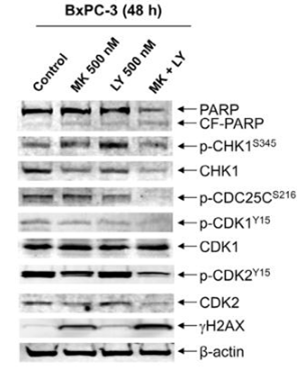
| Western blot | PARP / CF-PARP / p-CDC25C / p-CDK1 / p-CDK2 p-Chk1 / Chk1 / CDC25A |
|
25458954 |
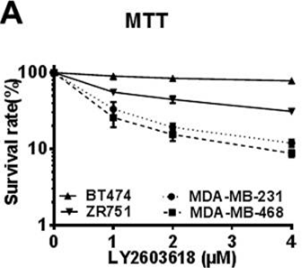
| Growth inhibition assay | Cell viability |
|
29326282 |
Informazioni sullo studio clinico
(dati da https://clinicaltrials.gov, aggiornato il 2024-05-22)
| Numero NCT | Reclutamento | Condizioni | Sponsor/Collaboratori | Data di inizio | Fasi |
|---|---|---|---|---|---|
| NCT01341457 | Completed | Solid Tumors |
Eli Lilly and Company |
May 2011 | Phase 1 |
| NCT01296568 | Completed | Advanced Cancer |
Eli Lilly and Company |
February 2011 | Phase 1 |
| NCT01139775 | Completed | Non Small Cell Lung Cancer |
Eli Lilly and Company |
February 2011 | Phase 1|Phase 2 |
| NCT00988858 | Completed | Non Small Cell Lung Cancer |
Eli Lilly and Company |
November 2009 | Phase 2 |
| NCT00839332 | Completed | Pancreatic Neoplasms |
Eli Lilly and Company |
February 2009 | Phase 1|Phase 2 |
Supporto tecnico
Istruzioni per la manipolazione
Tel: +1-832-582-8158 Ext:3
Per qualsiasi altra domanda, si prega di lasciare un messaggio.

I prodotti sono solo per uso di ricerca. Non per uso umano. Non vendiamo a pazienti.
©Copyright 2013 Selleck Chemicals. Tutti i diritti riservati.