
solo per uso di ricerca
AMG-458 c-Met inibitore
N. Cat.S2747
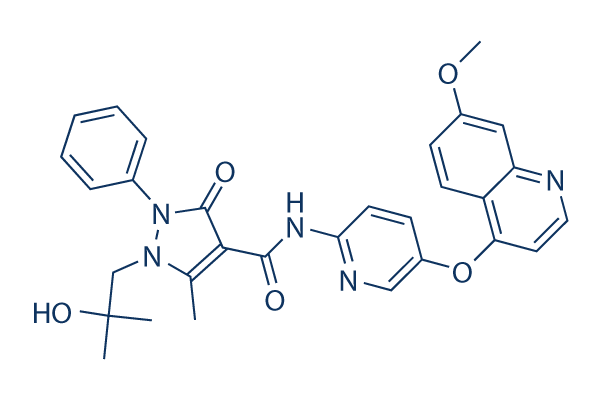
Struttura chimica
Peso molecolare: 539.58
Controllo Qualità
| Target correlati | EGFR VEGFR PDGFR FGFR Src MEK CSF-1R FLT3 HER2 c-Kit |
|---|---|
| Altro c-Met Inibitori | Tepotinib Dihexa SGX-523 PHA-665752 Foretinib SU11274 BMS-777607 JNJ-38877605 Tivantinib PF-04217903 |
Informazioni chimiche, conservazione e stabilità
| Peso molecolare | 539.58 | Formula | C30H29N5O5 |
Conservazione (Dalla data di ricezione) | |
|---|---|---|---|---|---|
| N. CAS | 913376-83-7 | Scarica SDF | Conservazione delle soluzioni stock |
|
|
| Sinonimi | N/A | Smiles | CC1=C(C(=O)N(N1CC(C)(C)O)C2=CC=CC=C2)C(=O)NC3=NC=C(C=C3)OC4=C5C=CC(=CC5=NC=C4)OC | ||
Solubilità
|
In vitro |
DMSO
: 26 mg/mL
(48.18 mM)
Water : Insoluble Ethanol : Insoluble |
Calcolatore di Molarità
|
In vivo |
|||||
Calcolatore di formulazione in vivo (Soluzione chiara)
Passo 1: Inserire le informazioni di seguito (Consigliato: Un animale aggiuntivo per tenere conto della perdita durante lesperimento)
Passo 2: Inserire la formulazione in vivo (Questo è solo il calcolatore, non la formulazione. Contattateci prima se non cè una formulazione in vivo nella sezione Solubilità.)
Risultati del calcolo:
Concentrazione di lavoro: mg/ml;
Metodo per preparare il liquido master di DMSO: mg farmaco predissolto in μL DMSO ( Concentrazione del liquido master mg/mL, Vi preghiamo di contattarci prima se la concentrazione supera la solubilità del DMSO del lotto del farmaco. )
Metodo per preparare la formulazione in vivo: Prendere μL DMSO liquido master, quindi aggiungereμL PEG300, mescolare e chiarire, quindi aggiungereμL Tween 80, mescolare e chiarire, quindi aggiungere μL ddH2O, mescolare e chiarire.
Metodo per preparare la formulazione in vivo: Prendere μL DMSO liquido master, quindi aggiungere μL Olio di mais, mescolare e chiarire.
Nota: 1. Si prega di assicurarsi che il liquido sia limpido prima di aggiungere il solvente successivo.
2. Assicurarsi di aggiungere il/i solvente/i in ordine. È necessario assicurarsi che la soluzione ottenuta, nellaggiunta precedente, sia una soluzione limpida prima di procedere allaggiunta del solvente successivo. Metodi fisici come il vortex, gli ultrasuoni o il bagno dacqua calda possono essere utilizzati per facilitare la dissoluzione.
Meccanismo dazione
| Caratteristiche |
Completely bioavailable across species and the intrinsic half-life is increased in higher mammals.
|
|---|---|
| Targets/IC50/Ki |
c-Met (H1094R)
0.5 nM(Ki)
c-Met (V1092I)
1.1 nM(Ki)
c-Met (Human)
1.2 nM(Ki)
c-Met (Mouse)
2.0 nM(Ki)
c-Met (D1228H)
2.2 nM(Ki)
c-Met (M1250T)
4.1 nM(Ki)
c-Met (Y1230H)
4.5 nM(Ki)
|
| In vitro |
AMG 458 inibisce anche la fosforilazione di c-Met mediata da HGF nelle cellule PC3 e CT26 con IC50 di 60 e 120 nM. Si osserva che AMG 458 si lega covalentemente alle proteine microsomiali epatiche di ratti e umani in assenza di NADPH. Si ritiene che AMG 458 reagisca con i gruppi tiol nelle proteine, producendo un coniugato tioetere di metossichinolina. Uno studio recente mostra che la fosforilazione costitutiva di c-Met in H441 è abrogata da AMG 458. La fosforilazione basale e indotta da HGF di c-Met in A549 è attenuata da AMG 458. La combinazione di radioterapia e trattamento con AMG 458 aumenta sinergicamente l'apoptosi nella linea cellulare H441 mediante la riduzione dei livelli di p-Akt e p-Erk, ma non in A549.
|
| In vivo |
AMG 458 è metabolicamente stabile nei microsomi epatici di topo, ratto, cane, scimmia e umano con basse clearance intrinseche (Clint: <5, 62, 8, 8, 18 (μL/min)/mg, rispettivamente). Se somministrato per via orale, AMG 458 raggiunge una biodisponibilità notevolmente elevata in tutte le specie testate. La somministrazione orale di AMG 458 inibisce la fosforilazione di c-Met mediata da HGF con una ED90 approssimativa di 30 mg/kg e un'esposizione plasmatica associata di circa 15 μM a 6 ore. AMG 458 inibisce significativamente la crescita tumorale nei modelli di xenotrapianto NIH3T3/TPR-Met e U-87 MG a 30 e 100 mg/kg q.d. e 30 mg/kg b.i.d. senza effetti avversi sul peso corporeo. Alte concentrazioni di AMG 458 in alcuni organi possono produrre tossicità tramite stress ossidativo.
|
Riferimenti |
|
Supporto tecnico
Istruzioni per la manipolazione
Tel: +1-832-582-8158 Ext:3
Per qualsiasi altra domanda, si prega di lasciare un messaggio.

I prodotti sono solo per uso di ricerca. Non per uso umano. Non vendiamo a pazienti.
©Copyright 2013 Selleck Chemicals. Tutti i diritti riservati.