
solo per uso di ricerca
AG-14361 PARP inibitore
N. Cat.S2178
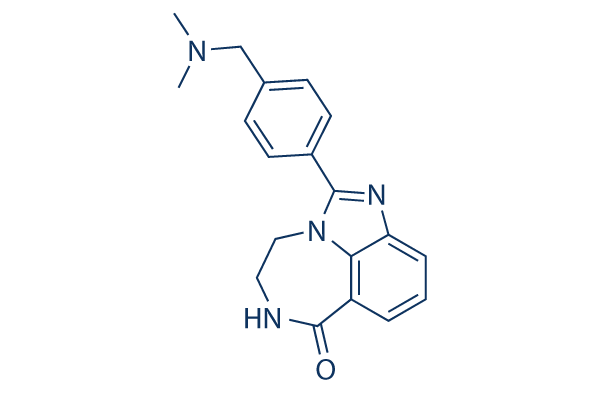
Struttura chimica
Peso molecolare: 320.39
Controllo Qualità
| Target correlati | HDAC ATM/ATR DNA-PK WRN DNA/RNA Synthesis Topoisomerase PPAR Sirtuin Casein Kinase eIF |
|---|---|
| Altro PARP Inibitori | XAV-939 AZD5305 (Saruparib) Veliparib (ABT-888) PJ34 HCl Iniparib (BSI-201) G007-LK Pamiparib UPF 1069 A-966492 Stenoparib (E7449) |
Coltura cellulare, trattamento e concentrazione di lavoro
| Linee cellulari | Tipo di saggio | Concentrazione | Tempo di incubazione | Formulazione | Descrizione dellattività | PMID |
|---|---|---|---|---|---|---|
| LoVo cells | Function assay | Concentration that gives 50% growth inhibition in LoVo cells, activity expressed as GI50, GI50=11.2 μM | ||||
| Clicca per visualizzare più dati sperimentali sulle linee cellulari | ||||||
Informazioni chimiche, conservazione e stabilità
| Peso molecolare | 320.39 | Formula | C19H20N4O |
Conservazione (Dalla data di ricezione) | |
|---|---|---|---|---|---|
| N. CAS | 328543-09-5 | Scarica SDF | Conservazione delle soluzioni stock |
|
|
| Sinonimi | N/A | Smiles | CN(C)CC1=CC=C(C=C1)C2=NC3=CC=CC4=C3N2CCNC4=O | ||
Solubilità
|
In vitro |
DMSO
: 51 mg/mL
(159.18 mM)
Ethanol : 21 mg/mL Water : Insoluble |
Calcolatore di Molarità
|
In vivo |
|||||
Calcolatore di formulazione in vivo (Soluzione chiara)
Passo 1: Inserire le informazioni di seguito (Consigliato: Un animale aggiuntivo per tenere conto della perdita durante lesperimento)
Passo 2: Inserire la formulazione in vivo (Questo è solo il calcolatore, non la formulazione. Contattateci prima se non cè una formulazione in vivo nella sezione Solubilità.)
Risultati del calcolo:
Concentrazione di lavoro: mg/ml;
Metodo per preparare il liquido master di DMSO: mg farmaco predissolto in μL DMSO ( Concentrazione del liquido master mg/mL, Vi preghiamo di contattarci prima se la concentrazione supera la solubilità del DMSO del lotto del farmaco. )
Metodo per preparare la formulazione in vivo: Prendere μL DMSO liquido master, quindi aggiungereμL PEG300, mescolare e chiarire, quindi aggiungereμL Tween 80, mescolare e chiarire, quindi aggiungere μL ddH2O, mescolare e chiarire.
Metodo per preparare la formulazione in vivo: Prendere μL DMSO liquido master, quindi aggiungere μL Olio di mais, mescolare e chiarire.
Nota: 1. Si prega di assicurarsi che il liquido sia limpido prima di aggiungere il solvente successivo.
2. Assicurarsi di aggiungere il/i solvente/i in ordine. È necessario assicurarsi che la soluzione ottenuta, nellaggiunta precedente, sia una soluzione limpida prima di procedere allaggiunta del solvente successivo. Metodi fisici come il vortex, gli ultrasuoni o il bagno dacqua calda possono essere utilizzati per facilitare la dissoluzione.
Meccanismo dazione
| Caratteristiche |
The 1st high-potency PARP-1 inhibitor with the specificity & in vivo activity to enhance chemotherapy and radiation therapy of human cancers.
|
|---|---|
| Targets/IC50/Ki |
PARP1
(Cell-free assay) <5 nM(Ki)
|
| In vitro |
AG14361 è almeno 1000 volte più potente dei benzammidi. L'IC50 per AG14361 è di 29 nM nelle cellule SW620 permeabilizzate e di 14 nM nelle cellule SW620 intatte. L'analisi cristallografica di AG14361 legato al dominio catalitico della PARP-1 di pollo mostra che il sistema ad anello triciclico di AG14361 si trova in una tasca composta dai residui amminoacidici Trp861, His862, Gly863, Tyr896, Phe897, Ala898, Lys903, Ser904, Tyr907 e Glu988. AG14361 forma importanti legami idrogeno con Ser904 e Gly863 e un legame idrogeno mediato dall'acqua con Glu988. L'inibizione della crescita indotta da AG14361 non è attribuita a effetti correlati alla PARP-1 perché la massima inibizione della PARP-1 si osserva a concentrazioni molto più basse (≤1 μM) rispetto al GI50. AG14361 a 0,4 μM non influenza l'espressione genica o la crescita delle cellule tumorali, ma aumenta l'attività antiproliferativa e inibisce il recupero dai danni da radiazioni γ potenzialmente letali nelle cellule LoVo del 73%. Inoltre, 0,4 μM AG14361 non altera sostanzialmente l'espressione genica come mostrato dall'analisi di microarray. Un'esposizione di 17 ore di cellule A549 a 0,4 μM AG14361 non cambia l'espressione dei 6800 geni. Quindi, sebbene 0,4 μM AG14361 inibisca l'attività cellulare della PARP-1 di oltre l'85%, non cambia essenzialmente l'espressione genica e la proliferazione cellulare, indicando che gli effetti cellulari di questa bassa concentrazione di AG14361 sono specifici per l'inibizione della PARP-1. Concentrazioni più elevate, che inibiscono la crescita, di AG14361 influenzano l'espressione genica, ma è improbabile che questi effetti siano correlati all'inibizione della PARP-1 perché la proliferazione cellulare è influenzata in modo uguale nelle cellule PARP-/- e PARP-1+/+. AG14361 viene rapidamente assorbito nel flusso sanguigno e distribuito al tumore e al fegato con concentrazioni più basse rilevate nel cervello. Il rapporto di concentrazione tessuto-plasma indica che AG14361 viene trattenuto nel tessuto tumorale nel tempo in entrambi i modelli di xenotrapianto, con concentrazioni tumorali (≥15 μM per 2 ore) in eccesso rispetto a quelle richieste per inibire l'attività della PARP-1 in vitro. AG14361 potenzia l'attività in tutte le cellule MMR-competenti (1,5–3,3 volte) ma è più efficace nelle cellule MMR-deficienti (potenziamento di 3,7–5,2 volte), superando la resistenza. Al contrario, la benzilguanina aumenta l'efficacia solo nelle cellule MMR-competenti ma è inefficace nelle cellule MMR-deficienti. AG14361 potenzia gli effetti inibitori della crescita e citotossici dei veleni della topoisomerasi I. AG14361 aumenta la persistenza delle rotture del singolo filamento di DNA indotte dalla camptotecina. |
| Saggio chinasico |
Saggi di attività della PARP-1
|
|
L'attività della PARP-1 umana ricombinante a lunghezza intera viene misurata in una miscela di reazione contenente 20 nM PARP-1, 500 μM NAD+ più [32P]NAD+ (0,1–0,3 μCi per miscela di reazione) e DNA di timo di vitello attivato (10 μg/mL) a 25oC; la reazione viene terminata dopo 4 minuti aggiungendo acido tricloroacetico al 10% (p/v) ghiacciato. Il prodotto di reazione [32P]ADP-ribosio incorporato nel materiale insolubile in acido viene depositato su filtri in fibra di vetro Whatman GF/C con un apparecchio di microfiltrazione Bio-Dot e quantificato con un PhosphorImager. Viene misurata l'inibizione dell'attività della PARP-1 da parte di AG14361 a 0–600 nM e il Ki per AG14361 viene calcolato mediante analisi di regressione non lineare.
|
|
| In vivo |
Il trattamento con AG14361 prima dell'irradiazione aumenta in modo statisticamente significativo la sensibilità alla radioterapia di topi portatori di xenotrapianti LoVo. AG14361 aumenta in modo statisticamente significativo il flusso sanguigno negli xenotrapianti e, quindi, potenzialmente aumenta la somministrazione di farmaci ai xenotrapianti tumorali. In vivo, dosi non tossiche di AG14361 aumentano il ritardo della crescita degli xenotrapianti LoVo indotto dalla raggi X di 2-3 volte. La co-somministrazione di AG14361 aumenta in modo statisticamente significativo l'attività contro gli xenotrapianti LoVo, con il ritardo della crescita tumorale che aumenta da 3 giorni a 9 giorni con AG14361 a 5 mg/kg e a 10 giorni con AG14361 a 15 mg/kg. La combinazione di AG14361 causa una regressione completa dei tumori xenotrapiantati SW620. L'attività della PARP-1, rilevata mediante saggio farmacodinamico, negli xenotrapianti SW620 è inibita di oltre il 75% per almeno 4 ore dopo la somministrazione intraperitoneale di AG14361 (10 mg/kg), coerentemente con la concentrazione di AG14361 che persiste nel tumore. |
Riferimenti |
|
Supporto tecnico
Istruzioni per la manipolazione
Tel: +1-832-582-8158 Ext:3
Per qualsiasi altra domanda, si prega di lasciare un messaggio.

I prodotti sono solo per uso di ricerca. Non per uso umano. Non vendiamo a pazienti.
©Copyright 2013 Selleck Chemicals. Tutti i diritti riservati.