DNA-dependent protein kinase (DNA-PK) is a nuclear protein Serine (Ser)/Threonine (Thr) kinase that acts as both a molecular sensor and transmitter of DNA damage, and plays important roles in the DNA repair of double stranded breaks (DSBs), mediating immunoglobulin V(D)J gene recombination events, as well as telomere stabilization. [show the full text]

DNA-PK inibitori (DNA-PK Inhibitors)
| N. Cat. | Nome del prodotto | Informazioni | Citazioni di utilizzo del prodotto | Validazioni del prodotto |
|---|---|---|---|---|
| S8586 | Nedisertib (M3814) | Nedisertib (M3814, Peposertib, MSC2490484A) è un inibitore orale altamente potente e selettivo della DNA activated protein kinase (DNA-PK) con una IC50 < 3 nM. |
|
|
| S8843 | AZD7648 | AZD7648 è un potente inibitore di DNA-PK con una IC50 di 0,6 nM in saggio biochimico e più di 100 volte selettivo contro 396 altre chinasi. |
|
|
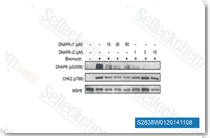
| S2638 | NU7441 (KU-57788) | NU7441 (KU-57788) è un inibitore molto potente e selettivo di DNA-PK con IC50 di 14 nM. Inibisce anche mTOR e PI3K con IC50 di 1,7 μM e 5 μM in saggi senza cellule, rispettivamente, e riduce la frequenza di NHEJ mentre aumenta il tasso di HDR in seguito alla scissione del DNA mediata da Cas9. |
|
|
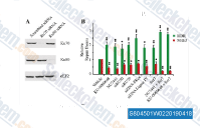
| S8045 | KU-0060648 | KU-0060648 è un doppio inibitore di DNA-PK e PI3Kα, PI3Kβ, PI3Kδ con IC50 rispettivamente di 8,6 nM e 4 nM, 0,5 nM, 0,1 nM, minore inibizione di PI3Kγ con IC50 di 0,59 μM. |
|
|
| S8593 | VX-984 | VX-984 (M9831) è un inibitore di DNA-PK oralmente attivo, potente, selettivo e ATP-competitivo. Questo composto sopprime efficacemente la giunzione delle estremità non omologhe (NHEJ) e aumenta le rotture a doppio filamento del DNA (DSBs). Migliora gli effetti citotossici delle radiazioni ionizzanti (IR) in varie linee cellulari tumorali, comprese le linee cellulari di carcinoma polmonare non a piccole cellule (NSCLC), in vitro. Inoltre, questo inibitore riduce l'autofosforilazione di DNA-PKcs. | ||
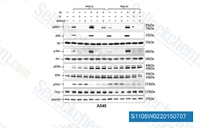
| S1105 | LY294002 | LY294002 (SF 1101, NSC 697286) è la prima molecola sintetica nota per inibire PI3Kα/δ/β con IC50 di 0,5 μM/0,57 μM/0,97 μM, rispettivamente; più stabile in soluzione rispetto alla Wortmannina, e blocca anche la formazione di autofagosomi. Non solo si lega alle PI3K di classe I e ad altre chinasi correlate a PI3K, ma anche a nuovi bersagli apparentemente non correlati alla famiglia PI3K. Questo composto inibisce anche CK2 con IC50 di 98 nM. È un inibitore non specifico della DNA-PKcs e attiva l'autophagy e l'apoptosis. |
|
|
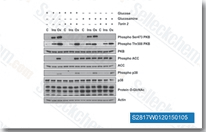
| S2817 | Torin 2 | Torin 2 è un inibitore potente e selettivo di mTOR con IC50 di 0,25 nM nella linea cellulare MEF p53 / -; selettività 800 volte superiore per mTOR rispetto a PI3K e proprietà farmacocinetiche migliorate. Questo composto inibisce ATM/ATR/DNA-PK con EC50 di 28 nM/35 nM/118 nM,rispettivamente nelle linee cellulari PC3. Diminuisce la vitalità cellulare e induce autophagy e apoptosis. |
|
|
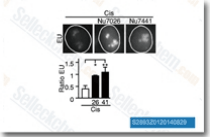
| S2893 | NU7026 | NU7026 (LY293646) è un potente inibitore di DNA-PK con IC50 di 0,23 μM in saggi senza cellule, 60 volte più selettivo per DNA-PK rispetto a PI3K e inattivo contro ATM e ATR. Questo composto migliora l'arresto cellulare G2/M e l'apoptosi. |
|
|
| S7891 | CC-115 | CC-115 è un doppio inibitore della DNA-dependent protein kinase (DNA-PK) e del mammalian target of rapamycin (mTOR) con valori di IC50 rispettivamente di 0,013 μM e 0,021 μM. Ha potenziale attività antineoplastica. |
|
|
| S8379 | YU238259 | YU238259 è un nuovo inibitore della riparazione del DNA dipendente dall'omologia (HDR), ma non inibisce la giunzione terminale non omologa (NHEJ), in saggi reporter GFP basati su cellule. |
|
|
DNA-dependent protein kinase (DNA-PK) is composed of three key components including two DNA-binding subunits Ku70 and Ku80 (Ku86), as well as one DNA-dependent protein kinase catalytic subunit (DNA-PKcs). Based on protein sequence similarity, DNA-PK belongs to the phosphatidylinositol-3-kinase (PI3K) family, whereas, DNA-PK is not known to phosphorylate lipids and is therefore called PI3K-like kinase (PI3KK). The carboxyl-terminal region of Ku70 contains a SAP domain that is believed to be involved in chromosomal organization. The carboxyl-terminal region of Ku80 is required for the Ku70 and Ku80 heterodimer interaction with DNA-PKcs. The Ku heterodimer can bind to a variety of double-stranded end structures, including blunt ends, overhangs are the 3' or 5' end, and covalently closed hairpin ends. Like ATM and ATR, DNA-PKcs is structurally similar as it contains carboxyl-terminal domains, a large amino-terminal domain in addition to FAT and FATC domains flanking the kinase domain. The DNA-PKcs structure contains a channel large enough to accommodate double-stranded DNA, while the structure of Ku heterodimer is an asymmetric open ring, allowing the DNA to pass through the center. DNA-PKcs is one of the largest kinases identified to date, and it is the only kinase that is absolutely dependent on DNA binding for activity. DNA-PK has a strong preference for phosphorylating Serine (Ser) and Threonine (Thr) residues that are followed by glutamine or, less commonly, a hydrophobic residue. [1][2]
DNA-PK is involved in the ligation step of the non-homologous end joining (NHEJ) pathway required for DNA double-stranded break (DSB) repair, V(D)J recombination and telomere stabilization. A heterodimer of Ku70 and Ku80 initially binds to the double-stranded DNA broken ends and translocates inwards in an ATP-independent manner and recruits DNA-PKcs. This results in the stabilization of the protein/DNA binding and enabling NHEJ to proceed. Moreover, DNA-PKcs acts as a scaffold protein by joining two broken DNA ends together in a complex containing two DNA-PKcs molecules that contributes to the synapsis of the broken DNA ends and the localization of DNA repair proteins such as DNA ligase IV/XRCC4 complex to the site of damage. DNA-PK is activated in cis by the DNA to which it is bound, and stimulated by Ku heterodimer as well as the interaction of two molecules of DNA-PKcs, while end-bridging through synapsis is required for full kinase activation. DNA-PKcs autophosphorylation at multiple sites, including Thr2609 and Ser2056, results in an inactivation of DNA-PK kinase activity and NHEJ ability. To ensure NHEJ can proceed efficiently, DNA-PK phosphorylates and activates the Werner syndrome protein (WRN) to remove 3' phosphate or 3' phosphoglycolate groups generated following IR, and the nuclease Artemis to remove 5' overhangs and shorten 3' overhangs. In addition, DNA-PK promotes processing of hairpin DNA structures in V(D)J recombination by activation of Artemis. Cells that lack DNA-PKcs are acutely radiosensitive and have defective DSB repair, while mice lacking DNA-PKcs remain viable but are immunodeficient (due to the absence of immune development) as a result of accumulated processed DNA intermediates. Additionally, DNA-PK has been strongly implicated in telomere maintenance. DNA-PKcs-/- mice display significant telomeric fusion events consistent with the role of DNA-PKcs in telomere maintenance. Furthermore, DNA-PK is involved in the modulation of transcription by phosphorylation of RNA polymerases including pol I and pol II through its kinase activity, thereby regulating the function of these enzymes. By direct p53 phosphorylation, the modification of Ku70 releasing Bax, or suppressing the expression of p21, DNA-PK plays a significant role in mediating a p53-dependent apoptotic response under a range of cellular conditions including exposure to ionizing radiation (IR), environmental carcinogens and chemotherapeutic agents or in cells that have critically shortened telomeres. [1][2]
Specific inhibitors of DNA-PK used to selectively reduce NHEJ activity have been shown to be effective as single-agent therapies in homologous recombination (HR) -defective tumors. Treatment with a flavone-based DNA-PK inhibitor IC87361 leads to tumor regression. The inhibitors of DNA-PK such as NU7441 enhance the cytotoxicity of physical and chemical agents, leading to reduced clonogenic survival and cellular proliferation, as well as increased apoptosis, regardless of p53 status. Moreover, DNA-PK inhibitors combined with other DNA-damage response (DDR) inhibitors enhance the therapeutic potential of anticancer agents. [3][4]

I prodotti sono solo per uso di ricerca. Non per uso umano. Non vendiamo a pazienti.
©Copyright 2013 Selleck Chemicals. Tutti i diritti riservati.