Mammalian target of rapamycin (mTOR), also known as FKBP12-rapamycin-associated protein (FRAP), is a 280 kDa serine/threonine kinase which plays a key role in regulating critical cellular processes such as growth, proliferation, cytoskeletal organization, transcription, protein synthesis and ribosomal biogenesis by integrating three major inputs-nutrients (amino acids), growth factors (insulin), and cellular energy status. [show the full text]

mTOR inibitori/attivatori (mTOR Inhibitors/Activators)
| N. Cat. | Nome del prodotto | Informazioni | Citazioni di utilizzo del prodotto | Validazioni del prodotto |
|---|---|---|---|---|
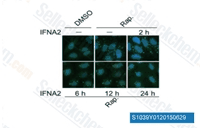
| S1039 | Rapamycin (Sirolimus) | La Rapamycin è un inibitore specifico di mTOR con IC50 di ~0.1 nM nelle cellule HEK293. Questo composto si lega a FKBP12 e agisce specificamente come un inibitore allosterico di mTORC1. È un attivatore di Autophagy e un immunosoppressore. |
|
|
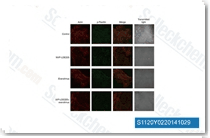
| S1120 | RAD001 (Everolimus) | Everolimus è un inibitore di mTOR di FKBP12 con IC50 di 1,6-2,4 nM in un saggio senza cellule. Everolimus induce l'apoptosi e l'autofagia cellulare e inibisce la proliferazione delle cellule tumorali. |
|
|
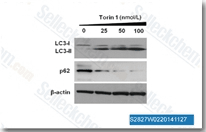
| S2827 | Torin 1 | Torin 1 è un potente inibitore di mTORC1/2 con IC50 di 2 nM/10 nM in saggi acellulari; mostra una selettività 1000 volte superiore per mTOR rispetto a PI3K. |
|
|
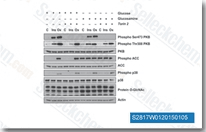
| S2817 | Torin 2 | Torin 2 è un inibitore potente e selettivo di mTOR con IC50 di 0,25 nM nella linea cellulare MEF p53 / -; selettività 800 volte superiore per mTOR rispetto a PI3K e proprietà farmacocinetiche migliorate. Questo composto inibisce ATM/ATR/DNA-PK con EC50 di 28 nM/35 nM/118 nM,rispettivamente nelle linee cellulari PC3. Diminuisce la vitalità cellulare e induce autophagy e apoptosis. |
|
|
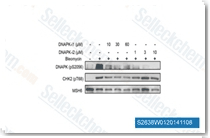
| S2638 | NU7441 (KU-57788) | NU7441 (KU-57788) è un inibitore molto potente e selettivo di DNA-PK con IC50 di 14 nM. Inibisce anche mTOR e PI3K con IC50 di 1,7 μM e 5 μM in saggi senza cellule, rispettivamente, e riduce la frequenza di NHEJ mentre aumenta il tasso di HDR in seguito alla scissione del DNA mediata da Cas9. |
|
|
| S9736 | ME-344 | ME-344 è un metabolita sintetico di NV-128, un potente inibitore del complesso I della fosforilazione ossidativa mitocondriale (OXPHOS), che interrompe la generazione di ATP e il consumo di ossigeno. Inibisce anche mTOR downregolando la via AKT/mTOR, esibendo attività antitumorale inibendo la crescita e la vitalità cellulare in linee cellulari leucemiche con valori di IC50 di 70-260 nM. | ||
| S8163 | Paxalisib (GDC-0084) | Paxalisib (GDC-0084, RG7666) è un inibitore di PI3K e mTOR penetrante nel cervello con valori di Kiapp di 2 nM, 46 nM, 3 nM, 10 nM e 70 nM per PI3Kα, PI3Kβ, PI3Kδ, PI3Kγ e mTOR. |
|
|
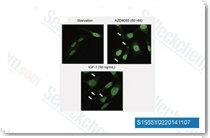
| S1555 | AZD8055 | AZD8055 è un nuovo inibitore di mTOR ATP-competitivo con IC50 di 0,8 nM nelle cellule MDA-MB-468 con eccellente selettività (∼1.000 volte) contro le isoforme di PI3K e ATM/DNA-PK. Questo composto induce l'apoptosi dipendente dalla caspasi e induce anche l'autofagia. Fase 1. |
|
|
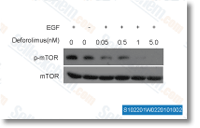
| S1022 | Ridaforolimus (Deforolimus, MK-8669) | Ridaforolimus (Deforolimus, MK-8669, AP23573) è un inibitore selettivo di mTOR con un'IC50 di 0,2 nM nella linea cellulare HT-1080; sebbene non classificato come profarmaco, l'inibizione di mTOR e il legame con FKBP12 sono simili a quelli della rapamicina. Fase 3. |
|
|
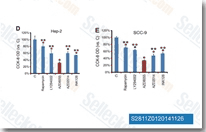
| S2811 | Sapanisertib (MLN0128, INK-128) | Sapanisertib (MLN0128, INK 128, TAK-228) è un potente e selettivo inibitore di mTOR con IC50 di 1 nM in saggi acellulari; >200 volte meno potente verso le isoforme PI3K di classe I, superiore nel blocco di mTORC1/2 e sensibile ai geni pro-invasione (vs Rapamicina). Fase 1. |
|
|
Mammalian target of Rapamycin (mTOR), also known as FKBP12-rapamycin-associated protein (FRAP), is a 280 kDa serine/threonine kinase [1-3]. mTOR kinase activity could be promoted by various extra- and intracellular stimulus like trophic factors, mitogens, hormones, amino acids and cellular stress [4-8]. In response to increased availability of stimuli, mTOR modulates numerous of important cellular processes, e.g. protein translation and autophagy, by phosphorylating its downstream molecules [9]. mTOR is the nuclear catalytic subunit of two complexes: mTORC1 and mTORC2 [1]. mTORC1 is comprised of mTOR, Raptor, mLST8, and PRAS40 (a mTOR inhibitor). This complex presented classic features of mTOR as a nutrient or energy sensor and protein synthesis conditioner [5, 10]. Low level of nutrient levels, growth factor and cellular stress inhibits the activity of mTORC1 [9, 10]. p70-S6 Kinase 1 (S6K1) and the eukaryotic initiation factor 4E (eIF4E) binding protein 1 (4E-BP1) are the best investigated targets of mTORC1 [5]. The activated mTORC1 showed a negative feedback inhibition on PI3K signaling [11]. mTORC1 could be specifically suppressed by rapamycin, as well as its allosteric ramifications. mTORC2 contains mTOR, Rictor, mLST8, and mSIN1 [12, 13]. Different from mTORC1, activated mTORC2 could induce the phosphorylation of Akt at serine 473 and serving as a positive feedback on PI3K signaling cascade [14]. Although mTORC2 was identified as a rapamycin-insensitive complex previously [14], an inhibition effect of rapamycin on free mTOR was observed in some cell lines [15]. Recent studies revealed that disordered activity of mTOR is related to some malignant and resistant cancer. The specific inhibitors, such as rapamycin and Temsirolimus(CCI-779), have been developed and trialed as novel anti-cancer agents [16, 17].

I prodotti sono solo per uso di ricerca. Non per uso umano. Non vendiamo a pazienti.
©Copyright 2013 Selleck Chemicals. Tutti i diritti riservati.