Phosphatidylinositol 3-kinase (PI 3-kinase or PI3K) is a famous target which is the upstream of akt because PI3K can activate Akt when PI3K is activated by growth factors including EGF, IGF, TGF-α and so on. The activation Class IA PI3Ks by growth factors is receptor tyrosine kinase (RTK)-dependent activation. Class IB PI3K is primarily regulated by small G-proteins such as Ras. PI3K is a key enzyme involved in cell processes, apoptosis and cancer. PI3K with mTOR, akt and MEK plays a key role in cancer. [show the full text]

PI3K inibitori/attivatori (PI3K Inhibitors/Activators)
| N. Cat. | Nome del prodotto | Informazioni | Citazioni di utilizzo del prodotto | Validazioni del prodotto |
|---|---|---|---|---|
| S8668 | GDC-0077 (Inavolisib) | Inavolisib (GDC-0077, RG6114, RO-7113755) è un potente inibitore selettivo di PI3K alpha (PI3Kα) con una IC50 di 0,038 nM. GDC-0077 è >300 volte più selettivo per PI3K alpha rispetto alle altre isoforme di PI3K di classe I (beta, delta e gamma) e >2000 volte più selettivo rispetto ai membri della famiglia PIK. GDC-0077 si lega al sito di legame dell'ATP di PI3K e inibisce la fosforilazione di PIP2 a PIP3. |
|
|
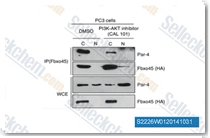
| S2226 | CAL-101 (Idelalisib) | Idelalisib (CAL-101) è un inibitore selettivo di p110δ con un'IC50 di 2,5 nM in saggi senza cellule; ha dimostrato di avere una selettività da 40 a 300 volte maggiore per p110δ rispetto a p110α/β/γ, e una selettività da 400 a 4000 volte maggiore per p110δ rispetto a C2β, hVPS34, DNA-PK e mTOR. Idelalisib stimola anche l'autophagy. |
|
|
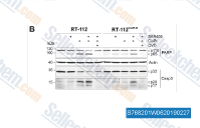
| S7682 | SAR405 | SAR405 è un inibitore chinasico a bassa massa molecolare di PIK3C3/Vps34 (KD 1,5 nM) che mostra un'elevata selettività e non è attivo fino a 10 μM sulle PI3K di classe I e classe II, nonché su mTOR. SAR405 previene l'autofagia e sinergizza con l'inibizione di MTOR (bersaglio meccanicistico della rapamicina) nelle cellule tumorali. |
|
|
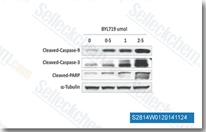
| S2814 | Alpelisib (BYL719) | Alpelisib (BYL719) è un potente e selettivo inibitore di PI3Kα con una IC50 di 5 nM in un saggio senza cellule, e un effetto minimo su PI3Kβ/γ/δ. Questo composto è in Fase 2. |
|
|
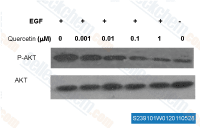
| S2391 | Quercetin (Sophoretin) | La Quercetin, un flavonoide naturale presente in verdura, frutta e vino, è uno stimolatore della SIRT1 ricombinante e anche un inibitore della PI3K con un'IC50 di 2,4-5,4 μM. La Quercetin induce mitophagy, apoptosis e autophagy protettiva. Fase 4. |
|
|
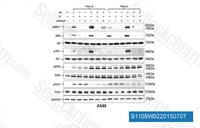
| S1105 | LY294002 | LY294002 (SF 1101, NSC 697286) è la prima molecola sintetica nota per inibire PI3Kα/δ/β con IC50 di 0,5 μM/0,57 μM/0,97 μM, rispettivamente; più stabile in soluzione rispetto alla Wortmannina, e blocca anche la formazione di autofagosomi. Non solo si lega alle PI3K di classe I e ad altre chinasi correlate a PI3K, ma anche a nuovi bersagli apparentemente non correlati alla famiglia PI3K. Questo composto inibisce anche CK2 con IC50 di 98 nM. È un inibitore non specifico della DNA-PKcs e attiva l'autophagy e l'apoptosis. |
|
|
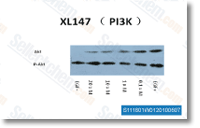
| S1118 | XL147 analogue | L'XL147 analogue (SAR245408) è un inibitore selettivo e reversibile della PI3K di classe I per PI3Kα/δ/γ con IC50 di 39 nM/36 nM/23 nM in saggi acellulari, meno potente per PI3Kβ. Questo composto induce l'apoptosi. Fase 1/2. |
|
|
| E1815 | Tersolisib (STX-478) | Tersolisib (STX-478) è un inibitore allosterico di PI3Kα altamente potente, selettivo per i mutanti, che mira selettivamente alle forme mutanti prevalenti di PI3Kα. Dimostra una forte efficacia contro le comuni mutazioni del dominio elicoidale e chinasi di PI3Kα, inclusa la variante H1047R, con un valore IC50 di 9,4 nmol/L. STX-478 mostra una selettività 14 volte maggiore per la PI3Kα mutante rispetto alla forma wild-type. Preserva la disfunzione metabolica e migliora la risposta terapeutica negli xenotrapianti con mutazione di PI3Kα. | ||
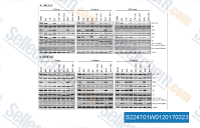
| S2247 | Buparlisib (BKM120) | Buparlisib (BKM120, NVP-BKM120) è un inibitore selettivo di PI3K di p110α/β/δ/γ con IC50 di 52 nM/166 nM/116 nM/262 nM in saggi acellulari, rispettivamente. Potenza ridotta contro VPS34, mTOR, DNAPK, con poca attività su PI4Kβ. Buparlisib induce l'apoptosi. Fase 2. |
|
|
| S7865 | 740 Y-P (PDGFR 740Y-P) | 740 Y-P (PDGFR 740Y-P, 740YPDGFR) è un attivatore fosfopeptidico permeabile alle cellule di PI3K. |
|
|
Phosphatidylinositol 3-kinases (PI3Ks) are a family of lipid kinases whose biological function is to phosphorylate the 3-hydroxyl group of phosphoinositide. It is proved that PI3K-dependent signaling pathway contributes to many cellular processes such as cell growth, proliferation, differentiation, motility, survival and intracellular trafficking, which might be involved in oncogenesis under certain situation[1]. When a growth factor or ligand binds to the tyrosine kinase receptors (RTK), the PI3K is activated by G protein-coupled receptors[2]. PI3Ks family is generally divided into Class I, Class II, and Class III according to their primary structure, regulation, and in vitro lipid substrate specificity[2]. Class I PI3Ks are heterodimeric molecules composed of a regulatory subunit (p85) and a catalytic subunit (p110). The regulatory subunit of PI3K could be further divided in to six subtypes: p85-α, p85-β, p55-γ, p150,p101 and p87. P85α is the most highly expressed regulatory subunit than the others. And the catalytic subunit could also further divided into four subtypes: p110-α, p110-β, p110-γ and p110-δ. The α and β isoforms of p110 are expressed in all kinds of cells, whereas δ is only found in leukocytes. The regulatory subunit p101 and catalytic subunit p110γ comprise a complex which is classified as Class IB PI3K. Other collocations of regulatory and catalytic subunits are called Class IA PI3Ks. However, class II is structurally different from Class I. There are three catalytic isoforms of Class II PI3Ks: PI3K-C2α, -C2β, and -C2γ, but no regulatory subunit. Class III is structurally similar to Class I for the reason that it is composed of a catalytic (Vps34) and a regulatory subunit (p150). Functionally, class I PI3Ks catalyze the production of phosphatidylinositol 3-phosphate (PtdIns-3,4-P), phosphatidylinositol (3,4)-bisphosphate (PtdIns-3,4-P2), and phosphatidylinositol (3,4,5)-triphosphate (PtdIns-3,4,5-P3). Class II is related to the production of PtdIns-3-P and PtdIns-3,4-P2, while class III specifically catalyzes the production of PtdIns-3,4-P2 [3-5].

I prodotti sono solo per uso di ricerca. Non per uso umano. Non vendiamo a pazienti.
©Copyright 2013 Selleck Chemicals. Tutti i diritti riservati.