
solo per uso di ricerca
Salvianolic acid B Sirtuin Attivatore
N. Cat.: S4735
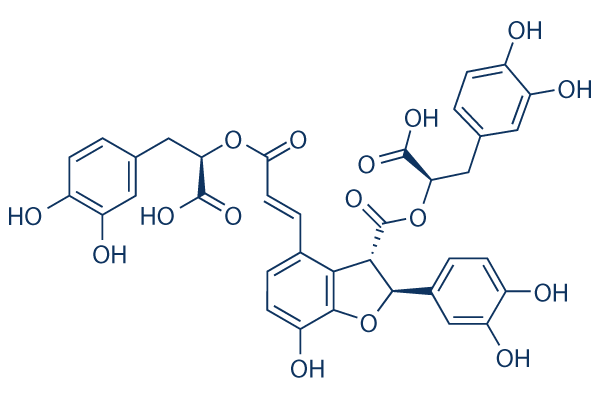
Struttura chimica
Peso molecolare: 718.61
Controllo Qualità (Quality Control)
| Target correlati | HDAC JAK BET Histone Methyltransferase PKC PARP HIF PRMT EZH2 AMPK |
|---|---|
| Altro Sirtuin Inibitori | SRT 1720 Hydrochloride Selisistat (EX-527) Sirtinol Fisetin 3-TYP AGK2 SRT2104 (GSK2245840) OSS_128167 SirReal2 SRT2183 |
Informazioni chimiche, conservazione e stabilità (Chemical Information, Storage & Stability)
| Peso molecolare | 718.61 | Formula | C36H30O16 |
Conservazione (Dalla data di ricezione) | 3 years -20°C powder (seal) |
|---|---|---|---|---|---|
| N. CAS | 121521-90-2 | Scarica SDF | Conservazione delle soluzioni stock | Le soluzioni sono instabili. Preparare al momento o acquistare formati piccoli e preconfezionati. Riconfezionare al ricevimento. | |
| Sinonimi | Sal B, Lithospermate B, Lithospermic acid B | Smiles | C1=CC(=C(C=C1CC(C(=O)O)OC(=O)C=CC2=C3C(C(OC3=C(C=C2)O)C4=CC(=C(C=C4)O)O)C(=O)OC(CC5=CC(=C(C=C5)O)O)C(=O)O)O)O | ||
Solubilità (Solubility)
|
In vitro |
DMSO
: 100 mg/mL
(139.15 mM)
Water : 100 mg/mL Ethanol : 100 mg/mL |
Calcolatore di Molarità
|
In vivo |
|||||
Calcolatore di formulazione in vivo (Soluzione chiara)
Passo 1: Inserire le informazioni di seguito (Consigliato: Un animale aggiuntivo per tenere conto della perdita durante l'esperimento)
Passo 2: Inserire la formulazione in vivo (Questo è solo il calcolatore, non la formulazione. Contattateci prima se non c'è una formulazione in vivo nella sezione Solubilità.)
Risultati del calcolo:
Concentrazione di lavoro: mg/ml;
Metodo per preparare il liquido master di DMSO: mg farmaco predissolto in μL DMSO ( Concentrazione del liquido master mg/mL, Vi preghiamo di contattarci prima se la concentrazione supera la solubilità del DMSO del lotto del farmaco. )
Metodo per preparare la formulazione in vivo: Prendere μL DMSO liquido master, quindi aggiungereμL PEG300, mescolare e chiarire, quindi aggiungereμL Tween 80, mescolare e chiarire, quindi aggiungere μL ddH2O, mescolare e chiarire.
Metodo per preparare la formulazione in vivo: Prendere μL DMSO liquido master, quindi aggiungere μL Olio di mais, mescolare e chiarire.
Nota: 1. Si prega di assicurarsi che il liquido sia limpido prima di aggiungere il solvente successivo.
2. Assicurarsi di aggiungere il/i solvente/i in ordine. È necessario assicurarsi che la soluzione ottenuta, nell'aggiunta precedente, sia una soluzione limpida prima di procedere all'aggiunta del solvente successivo. Metodi fisici come il vortex, gli ultrasuoni o il bagno d'acqua calda possono essere utilizzati per facilitare la dissoluzione.
Meccanismo d'azione (Mechanism of Action)
| Targets/IC50/Ki |
SIRT
|
|---|---|
| In vitro |
Salvianolic acid B, also known as satanic acid B or lithospermic acid B, is a new generation of the natural antioxidants. It can influence Ca2+ aggregation and endothelial cell NO release of hypoxia/ reoxygenation-induced cell. When this compound concentration is 2.5, 5, and 10 mg/l, cell viability and superoxide dismutase (SOD) activity are enhanced, and the formation of malondialdehyde (MDA) in human umbilical vein endothelial cells (ECV304) is inhibited. SalB inhibits HG-induced oxidative stress and reduces the generation of ROS and 8-hydroxy-2-deoxyguanosine (8-OHDG) and mitochondrial depolarization and apoptosis in a dose-dependent manner. It can downregulate the expression of Bax and AIF nuclear translocation and cytochrome c release mediated by HG, but upregulate the expression of Bcl-2 induced by HG. Besides, this chemical attenuates HG-induced caspase of the enzyme 3, 9 and minimize PARP cleavage of Schwann cells (SCs). It inhibits angiotensin II or H2O2 and TNF-α-induced gelatinolytic activity in human aortic smooth muscle cells (HASMCs) in a concentration-dependent manner. This compound can inhibit platelet aggregation and adhesion. It can promote cardiac angiogenesis effect. SalB can enhance cell activity and reduce the number of sub-G1 and apoptotic nuclei of ischemic cell model in order to show its antiapoptotic effects. It inhibits ischemia and hypoxia of myocardial injury. This chemical inhibits the synthesis of type I collagen of non-TGF-1 stimulated human hepatic stellate cell line (LX-2). SalB activates mammalian sirtuins 1 (SIRT1), an NAD-dependent class III histone deacetylase (HDAC) that plays important roles in several physiological processes, including gene transcription, senescence, energy metabolism, oxidative stress and inflammation. (HG:High glucose)
|
| In vivo |
Salvianolic acid B can significantly reduce the myocardial infarct size and blood lactate dehydrogenase level of model rat with acute myocardial infarction, improve cardiac function and myocardial tissue structure, thus inhibiting ischemia and hypoxia of myocardial injury. This compound can improve blood hemorheology, reduce oxidative damage, improve the vascular endothelial cell function, and prevent the development of coronary artery disease. It could selectively inhibit the activity of MMP-9 in a rat model of myocardial infarction. This chemical can also effectively increase the thickness of the left ventricular wall in the myocardial infarction rats to improve the contraction of the heart, and reduce cardiac fibrosis. SalB treatment ameliorates ethanol-induced hepatic inflammation by decreasing the levels of hepatotoxic cytokines such as tumor necrosis factor-α (TNF-α) and interleukin-6 (IL-6). It has beneficial effects against hepatic fibrosis in animal models and has been shown to possess cardioprotective and neuroprotective activity via anti-oxidative and anti-inflammatory actions.
|
Riferimenti |
|
Informazioni sullo studio clinico (Clinical Trial Information)
(dati da https://clinicaltrials.gov, aggiornato il 2024-05-22)
| Numero NCT | Reclutamento | Condizioni | Sponsor/Collaboratori | Data di inizio | Fasi |
|---|---|---|---|---|---|
| NCT02694848 | Unknown status | Angina |
China Academy of Chinese Medical Sciences|Xiyuan Hospital of China Academy of Chinese Medical Sciences|Guang''anmen Hospital of China Academy of Chinese Medical Sciences|General Hospital of Beijing PLA Military Region|Guangdong Provincial Hospital of Traditional Chinese Medicine |
2016-02 | Phase 4 |

I prodotti sono solo per uso di ricerca. Non per uso umano. Non vendiamo a pazienti.
©Copyright 2013 Selleck Chemicals. Tutti i diritti riservati.