
solo per uso di ricerca
Bezafibrate PPAR Agonista
N. Cat.: S4159
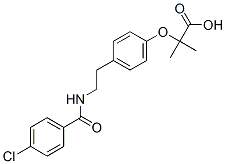
Struttura chimica
Peso molecolare: 361.82
Controllo Qualità (Quality Control)
| Target correlati | Dehydrogenase HSP Transferase P450 (e.g. CYP17) PDE phosphatase Vitamin Carbohydrate Metabolism Mitochondrial Metabolism Casein Kinase |
|---|---|
| Altro PPAR Inibitori | T0070907 GW9662 GW6471 WY-14643 (Pirinixic Acid) GSK3787 GW0742 AZ6102 Palmitoylethanolamide Harmine Daidzein |
Informazioni chimiche, conservazione e stabilità (Chemical Information, Storage & Stability)
| Peso molecolare | 361.82 | Formula | C19H20ClNO4 |
Conservazione (Dalla data di ricezione) | |
|---|---|---|---|---|---|
| N. CAS | 41859-67-0 | Scarica SDF | Conservazione delle soluzioni stock |
|
|
| Sinonimi | BM 15075 | Smiles | CC(C)(C(=O)O)OC1=CC=C(C=C1)CCNC(=O)C2=CC=C(C=C2)Cl | ||
Solubilità (Solubility)
|
In vitro |
DMSO
: 72 mg/mL
(198.99 mM)
Ethanol : 60 mg/mL Water : Insoluble |
Calcolatore di Molarità
|
In vivo |
|||||
Calcolatore di formulazione in vivo (Soluzione chiara)
Passo 1: Inserire le informazioni di seguito (Consigliato: Un animale aggiuntivo per tenere conto della perdita durante l'esperimento)
Passo 2: Inserire la formulazione in vivo (Questo è solo il calcolatore, non la formulazione. Contattateci prima se non c'è una formulazione in vivo nella sezione Solubilità.)
Risultati del calcolo:
Concentrazione di lavoro: mg/ml;
Metodo per preparare il liquido master di DMSO: mg farmaco predissolto in μL DMSO ( Concentrazione del liquido master mg/mL, Vi preghiamo di contattarci prima se la concentrazione supera la solubilità del DMSO del lotto del farmaco. )
Metodo per preparare la formulazione in vivo: Prendere μL DMSO liquido master, quindi aggiungereμL PEG300, mescolare e chiarire, quindi aggiungereμL Tween 80, mescolare e chiarire, quindi aggiungere μL ddH2O, mescolare e chiarire.
Metodo per preparare la formulazione in vivo: Prendere μL DMSO liquido master, quindi aggiungere μL Olio di mais, mescolare e chiarire.
Nota: 1. Si prega di assicurarsi che il liquido sia limpido prima di aggiungere il solvente successivo.
2. Assicurarsi di aggiungere il/i solvente/i in ordine. È necessario assicurarsi che la soluzione ottenuta, nell'aggiunta precedente, sia una soluzione limpida prima di procedere all'aggiunta del solvente successivo. Metodi fisici come il vortex, gli ultrasuoni o il bagno d'acqua calda possono essere utilizzati per facilitare la dissoluzione.
Meccanismo d'azione (Mechanism of Action)
| Targets/IC50/Ki |
PPAR
|
|---|---|
| In vitro |
Bezafibrate is a lipid-lowering fibric acid derivative. This compound binds to xPPARβ with EC50 of 5 μM. It transcriptionally activates the PPARβ of Xenopus with EC50 of 1 μM.
This chemical exposure to rat primary culture of adipocytes for 24 h increases the mRNA levels of crucial genes involved in peroxisomal and mitochondrial β-oxidation. The mRNA levels of the peroxisomal β-oxidation rate-limiting enzyme acyl-CoA oxidase and of the muscle-type carnitine palmitoyl transferase I (M-CPT-I) increases by 1.6-fold and 4.5-fold, respectively. It induces an increase in the transcript levels of the uncoupling protein-2 (UCP-2; 1.5-fold induction) and UCP-3 (3.7-fold induction), mitochondrial proteins that reduce ATP yield and may facilitate the oxidation of fatty acids. Furthermore, this compound increases the mRNA levels of the fatty acid translocase (2-fold induction). It causes a 1.9-fold induction in 9,10-[3H]palmitate oxidation. Moreover, this chemical reduces the mRNA expression of several adipocyte markers, including PPARγ (30% reduction), tumor necrosis factor-α (33% reduction), and the ob gene (26% reduction). The reduction of the adipocyte markers causes by it is accompanied by an increase in the mRNA levels of the preadipocyte marker Pref-1 (1.6-fold induction).
|
| In vivo |
Bezafibrate treatment is able to induce increasing mRNA levels of M-CPT-I (4.5-fold induction), fatty acid translocase (2.6-fold induction) and Pref-1 (5.6-fold induction) in epididymal white adipose tissue of rats. Similarly, increases. This compound feeding causes a significant increase in liver weight in wild-type and PPARβ-null mice compared to controls, while liver weight is unchanged in similarly fed PPAR-α null mice. Gonadal adipose stores are significantly smaller in wild-type and PPARβ-null mice fed this compound than in controls (2.8-fold less and ~2.6-fold less, respectively), and this effect is not found in similarly fed PPARα-null mice. It is able to cause changes of mRNAs encoding lipid metabolizing enzymes (such as AOX , cytochrome P450 4A (CYP4A), LPL, ACS, and LCA D) in wild-type, PPARβ-null mice and PPARα-null mice compared to controls. This chemical is able to induce UCPs expression, and modify energy homeostasis by directly inducing aco gene expression (14.5-fold at 7 days) and peroxisomal fatty acid β-oxidation in white adipose tissue of rats. Further, it significantly reduces plasma triglyceride and leptin concentrations, without modifying the levels of PPARγ or ob gene in white adipose tissue.
|
Riferimenti |
|
Informazioni sullo studio clinico (Clinical Trial Information)
(dati da https://clinicaltrials.gov, aggiornato il 2025-08-27)
| Numero NCT | Reclutamento | Condizioni | Sponsor/Collaboratori | Data di inizio | Fasi |
|---|---|---|---|---|---|
| NCT06443606 | RECRUITING | BPC; Non Optimal Response to UDCA |
Assistance Publique - Hôpitaux de Paris |
2025-03-27 | PHASE3 |
| NCT02481245 | COMPLETED | Bipolar Disorder; Depressive Episode |
Massachusetts General Hospital |
2018-01-11 | PHASE2 |
| NCT06488911 | TERMINATED | Primary Biliary Cholangitis |
Intercept Pharmaceuticals |
2024-07-01 | PHASE3 |
| NCT04594694 | TERMINATED | Primary Biliary Cholangitis |
Intercept Pharmaceuticals |
2019-10-02 | PHASE2 |
| NCT05239468 | COMPLETED | Primary Biliary Cholangitis |
Intercept Pharmaceuticals |
2022-03-21 | PHASE2 |
| NCT04997811 | UNKNOWN | Myelodysplastic Syndromes (MDS) |
Prof. Janet Dunn |
2021-12-21 | PHASE2 |

I prodotti sono solo per uso di ricerca. Non per uso umano. Non vendiamo a pazienti.
©Copyright 2013 Selleck Chemicals. Tutti i diritti riservati.