
solo per uso di ricerca
Belinostat (PXD101) HDAC inibitore
N. Cat.S1085
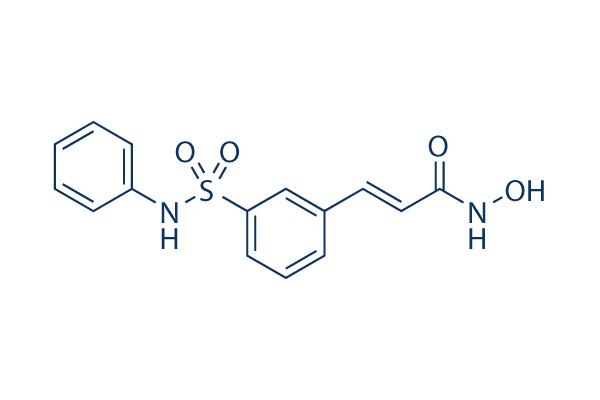
Struttura chimica
Peso molecolare: 318.35
Controllo Qualità
Coltura cellulare, trattamento e concentrazione di lavoro
| Linee cellulari | Tipo di saggio | Concentrazione | Tempo di incubazione | Formulazione | Descrizione dellattività | PMID |
|---|---|---|---|---|---|---|
| HCT116 | Function Assay | 0.9 μM | 24 h | down-regulats TS protein levels after 6 h incubation | 17124594 | |
| HCT116 | Growth Inhibition Assay | 48 h | EC50=0.28 μM | 17124594 | ||
| Granta-519 | Growth Inhibition Assay | 24 h | IC50=56.3 μM | 20068080 | ||
| Jeko-1 | Growth Inhibition Assay | 24 h | IC50=0.2 μM | 20068080 | ||
| HBL-2 | Growth Inhibition Assay | 24 h | IC50=0.4 μM | 20068080 | ||
| Panc-1 | Apoptosis Assay | 100/500/1000 nM | 48 h | induces dose dependent apoptosis | 22681698 | |
| AsPC-1 | Apoptosis Assay | 100/500/1000 nM | 48 h | induces dose dependent apoptosis | 22681698 | |
| T3M4 | Apoptosis Assay | 100/500/1000 nM | 48 h | induces dose dependent apoptosis | 22681698 | |
| Panc-1 | Growth Inhibition Assay | 0-800 nM | 48 h | inhibits cell proliferation in a dose dependent manner | 22681698 | |
| AsPC-1 | Growth Inhibition Assay | 0-800 nM | 48 h | inhibits cell proliferation in a dose dependent manner | 22681698 | |
| T3M4 | Growth Inhibition Assay | 0-800 nM | 48 h | inhibits cell proliferation in a dose dependent manner | 22681698 | |
| MiaPaCa2 | Function Assay | 1/10 μM | 24 h | induces growth arrested in G2/M | 23475695 | |
| AsPc1 | Function Assay | 1/10 μM | 24 h | induces growth arrested in G2/M | 23475695 | |
| Panc0403 | Apoptosis Assay | 1 μM | 24 h | induces apoptosis | 23475695 | |
| Panc1005 | Apoptosis Assay | 1 μM | 24 h | induces apoptosis | 23475695 | |
| Panc0327 | Apoptosis Assay | 1 μM | 24 h | induces apoptosis | 23475695 | |
| Panc0203 | Growth Inhibition Assay | 48 h | EC50=22.2 μM | 23475695 | ||
| PL45 | Growth Inhibition Assay | 48 h | EC50=20.8 μM | 23475695 | ||
| Panc1005 | Growth Inhibition Assay | 48 h | EC50=1.1 μM | 23475695 | ||
| Panc0403 | Growth Inhibition Assay | 48 h | EC50=1.1 μM | 23475695 | ||
| BxPc3 | Growth Inhibition Assay | 48 h | EC50=1.0 μM | 23475695 | ||
| MiaPaCa2 | Growth Inhibition Assay | 48 h | EC50=0.7 μM | 23475695 | ||
| Panc0327 | Growth Inhibition Assay | 48 h | EC50=0.5 μM | 23475695 | ||
| AsPc1 | Growth Inhibition Assay | 48 h | EC50=0.3 μM | 23475695 | ||
| PC9 | Function Assay | 0.5/1/2 μM | 4 h | DMSO | inhibits the levels of Akt (p-Akt) and EGFR | 23515752 |
| H1650 | Function Assay | 0.5/1/2 μM | 4 h | DMSO | inhibits the levels of Akt (p-Akt) and EGFR | 23515752 |
| H460 | Function Assay | 0.5/1/2 μM | 4 h | DMSO | inhibits the levels of Akt (p-Akt) and EGFR | 23515752 |
| PC9 | Function Assay | 500 nM | 24 h | DMSO | decreases EGFR expression | 23515752 |
| H1650 | Function Assay | 500 nM | 24 h | DMSO | decreases EGFR expression | 23515752 |
| H460 | Function Assay | 500 nM | 24 h | DMSO | decreases EGFR expression | 23515752 |
| HCC4006 | Growth Inhibition Assay | 72 h | DMSO | IC50=0.46 μM | 23515752 | |
| HCC2935 | Growth Inhibition Assay | 72 h | DMSO | IC50=0.97 μM | 23515752 | |
| HCC827 | Growth Inhibition Assay | 72 h | DMSO | IC50=0.29 μM | 23515752 | |
| HCC2279 | Growth Inhibition Assay | 72 h | DMSO | IC50=0.4 μM | 23515752 | |
| PC9 | Growth Inhibition Assay | 72 h | DMSO | IC50=0.29 μM | 23515752 | |
| H820 | Growth Inhibition Assay | 72 h | DMSO | IC50=0.4 μM | 23515752 | |
| H1650 | Growth Inhibition Assay | 72 h | DMSO | IC50=0.88 μM | 23515752 | |
| H1975 | Growth Inhibition Assay | 72 h | DMSO | IC50=0.68 μM | 23515752 | |
| H520 | Growth Inhibition Assay | 72 h | DMSO | IC50=0.75 μM | 23515752 | |
| H1299 | Growth Inhibition Assay | 72 h | DMSO | IC50=1.2 μM | 23515752 | |
| H460 | Growth Inhibition Assay | 72 h | DMSO | IC50=0.86 μM | 23515752 | |
| H1666 | Growth Inhibition Assay | 72 h | DMSO | IC50>10 μM | 23515752 | |
| PANC-1 | Function Assay | 10 μM | 2/4 h | DMSO | increases intracellular ROS level | 23743198 |
| PANC-1 | Cell Viability Assay | 1/10 μM | 48 h | DMSO | decreases cell viability in a dose dependent manner | 23743198 |
| PANC-1 | Function Assay | 10 μM | 2/4/6 h | DMSO | induces AMPK activation | 23743198 |
| HL-60 | Function Assay | 0.2 μM | 24/48/72 h | enhances RA-induced granulocytic differentiation | 25864732 | |
| NB4 | Function Assay | 0.2 μM | 24/48/72 h | enhances RA-induced granulocytic differentiation | 25864732 | |
| HL-60 | Function Assay | 2 μM | 24/48 h | blocks cell cycle in S phase | 25864732 | |
| NB4 | Function Assay | 2 μM | 24/48 h | blocks cell cycle in S phase | 25864732 | |
| HL-60 | Cell Viability Assay | 0.2/2 μM | 24/48/72 h | decreases cell viability in both time and dose dependent manner | 25864732 | |
| NB4 | Cell Viability Assay | 0.2/2 μM | 24/48/72 h | decreases cell viability in both time and dose dependent manner | 25864732 | |
| RAW264.7 | Anti-inflammatory assay | 1 hr | Anti-inflammatory activity in LPS-stimulated mouse RAW264.7 cells assessed as suppression of IL6 production pre-incubated for 1 hr before LPS stimulation for 24 hrs by ELISA method, IC50 = 0.000059 μM. | 25113875 | ||
| HEK293 | Function assay | Inhibition of HDAC6 in HEK293 cells, IC50 = 0.015 μM. | 18308563 | |||
| HEK293 | Function assay | Inhibition of HDAC1 in HEK293 cells, IC50 = 0.018 μM. | 18308563 | |||
| HeLa | Function assay | 30 mins | Inhibition of HDAC in human HeLa cells nuclear extracts incubated for 30 mins by fluorescent assay, IC50 = 0.0264 μM. | 25113875 | ||
| HeLa | Function assay | Inhibition of HDAC in human HeLa cells using Fluor de Lys as substrate by fluorescence assay, IC50 = 0.027 μM. | 23639537 | |||
| HeLa | Function assay | Inhibition of HDAC from human HeLa cells, IC50 = 0.028 μM. | 18247554 | |||
| HEK293 | Function assay | Inhibition of HDAC3 in HEK293 cells, IC50 = 0.046 μM. | 18308563 | |||
| MDA-MB-231 | Antiproliferative assay | 72 hrs | Antiproliferative activity against human MDA-MB-231 cells after 72 hrs by resazurin dye based fluorescence assay, IC50 = 0.062 μM. | 29456804 | ||
| Jurkat | Antiproliferative assay | 48 hrs | Antiproliferative activity against human Jurkat cells after 48 hrs by MTT assay, IC50 = 0.07 μM. | 29533873 | ||
| A549 | Antiproliferative assay | 72 hrs | Antiproliferative activity against human A549 cells after 72 hrs by resazurin dye based fluorescence assay, IC50 = 0.077 μM. | 29456804 | ||
| HeLa | Antiproliferative assay | 72 hrs | Antiproliferative activity against human HeLa cells after 72 hrs by resazurin dye based fluorescence assay, IC50 = 0.087 μM. | 29456804 | ||
| MCF7 | Antiproliferative assay | 72 hrs | Antiproliferative activity against human MCF7 cells after 72 hrs by resazurin dye based fluorescence assay, IC50 = 0.096 μM. | 29456804 | ||
| HEL | Antiproliferative assay | 48 hrs | Antiproliferative activity against human HEL cells after 48 hrs by MTT assay, IC50 = 0.1 μM. | 29533873 | ||
| Huh7 | Antiviral assay | 3 days | Antiviral activity against HCV genotype 1b infected in human Huh7 cells after 3 days by luciferase reporter gene assay, EC50 = 0.12 μM. | 25490700 | ||
| HCT116 | Antiproliferative assay | 48 hrs | Antiproliferative activity against human HCT116 cells after 48 hrs by SRB assay, GI50 = 0.13 μM. | 27344487 | ||
| MOLT4 | Antiproliferative assay | 48 hrs | Antiproliferative activity against human MOLT4 cells after 48 hrs by MTT assay, IC50 = 0.14 μM. | 29533873 | ||
| HCT116 | Antiproliferative assay | Antiproliferative activity against human HCT116 cells assessed as growth inhibition, IC50 = 0.16 μM. | 21650221 | |||
| HCT116 | Antiproliferative assay | Antiproliferative activity against human HCT116 cells, IC50 = 0.16 μM. | 21742496 | |||
| SK-N-BE(2) | Antiproliferative assay | 48 hrs | Antiproliferative activity against human SK-N-BE(2) cells after 48 hrs by MTT assay, IC50 = 0.31 μM. | 29533873 | ||
| PC3 | Antiproliferative assay | 48 hrs | Antiproliferative activity against human PC3 cells after 48 hrs by SRB assay, GI50 = 0.39 μM. | 27344487 | ||
| PC3 | Antiproliferative assay | 96 hrs | Antiproliferative activity against human PC3 cells after 96 hrs by celltiter 96 assay, IC50 = 0.45 μM. | 21634430 | ||
| H1299 | Antiproliferative assay | Antiproliferative activity against human H1299 cells, IC50 = 0.46 μM. | 21650221 | |||
| HeLa | Antiproliferative assay | 48 hrs | Antiproliferative activity against human HeLa cells after 48 hrs by MTT assay, IC50 = 0.51 μM. | 29533873 | ||
| HCT116 | Antiproliferative assay | 96 hrs | Antiproliferative activity against human HCT116 cells after 96 hrs by celltiter 96 assay, IC50 = 0.6 μM. | 21634430 | ||
| A2780 | Antiproliferative assay | 96 hrs | Antiproliferative activity against human A2780 cells after 96 hrs by celltiter 96 assay, IC50 = 0.67 μM. | 21634430 | ||
| HuH7 | Cytotoxicity assay | 3 days | Cytotoxicity against human HuH7 cells assessed as inhibition of cell viability after 3 days by CellTiter 96 assay, CC50 = 0.68 μM. | 25490700 | ||
| COLO205 | Antiproliferative assay | 96 hrs | Antiproliferative activity against human COLO205 cells after 96 hrs by celltiter 96 assay, IC50 = 0.7 μM. | 21634430 | ||
| A549 | Antiproliferative assay | 48 hrs | Antiproliferative activity against human A549 cells after 48 hrs by SRB assay, GI50 = 0.78 μM. | 27344487 | ||
| HL60 | Antiproliferative assay | 48 hrs | Antiproliferative activity against human HL60 cells after 48 hrs by SRB assay, GI50 = 1.09 μM. | 27344487 | ||
| K562 | Antiproliferative assay | 48 hrs | Antiproliferative activity against human K562 cells after 48 hrs by MTT assay, IC50 = 1.1 μM. | 29533873 | ||
| PC3 | Antiproliferative assay | 48 hrs | Antiproliferative activity against human PC3 cells after 48 hrs by MTT assay, IC50 = 1.3 μM. | 29533873 | ||
| NFF | Cytotoxicity assay | 72 hrs | Cytotoxicity against human NFF cells after 72 hrs by SRB assay, IC50 = 1.4 μM. | 28241112 | ||
| HEK293 | Cytotoxicity assay | 48 hrs | Cytotoxicity against HEK293 cells after 48 hrs by resazurin assay, IC50 = 1.4 μM. | 28241112 | ||
| NFF | Cytotoxicity assay | 72 hrs | Cytotoxicity against human NFF cells after 72 hrs by sulforhodamine B assay, IC50 = 1.42 μM. | 30245402 | ||
| HEK293 | Cytotoxicity assay | 48 hrs | Cytotoxicity against HEK293 cells after 48 hrs by resazurin dye based assay, IC50 = 1.42 μM. | 30245402 | ||
| RAW264.7 | Anti-inflammatory assay | 1 hr | Anti-inflammatory activity in LPS-stimulated mouse RAW264.7 cells assessed as suppression of nitric oxide production pre-incubated for 1 hr before LPS stimulation for 24 hrs by Griess reagent based assay, IC50 = 2.2 μM. | 25113875 | ||
| RAW264.7 | Anti-inflammatory assay | 1 hr | Anti-inflammatory activity in LPS-stimulated mouse RAW264.7 cells assessed as suppression of TNFalpha production pre-incubated for 1 hr before LPS stimulation for 24 hrs by ELISA method, IC50 = 4.7 μM. | 25113875 | ||
| RAW264.7 | Anti-inflammatory assay | 1 hr | Anti-inflammatory activity in LPS-stimulated mouse RAW264.7 cells assessed as suppression of PGE2 production pre-incubated for 1 hr before LPS stimulation for 24 hrs by enzyme immunoassay method, IC50 = 8.28 μM. | 25113875 | ||
| Huh-luc/neo7 | Function assay | 1 uM | 1 to 3 hrs | Inhibition of HDAC class 1 in human Huh-luc/neo7 cells assessed as histone H3 acetylation at 1 uM after 1 to 3 hrs by Western blotting analysis | 25937017 | |
| PC3 | Function assay | 0.3 uM | 48 hrs | Inhibition of HDAC in human PC3 cells assessed as increase in amount of acetylated histone H3 at 0.3 uM after 48 hrs by Western blot analysis | 27344487 | |
| HCT116 | Function assay | 0.3 uM | 48 hrs | Inhibition of HDAC in human HCT116 cells assessed as increase in amount of acetylated histone H3 at 0.3 uM after 48 hrs by Western blot analysis | 27344487 | |
| Clicca per visualizzare più dati sperimentali sulle linee cellulari | ||||||
Informazioni chimiche, conservazione e stabilità
| Peso molecolare | 318.35 | Formula | C15H14N2O4S |
Conservazione (Dalla data di ricezione) | |
|---|---|---|---|---|---|
| N. CAS | 866323-14-0 | Scarica SDF | Conservazione delle soluzioni stock |
|
|
| Sinonimi | PXD101,NSC726630, PX-105684 | Smiles | C1=CC=C(C=C1)NS(=O)(=O)C2=CC=CC(=C2)C=CC(=O)NO | ||
Solubilità
|
In vitro |
DMSO
: 64 mg/mL
(201.03 mM)
Water : Insoluble Ethanol : Insoluble |
Calcolatore di Molarità
|
In vivo |
|||||
Calcolatore di formulazione in vivo (Soluzione chiara)
Passo 1: Inserire le informazioni di seguito (Consigliato: Un animale aggiuntivo per tenere conto della perdita durante lesperimento)
Passo 2: Inserire la formulazione in vivo (Questo è solo il calcolatore, non la formulazione. Contattateci prima se non cè una formulazione in vivo nella sezione Solubilità.)
Risultati del calcolo:
Concentrazione di lavoro: mg/ml;
Metodo per preparare il liquido master di DMSO: mg farmaco predissolto in μL DMSO ( Concentrazione del liquido master mg/mL, Vi preghiamo di contattarci prima se la concentrazione supera la solubilità del DMSO del lotto del farmaco. )
Metodo per preparare la formulazione in vivo: Prendere μL DMSO liquido master, quindi aggiungereμL PEG300, mescolare e chiarire, quindi aggiungereμL Tween 80, mescolare e chiarire, quindi aggiungere μL ddH2O, mescolare e chiarire.
Metodo per preparare la formulazione in vivo: Prendere μL DMSO liquido master, quindi aggiungere μL Olio di mais, mescolare e chiarire.
Nota: 1. Si prega di assicurarsi che il liquido sia limpido prima di aggiungere il solvente successivo.
2. Assicurarsi di aggiungere il/i solvente/i in ordine. È necessario assicurarsi che la soluzione ottenuta, nellaggiunta precedente, sia una soluzione limpida prima di procedere allaggiunta del solvente successivo. Metodi fisici come il vortex, gli ultrasuoni o il bagno dacqua calda possono essere utilizzati per facilitare la dissoluzione.
Meccanismo dazione
| Caratteristiche |
Lead compound of Topotarget.
|
|---|---|
| Targets/IC50/Ki |
HDAC
(Cell-free assay) 27 nM
|
| In vitro |
Belinostat inibisce la crescita delle cellule tumorali (A2780, HCT116, HT29, WIL, CALU-3, MCF7, PC3 e HS852) con IC50 da 0,2-0,66 μM. PD101 mostra bassa attività nelle cellule A2780/cp70 e 2780AD, che sono derivati di cellule A2780 resistenti al cisplatino e alla doxorubicina. Questo composto potrebbe indurre apoptosi attraverso la scissione di PARP e l'acetilazione degli istoni H3/H4. Inibisce la crescita delle cellule di cancro alla vescica, specialmente nelle cellule 5637, il che mostra accumulo della fase G0-G1, diminuzione della fase S e aumento della fase G2-M. L'attività inibitoria della crescita di questa sostanza chimica sulle linee cellulari non è fortemente influenzata dal fenotipo di resistenza multifarmacologica, mentre l'attività del docetaxel è chiaramente influenzata. Potrebbe migliorare l'attività inibitoria della crescita del docetaxel o del carboplatino nelle cellule OVCAR-3 e A2780. Questo composto mostra anche una maggiore acetilazione della tubulina nelle linee cellulari di cancro ovarico. Uno studio recente mostra che attiva la protein chinasi A in un meccanismo dipendente dalla segnalazione TGF-β e diminuisce l'mRNA della survivina.
|
| Saggio chinasico |
Attività dell'istone deacetilasi
|
|
Le colture subconfluenti vengono raccolte e lavate due volte in PBS ghiacciato e centrifugate a 200 × g per 5 min. Il pellet cellulare viene risospeso in due volumi di tampone di lisi [tampone Tris 60 mM (pH 7.4) contenente 30% di glicerolo e 450 mM NaCl] e lisato mediante tre cicli di congelamento (ghiaccio secco) e scongelamento (bagno d'acqua a 30 °C). I detriti cellulari vengono rimossi mediante centrifugazione a 1.2 × 10⁴ g per 5 min, e il surnatante viene conservato a −80 °C. Il peptide di istone H4 (sequenza SGRGKGGKGLGKGGAKRHRK corrispondente ai 20 residui NH2-terminali) viene acetilato da una proteina ricombinante contenente il dominio ipoxantina-aminopterina-timidina di p300, utilizzando [3H]acetil CoA come fonte di acetato. Il peptide H4 (100 μg) viene miscelato con tampone ipoxantina-aminopterina-timidina (50 mM Tris HCl pH 8.0, 5% glicerolo, 50 mM KCl e 0.1 mM EDTA), 1 mM DTT, 1 mM 4-(2-aminoetil)benzensolfonilfluoruro, 1 × inibitori completi delle proteasi, 50 μL di p300 purificata e 1.85 m [3H]acetil CoA (4.50Ci/mmol) in un volume finale di 300 μL e incubato a 30 °C per 45 min. La proteina p300 viene rimossa mediante incubazione con 20 μL di perle di Ni-agaroasi al 50% per 1 ora a 4 °C e centrifugazione. Il surnatante viene applicato a una colonna Sephadex G15 da 2 mL, e il flusso attraverso viene raccolto. Un millilitro di H2O distillata viene applicato delicatamente, e vengono raccolte tre frazioni di gocce; questo viene ripetuto fino a quando sono stati aggiunti 4–5 mL di H2O distillata, e vengono raccolte ~40 frazioni. Tre microlitri di ciascuna frazione vengono diluiti in 2 mL di liquido di scintillazione e contati in un contatore a scintillazione per identificare le frazioni contenenti il peptide marcato. Queste frazioni vengono raggruppate, e 1 μL del campione combinato viene misurato per valutare la radioattività in ogni lotto di peptide (3-7×10³ cpm/μL). Per i saggi di attività, la reazione viene condotta in un volume totale di 150 μL di tampone [60 mM Tris (pH 7.4) contenente 30% di glicerolo] contenente 2 μL di estratto cellulare e, quando utilizzato, 2 μL di questo composto. La reazione viene avviata con l'aggiunta di 2 μL di substrato marcato con [3H] (peptide di istone H4 acetilato corrispondente ai 20 residui NH2-terminali). I campioni vengono incubati a 37 °C per 45 min, e la reazione viene interrotta con l'aggiunta di HCl e acido acetico (concentrazioni finali rispettivamente di 0.72 e 0.12 M). L'acetato [3H] rilasciato viene estratto in 750 μL di acetato di etile, e i campioni vengono centrifugati a 1.2 × 10⁴ g per 5 min. La fase superiore (600 μL) viene trasferita a 3 mL di liquido di scintillazione e contata.
|
|
| In vivo |
Belinostat indica un significativo ritardo della crescita tumorale in xenotrapianti A2780 e A2780/cp70 a una dose di 10mg/kg senza effetti sul peso corporeo. Questo composto induce anche p21WAF1, HDAC core e geni di comunicazione cellulare nei tumori della vescica del topo. La sua monoterapia induce effetti antitumorali dose-proporzionali con un TGI del 47% a una dose di 100mg/kg in xenotrapianti A2780. La combinazione di questa sostanza chimica (100 mg/kg) con carboplatino (40 mg/kg) potrebbe ritardare la crescita tumorale da 18,6 giorni a 22,5 giorni. In combinazione con bortezomib, si traduce in una grande inibizione tumorale e tossicità gastrointestinale nei topi con xenotrapianto UMSCC-11A resistente al bortezomib.
|
Riferimenti |
|
Applicazioni
| Metodi | Biomarcatori | Immagini | PMID |
|---|---|---|---|
| Western blot | p-H2AX(Ser139) / KU70 / KU80 / RAD51 / RAD52 / ERCC1 Acetyl Histone H3 / Acetyl Histone H4 / Acetyl tubulin p21 / p27 SOS1 / SOS2 PARP / p-ERK / p-p38 / p38 / p-BRAF / p-MEK / MEK |

|
24155971 |
| Growth inhibition assay | Cell viability IC50 |
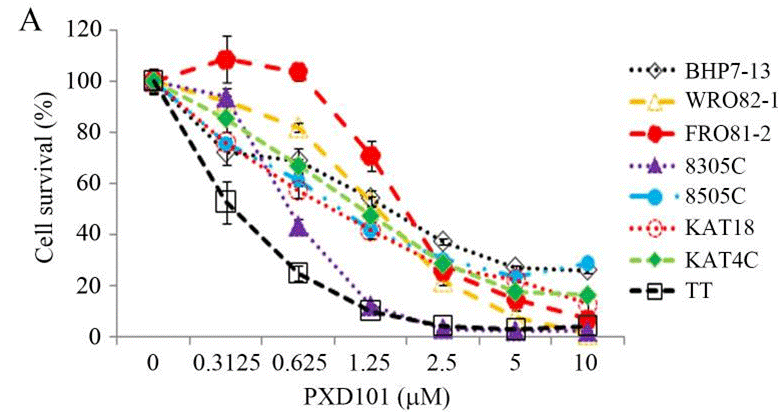
|
24155971 |
Informazioni sullo studio clinico
(dati da https://clinicaltrials.gov, aggiornato il 2024-05-22)
| Numero NCT | Reclutamento | Condizioni | Sponsor/Collaboratori | Data di inizio | Fasi |
|---|---|---|---|---|---|
| NCT06406465 | Not yet recruiting | Carcinoma Neuroendocrine|Tumor Neuroendocrine|Tumors Neuroendocrine|Neuroendocrine; Carcinoma|Small Cell; Receptors |
National Cancer Institute (NCI)|National Institutes of Health Clinical Center (CC) |
May 15 2024 | Phase 2 |
| NCT04315233 | Recruiting | Metastatic Breast Cancer|Recurrent Ovarian Carcinoma |
University of Utah|Novartis|Acrotech Biopharma |
May 3 2021 | Phase 1 |
| NCT04703920 | Recruiting | Metastatic Breast Cancer|Metastatic Castration-resistant Prostate Cancer|Metastatic Ovarian Carcinoma |
University of Michigan Rogel Cancer Center|Pfizer|Acrotech Biopharma Inc. |
March 4 2021 | Phase 1 |
| NCT03772925 | Active not recruiting | Recurrent Acute Myeloid Leukemia|Recurrent Myelodysplastic Syndrome|Refractory Acute Myeloid Leukemia|Refractory Myelodysplastic Syndrome |
National Cancer Institute (NCI) |
June 20 2019 | Phase 1 |
Supporto tecnico
Istruzioni per la manipolazione
Tel: +1-832-582-8158 Ext:3
Per qualsiasi altra domanda, si prega di lasciare un messaggio.
Domande Frequenti
Domanda 1:
Could you please give some suggestions for the use of it in vivo (i.p. injection)?
Risposta:
For I.P. injection, it can be dissolved in 2% DMSO+30% PEG 300+ddH2O at 10 mg/ml clearly. When preparing the solution, please dissolve this compound in DMSO clearly first. Then add PEG, after they mixed well, then dilute with water. Hope this information is useful to you.

I prodotti sono solo per uso di ricerca. Non per uso umano. Non vendiamo a pazienti.
©Copyright 2013 Selleck Chemicals. Tutti i diritti riservati.