
solo per uso di ricerca
BMS-536924 IGF-1R Inibitore
N. Cat.: S1012
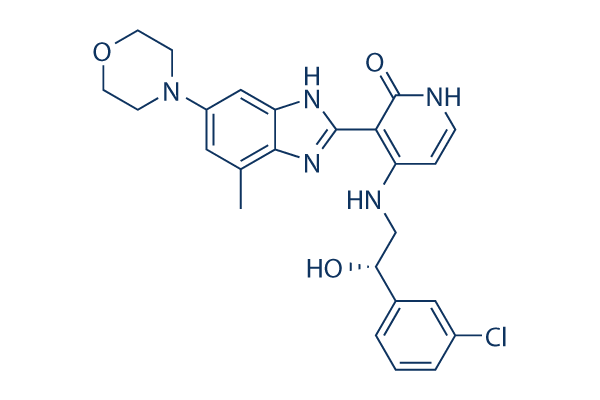
Struttura chimica
Peso molecolare: 479.96
Controllo Qualità (Quality Control)
| Target correlati | EGFR VEGFR FGFR PDGFR c-Met Src MEK CSF-1R FLT3 HER2 |
|---|---|
| Altro IGF-1R Inibitori | Linsitinib (OSI-906) NVP-AEW541 BMS-754807 Picropodophyllin (AXL1717) AG-1024 GSK1904529A NVP-ADW742 NT157 PQ 401 MSDC-0160 |
Informazioni chimiche, conservazione e stabilità (Chemical Information, Storage & Stability)
| Peso molecolare | 479.96 | Formula | C25H26ClN5O3 |
Conservazione (Dalla data di ricezione) | |
|---|---|---|---|---|---|
| N. CAS | 468740-43-4 | Scarica SDF | Conservazione delle soluzioni stock |
|
|
| Sinonimi | CS-0117 | Smiles | CC1=CC(=CC2=C1N=C(N2)C3=C(C=CNC3=O)NCC(C4=CC(=CC=C4)Cl)O)N5CCOCC5 | ||
Solubilità (Solubility)
|
In vitro |
DMSO
: 96 mg/mL
(200.01 mM)
Water : Insoluble Ethanol : Insoluble |
Calcolatore di Molarità
|
In vivo |
|||||
Calcolatore di formulazione in vivo (Soluzione chiara)
Passo 1: Inserire le informazioni di seguito (Consigliato: Un animale aggiuntivo per tenere conto della perdita durante l'esperimento)
Passo 2: Inserire la formulazione in vivo (Questo è solo il calcolatore, non la formulazione. Contattateci prima se non c'è una formulazione in vivo nella sezione Solubilità.)
Risultati del calcolo:
Concentrazione di lavoro: mg/ml;
Metodo per preparare il liquido master di DMSO: mg farmaco predissolto in μL DMSO ( Concentrazione del liquido master mg/mL, Vi preghiamo di contattarci prima se la concentrazione supera la solubilità del DMSO del lotto del farmaco. )
Metodo per preparare la formulazione in vivo: Prendere μL DMSO liquido master, quindi aggiungereμL PEG300, mescolare e chiarire, quindi aggiungereμL Tween 80, mescolare e chiarire, quindi aggiungere μL ddH2O, mescolare e chiarire.
Metodo per preparare la formulazione in vivo: Prendere μL DMSO liquido master, quindi aggiungere μL Olio di mais, mescolare e chiarire.
Nota: 1. Si prega di assicurarsi che il liquido sia limpido prima di aggiungere il solvente successivo.
2. Assicurarsi di aggiungere il/i solvente/i in ordine. È necessario assicurarsi che la soluzione ottenuta, nell'aggiunta precedente, sia una soluzione limpida prima di procedere all'aggiunta del solvente successivo. Metodi fisici come il vortex, gli ultrasuoni o il bagno d'acqua calda possono essere utilizzati per facilitare la dissoluzione.
Meccanismo d'azione (Mechanism of Action)
| Targets/IC50/Ki |
Insulin Receptor
73 nM
IGF-1R
100 nM
FAK
150 nM
MEK
182 nM
LCK
341 nM
VEGFR2
1.4 μM
EGF
1.6 μM
Met
4.87 μM
|
|---|---|
| In vitro |
BMS-536924 also inhibits FAK and Lck with IC50 of 150 nM and 341 nM, respectively. This compound inhibits cellular proliferation and disrupts Akt and MAPK phosphorylation. It inhibits IGF-I-stimulated IGF-1R signaling in MCF10A cells and blocks constitutive IGF-1R activity in CD8-IGF-1R-MCF10A. Preincubation of MCF10A cells with 1 μM of this chemical completely blocks the ability of IGF-I to stimulate IGF-1R phosphorylation. IGF-I stimulation results in increased phosphorylation of ERK1/2, GSK3β, and Akt. This compound inhibits this ligand-induced phosphorylation. Treatment of the CD8-IGF-1R-MCF10A cells with this inhibitor results in a dose-dependent inhibition of phosphorylation with partial inhibition at 0.01 μM and 0.1 μM, but complete receptor inhibition at a concentration of 1 μM. Maximal inhibition of phosphorylated IGF-1R is observed as early as 10 minutes following incubation. It retains its ability to inhibit IGF-1R phosphorylation for up to 48 hours. Addition of this agent time-dependently inhibits Akt phosphorylation starting at 1 hour. By 48 hours, Akt activation is completely blocked. Treatment with this compound shows antiproliferation activity in a panel of cancer cell lines including TC32, HT1080/S, SK-LMS-1, H513 and CTR cells. pIGF-1R/pIR is activated upon IGF-I/insulin stimulation and the activation is inhibited by this chemical at similar potencies in Rh41 and Rh36 cell lines. The expression of programmed cell death 4 (PDCD4), cleavage of poly(ADP-ribose) polymerase (PARP) and caspase-3 are up-regulated in Rh41 cells treated with this inhibitor.
|
| Saggio chinasico |
Attività della via IGF-I
|
|
1 × 10⁶ cellule pBabe-MCF10A vengono seminate in piastre da 60 mm. Dopo 24 ore, il terreno viene cambiato con terreno privo di siero e incubato durante la notte a 37 °C per 24 ore. Le cellule vengono quindi preincubate con o senza 1 μM di BMS-536924 per 1 ora in terreno privo di siero, seguita da stimolazione con IGF-I (50 ng/mL) per 10 minuti. I monostrati cellulari vengono lavati due volte con PBS e raccolti per l'analisi immunoblot.
|
|
| In vivo |
Oral administration of BMS-536924 at 100-300 mpk strongly inhibits IGR-1R Sal tumor model. Efficacy is also observed in the nonengineered Colo205 human colon carcinoma mode. Oral administration of this compound on a once a day schedule (100-300 mpk) or a twice a day schedule (50, 100 mpk) demonstrates antitumor activity in this tumor model. Oral glucose tolerance test (OGTT) shows 100 mpk (b.i.d.) causes a significant elevation in glucose levels after glucose challenge. The pharmacokinetic parameters of this chemical, administered orally in poly(ethylene glycol) 400 and water (80:20 v/v), are determined in mouse, rat, dog, and monkey. Good bioavailability is evident in all species. Significant nonlinear pharmacokinetics is observed in rodents at increasing p.o. dose. This compound reduces the tumor xenografts volume of CD8-IGF-1R-MCF10A cells after two weeks' treatment (100mg/kg) to 76%. Oral administration of 70 mg/kg this chemical significantly inhibits tumor growth (TGBC-1TKB cells) inoculated in nude mice. It up regulates apoptosis in xenografts tumors. The treatment doesn't have adverse effects on the body weight of mice or the glucose levels at the time of death, suggesting tolerable toxicity.
|
Riferimenti |
|
Domande Frequenti (Frequently Asked Questions)
Domanda 1:
What are the differences between it and S1034?
Risposta:
The most remarkable difference between these two IGF-IR inhibitors is that S1012 is an ATP-competitive inhibitor. You will get more information about the differences between IR inhibitors in this reference: http://www.sciencedirect.com/science/article/pii/S1359644605035129.

I prodotti sono solo per uso di ricerca. Non per uso umano. Non vendiamo a pazienti.
©Copyright 2013 Selleck Chemicals. Tutti i diritti riservati.