
solo per uso di ricerca
LDN-193189 Dihydrochloride Inibitore della segnalazione BMP
N. Cat.S7507
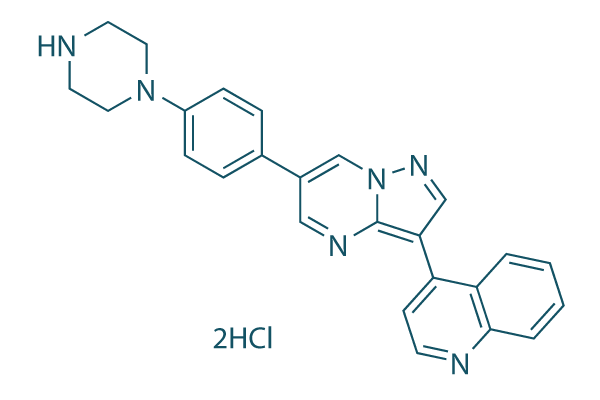
Struttura chimica
Peso molecolare: 479.4
Controllo Qualità
| Target correlati | PKC ROCK Bcr-Abl |
|---|---|
| Altro TGF-beta/Smad Inibitori | RepSox (E-616452) Vactosertib (TEW-7197) LDN-193189 A-83-01 Galunisertib (LY2157299) SRI-011381 (C381) LY2109761 SIS3 Hydrochloride SB-525334 DMH1 |
Coltura cellulare, trattamento e concentrazione di lavoro
| Linee cellulari | Tipo di saggio | Concentrazione | Tempo di incubazione | Formulazione | Descrizione dellattività | PMID |
|---|---|---|---|---|---|---|
| EOC216 | Cell viability assay | 0.1, 1, 2, 5, 10 μM | 1, 3, 5, 7, 9 days | exhibited a dose dependent LDN-induced decrease in viability | 25227893 | |
| PC3 | Function assay | 500 nM | LDN-193189 repressed activation of Smad1/5/8, and also repressed P-Smad3 levels | 22452883 | ||
| C2C12 | Function assay | 0.5 μM | 1 day | LDN-193189 promotes myogenesis | 25368322 | |
| C2C12 | Function assay | 30 mins | Inhibition of BMP6-induced ALK2 transcriptional activity in mouse C2C12 cells expressing BRE-Luc after 30 mins by luciferase reporter gene assay, EC50 = 0.014 μM. | 30227946 | ||
| BT-12 | qHTS assay | qHTS of pediatric cancer cell lines to identify multiple opportunities for drug repurposing: Primary screen for BT-12 cells | 29435139 | |||
| fibroblast cells | qHTS assay | qHTS of pediatric cancer cell lines to identify multiple opportunities for drug repurposing: Primary screen for control Hh wild type fibroblast cells | 29435139 | |||
| Rh30 | qHTS assay | qHTS of pediatric cancer cell lines to identify multiple opportunities for drug repurposing: Primary screen for Rh30 cells | 29435139 | |||
| C2C12 | Function assay | 0.1 uM | Inhibition of ALK5 in mouse C2C12 cells assessed as decrease in TGFbeta1-induced Smad1/5 phosphorylation at 0.1 uM by Western blot method | 28103025 | ||
| Clicca per visualizzare più dati sperimentali sulle linee cellulari | ||||||
Informazioni chimiche, conservazione e stabilità
| Peso molecolare | 479.4 | Formula | C25H24Cl2N6 |
Conservazione (Dalla data di ricezione) | |
|---|---|---|---|---|---|
| N. CAS | 1435934-00-1 | -- | Conservazione delle soluzioni stock |
|
|
| Sinonimi | DM-3189 2HCl | Smiles | C1CN(CCN1)C2=CC=C(C=C2)C3=CN4C(=C(C=N4)C5=CC=NC6=CC=CC=C56)N=C3.Cl.Cl | ||
Solubilità
|
In vitro |
Water : 24 mg/mL
DMSO
: 12 mg/mL
(25.03 mM)
Ethanol : Insoluble |
Calcolatore di Molarità
|
In vivo |
|||||
Calcolatore di formulazione in vivo (Soluzione chiara)
Passo 1: Inserire le informazioni di seguito (Consigliato: Un animale aggiuntivo per tenere conto della perdita durante lesperimento)
Passo 2: Inserire la formulazione in vivo (Questo è solo il calcolatore, non la formulazione. Contattateci prima se non cè una formulazione in vivo nella sezione Solubilità.)
Risultati del calcolo:
Concentrazione di lavoro: mg/ml;
Metodo per preparare il liquido master di DMSO: mg farmaco predissolto in μL DMSO ( Concentrazione del liquido master mg/mL, Vi preghiamo di contattarci prima se la concentrazione supera la solubilità del DMSO del lotto del farmaco. )
Metodo per preparare la formulazione in vivo: Prendere μL DMSO liquido master, quindi aggiungereμL PEG300, mescolare e chiarire, quindi aggiungereμL Tween 80, mescolare e chiarire, quindi aggiungere μL ddH2O, mescolare e chiarire.
Metodo per preparare la formulazione in vivo: Prendere μL DMSO liquido master, quindi aggiungere μL Olio di mais, mescolare e chiarire.
Nota: 1. Si prega di assicurarsi che il liquido sia limpido prima di aggiungere il solvente successivo.
2. Assicurarsi di aggiungere il/i solvente/i in ordine. È necessario assicurarsi che la soluzione ottenuta, nellaggiunta precedente, sia una soluzione limpida prima di procedere allaggiunta del solvente successivo. Metodi fisici come il vortex, gli ultrasuoni o il bagno dacqua calda possono essere utilizzati per facilitare la dissoluzione.
Meccanismo dazione
| Caratteristiche |
Selective BMP type I receptor inhibitor.
|
|---|---|
| Targets/IC50/Ki |
ALK1
(Cell-free assay) 0.8 nM
ALK2
(Cell-free assay) 0.8 nM
ALK3
(Cell-free assay) 5.3 nM
ALK6
(Cell-free assay) 16.7 nM
|
| In vitro |
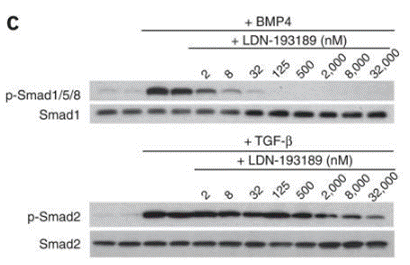
LDN193189 inibisce potentemente l'attivazione di Smad1, Smad5 e Smad8 mediata da BMP4 con IC50 di 5 nM, e inibisce efficacemente l'attività trascrizionale dei recettori BMP di tipo I ALK2 e ALK3 con IC50 di 5 nM e 30 nM, rispettivamente. Inoltre, LDN193189 mostra anche un effetto inibitorio sull'attività trascrizionale indotta da proteine mutanti ALK2R206H o ALK2Q207D costitutivamente attive. Uno studio recente mostra che LDN-193189 blocca la produzione di specie reattive dell'ossigeno indotte da LDL ossidato durante l'aterogenesi nelle cellule endoteliali aortiche umane. |
| Saggio chinasico |
Attività della fosfatasi alcalina
|
|
Le cellule C2C12 vengono seminate in piastre da 96 pozzetti a 2.000 cellule per pozzetto in DMEM integrato con 2% di FBS. I pozzetti vengono trattati in quadruplicato con ligandi BMP e LDN-193189 o veicolo. Le cellule vengono raccolte dopo 6 giorni di coltura in 50 μL di soluzione salina tamponata con Tris e 1% di Triton X-100. I lisati vengono aggiunti al reagente p-nitro-fenilfosfato in piastre da 96 pozzetti per 1 ora e quindi viene valutata l'attività della fosfatasi alcalina (assorbanza a 405 nm). La vitalità e la quantità cellulare vengono misurate con Cell Titer Aqueous One (assorbanza a 490 nm), utilizzando pozzetti replicati trattati in modo identico a quelli utilizzati per le misurazioni della fosfatasi alcalina.
|
|
| In vivo |
In topi transgenici caALK2 condizionali con Ad.Cre al giorno postnatale 7 (P7), LDN-193189 (3 mg/kg i.p.) porta a lievi calcificazioni intorno alla tibia e al perone sinistri, visibili per la prima volta a P13, e previene le lesioni radiografiche a P15 senza causare perdita di peso o ritardo della crescita, fratture spontanee, diminuzione della densità ossea o anomalie comportamentali. LDN193189 dorsalizza gli embrioni di pesce zebra inibendo le vie di segnalazione indotte dalla proteina morfogenetica ossea (BMP)6 senza effetti sullo sviluppo vascolare. In topi portatori di tumore PCa-118b, il trattamento con LDN-193189 attenua la crescita tumorale e riduce la formazione ossea nei tumori. In topi con deficienza del recettore LDL (LDLR-/-), LDN-193189 inibisce potentemente lo sviluppo dell'ateroma. Inoltre, LDN-193189 mostra anche effetti inibitori sull'infiammazione vascolare associata, sull'attività osteogenica e sulla calcificazione. |
Riferimenti |
|
Applicazioni
| Metodi | Biomarcatori | Immagini | PMID |
|---|---|---|---|
| Western blot | pSmad Smad / ID1 / PARP / Cleaved PARP |
|
19029982 |
Supporto tecnico
Istruzioni per la manipolazione
Tel: +1-832-582-8158 Ext:3
Per qualsiasi altra domanda, si prega di lasciare un messaggio.

I prodotti sono solo per uso di ricerca. Non per uso umano. Non vendiamo a pazienti.
©Copyright 2013 Selleck Chemicals. Tutti i diritti riservati.