
solo per uso di ricerca
Abemaciclib (LY2835219) inibitore di CDK4/6
N. Cat.S5716
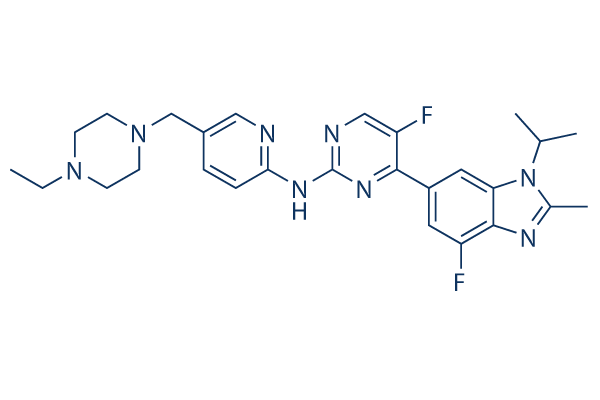
Struttura chimica
Peso molecolare: 506.59
Controllo Qualità
Coltura cellulare, trattamento e concentrazione di lavoro
| Linee cellulari | Tipo di saggio | Concentrazione | Tempo di incubazione | Formulazione | Descrizione dellattività | PMID |
|---|---|---|---|---|---|---|
| COLO205 cells | Function assay | 24 h | Inhibition of CDK4/6 in human COLO205 cells assessed as inhibition of Rb phosphorylation after 24 hrs by propidium iodide staining-based laser-scanning fluorescence microplate cytometric analysis, IC50=0.12 μM | 26115571 | ||
| SK-ES-1 | Proliferation assay | 96 hours | antiproliferative effects with an absolute EC50 value below 1 μmol/L | 30131386 | ||
| Cado-ES-1 | Proliferation assay | 96 hours | antiproliferative effects with an absolute EC50 value below 1 μmol/L | 30131386 | ||
| ES-7 | Proliferation assay | 96 hours | antiproliferative effects with an absolute EC50 value below 1 μmol/L | 30131386 | ||
| TC-71 | Proliferation assay | 96 hours | antiproliferative effects with an absolute EC50 value below 1 μmol/L | 30131386 | ||
| A673 | Proliferation assay | 96 hours | antiproliferative effects with an absolute EC50 value below 1 μmol/L | 30131386 | ||
| RD-ES | Proliferation assay | 96 hours | antiproliferative effects with an absolute EC50 value below 1 μmol/L | 30131386 | ||
| ES-1 | Proliferation assay | 96 hours | antiproliferative effects with an absolute EC50 value below 1 μmol/L | 30131386 | ||
| ES-3 | Proliferation assay | 96 hours | antiproliferative effects with an absolute EC50 value below 1 μmol/L | 30131386 | ||
| CHLA-258 | Proliferation assay | 96 hours | antiproliferative effects with an absolute EC50 value below 1 μmol/L | 30131386 | ||
| MHH-ES-1 | Proliferation assay | 96 hours | antiproliferative effects with an absolute EC50 value below 1 μmol/L | 30131386 | ||
| ES-8 | Proliferation assay | 96 hours | antiproliferative effects with an absolute EC50 value below 1 μmol/L | 30131386 | ||
| EW8 | Proliferation assay | 96 hours | antiproliferative effects with an absolute EC50 value below 1 μmol/L | 30131386 | ||
| ES-6 | Proliferation assay | 96 hours | antiproliferative effects with an absolute EC50 value below 1 μmol/L | 30131386 | ||
| ES-2 | Proliferation assay | 96 hours | antiproliferative effects with an absolute EC50 value below 1 μmol/L | 30131386 | ||
| SMS-CTR | Proliferation assay | 96 hours | antiproliferative effects with an absolute EC50 value below 1 μmol/L | 30131386 | ||
| ES-4 | Proliferation assay | 96 hours | antiproliferative effects with an absolute EC50 value below 1 μmol/L | 30131386 | ||
| CT26 | Cell viability assay | 96 hours | IC50=2.7 μM | 29539425 | ||
| insect cells | Function assay | 50 mins | Competitive inhibition of human CDK4/cyclin D1 expressed in insect cells assessed as phosphorylation of CTRF after 50 mins by Michaelis-Menten plot analysis in presence of ATP, Ki = 0.0006 μM. | 26115571 | ||
| insect cells | Function assay | 50 mins | Inhibition of human CDK4/cyclin D1 expressed in insect cells assessed as phosphorylation of CTRF after 50 mins by microplate scintillation counter, IC50 = 0.002 μM. | 26115571 | ||
| COLO205 | Function assay | 24 hrs | Inhibition of CDK4/6 in human COLO205 cells assessed as maximum cell cycle arrest at G1 phase after 24 hrs by propidium iodide staining-based flow cytometric analysis, INH = 6.7 μM. | 26115571 | ||
| Sf9 | Function assay | Inhibition of CDK1/Cyclin B (unknown origin) expressed in baculoviral infected insect Sf9 cells using histone H1 as substrate in presence of [gamma-33P]ATP, IC50 = 0.371 μM. | 26741853 | |||
| Sf9 | Function assay | 90 mins | Inhibition of recombinant human N-terminal GST-tagged CDK4 (4 to 303 residues)/cyclin D1 (4 to 295 residues) expressed in sf9 cells using C-terminal retinoblastoma fragment as substrate after 90 mins by [gamma-33P]ATP based microbeta scintillation countin, Ki = 0.002 μM. | 27171036 | ||
| Sf9 | Function assay | 90 mins | Inhibition of recombinant full length human N-terminal GST-tagged CDK6 (1 to 326 residues)/cyclin D1 (4 to 295 residues) expressed in sf9 cells using C-terminal retinoblastoma fragment as substrate after 90 mins by [gamma-33P]ATP based microbeta scintilla, Ki = 0.01 μM. | 27171036 | ||
| Sf21 | Function assay | Inhibition of recombinant human full length C-terminal His6-tagged CDK7/cyclin H/N-terminal GST-tagged MAT1 expressed in baculovirus infected Sf21 insect cells using cdk7 substrate peptide, Ki = 3.91 μM. | 27171036 | |||
| COLO205 | Antiproliferative assay | 96 hrs | Antiproliferative activity against human COLO205 cells after 96 hrs by CCK-8 assay, IC50 = 0.46 μM. | 29074254 | ||
| U87MG | Antiproliferative assay | 72 hrs | Antiproliferative activity against human U87MG cells after 72 hrs by DAPI staining based assay, IC50 = 0.0481 μM. | 29247857 | ||
| Sf9 | Function assay | Inhibition of recombinant human N-terminal GST-tagged CDK4 (S4 to E303 residues)/Cyclin D1 (Q4 to I295 residues) expressed in sf9 cells using Rb protein (773 to 928 residues) as substrate in presence of [33P]-ATP by scintillation counting method, IC50 = 0.002 μM. | 29429832 | |||
| Sf9 | Function assay | 90 mins | Inhibition of recombinant human full length CDK6 expressed in baculovirus infected Sf9 insect cells using histone H1 substrate after 90 mins by ADP-Glo assay, IC50 = 0.0078 μM. | 29429832 | ||
| Sf9 | Function assay | Inhibition of recombinant human N-terminal GST-tagged CDK4 (M1 to A326 residues)/Cyclin D1 (Q4 to I295 residues) expressed in sf9 cells using Rb protein (773 to 928 residues) as substrate in presence of [33P]-ATP by scintillation counting method, IC50 = 0.01 μM. | 29429832 | |||
| Sf9 | Function assay | 90 mins | Inhibition of recombinant human full length CDK1/Cyclin D3 expressed in baculovirus infected Sf9 insect cells using histone H1 substrate after 90 mins by ADP-Glo assay, IC50 = 0.056 μM. | 29429832 | ||
| MDA-MB-231 | Antiproliferative assay | 72 hrs | Antiproliferative activity against human MDA-MB-231 cells after 72 hrs by DAPI staining based assay, IC50 = 0.191 μM. | 29429832 | ||
| COLO205 | Antiproliferative assay | 96 hrs | Antiproliferative activity against human COLO205 cells after 96 hrs by CCK8 assay, IC50 = 0.217 μM. | 29459274 | ||
| MDA-MB-468 | Antiproliferative assay | 96 hrs | Antiproliferative activity against human MDA-MB-468 cells after 96 hrs by CCK8 assay, IC50 = 4.808 μM. | 29459274 | ||
| COLO205 | Function assay | 0.1 to 10 uM | 24 hrs | Inhibition of CDK4 in human COLO205 cells assessed as reduction in total Rb protein level at 0.1 to 10 uM after 24 hrs by immunoblotting method | 29459274 | |
| COLO205 | Cell cycle arrest assay | up to 10 uM | 24 hrs | Cell cycle arrest in human COLO205 cells assessed as accumulation at G2/M phase up to 10 uM after 24 hrs by propidium iodide staining based FACS analysis | 29459274 | |
| Clicca per visualizzare più dati sperimentali sulle linee cellulari | ||||||
Informazioni chimiche, conservazione e stabilità
| Peso molecolare | 506.59 | Formula | C27H32F2N8 |
Conservazione (Dalla data di ricezione) | 3 years -20°C powder |
|---|---|---|---|---|---|
| N. CAS | 1231929-97-7 | -- | Conservazione delle soluzioni stock |
|
|
| Sinonimi | LY2835219 | Smiles | CCN1CCN(CC1)CC2=CN=C(C=C2)NC3=NC=C(C(=N3)C4=CC5=C(C(=C4)F)N=C(N5C(C)C)C)F | ||
Solubilità
|
In vitro |
Ethanol : 8 mg/mL
DMSO
: 6 mg/mL
(11.84 mM)
Water : Insoluble |
Calcolatore di Molarità
|
In vivo |
|||||
Calcolatore di formulazione in vivo (Soluzione chiara)
Passo 1: Inserire le informazioni di seguito (Consigliato: Un animale aggiuntivo per tenere conto della perdita durante lesperimento)
Passo 2: Inserire la formulazione in vivo (Questo è solo il calcolatore, non la formulazione. Contattateci prima se non cè una formulazione in vivo nella sezione Solubilità.)
Risultati del calcolo:
Concentrazione di lavoro: mg/ml;
Metodo per preparare il liquido master di DMSO: mg farmaco predissolto in μL DMSO ( Concentrazione del liquido master mg/mL, Vi preghiamo di contattarci prima se la concentrazione supera la solubilità del DMSO del lotto del farmaco. )
Metodo per preparare la formulazione in vivo: Prendere μL DMSO liquido master, quindi aggiungereμL PEG300, mescolare e chiarire, quindi aggiungereμL Tween 80, mescolare e chiarire, quindi aggiungere μL ddH2O, mescolare e chiarire.
Metodo per preparare la formulazione in vivo: Prendere μL DMSO liquido master, quindi aggiungere μL Olio di mais, mescolare e chiarire.
Nota: 1. Si prega di assicurarsi che il liquido sia limpido prima di aggiungere il solvente successivo.
2. Assicurarsi di aggiungere il/i solvente/i in ordine. È necessario assicurarsi che la soluzione ottenuta, nellaggiunta precedente, sia una soluzione limpida prima di procedere allaggiunta del solvente successivo. Metodi fisici come il vortex, gli ultrasuoni o il bagno dacqua calda possono essere utilizzati per facilitare la dissoluzione.
Meccanismo dazione
| Targets/IC50/Ki |
CDK4
(Cell-free assay) 2 nM
CDK6
(Cell-free assay) 10 nM
|
|---|---|
| In vitro |
Abemaciclib inibisce in modo altamente selettivo i complessi CDK4/ciclina D1 (IC50 = 2 nmol/L) e CDK6/ciclina D1 (IC50 = 10 nmol/L), senza attività contro altri complessi CDK/ciclina o chinasi correlate al Cell Cycle all'interno degli intervalli nanomolari, ad eccezione dell'inibizione di CDK9 a una IC50 almeno cinque volte superiore. Oltre all'attività dipendente dal Cell Cycle, abemaciclib è in grado di potenziare l'immunità antitumorale potenziando la presentazione degli antigeni tumorali e sopprimendo selettivamente la proliferazione delle cellule T regolatorie (Treg) allo stesso tempo. In linea con la sua attività contro CDK4 e CDK6, abemaciclib inibisce la fosforilazione di RB e porta all'arresto in G1 in linee cellulari RB-efficienti. In vitro, il trattamento con abemaciclib ha determinato una maggiore attivazione delle cellule T umane e un'espressione regolata al rialzo dei geni di presentazione degli antigeni nelle cellule di carcinoma mammario MCF-7.
|
| In vivo |
In un modello di xenotrapianto di cancro colorettale utilizzato per sviluppare un modello farmacocinetico/farmacodinamico integrato, abemaciclib può essere dosato per via orale con un programma continuo per ottenere un'inibizione del bersaglio sostenuta e dimostra non solo un'inibizione duratura del Cell Cycle, ma anche un'attività antitumorale come agente singolo. L'inibizione della crescita tumorale è osservata in numerosi altri modelli di xenotrapianto di cancro umano, inclusi quelli derivati da carcinoma polmonare non a piccole cellule (NSCLC), melanoma, glioblastoma e linfoma a cellule mantellari. Abemaciclib si distribuisce attraverso la barriera emato-encefalica e prolunga la sopravvivenza in un modello di xenotrapianto di glioblastoma intracranico. Nell'uomo, la farmacocinetica di abemaciclib mostra una fase di assorbimento lenta con un tempo mediano dalla dose orale alla concentrazione plasmatica massima (tmax) che varia da 4 a 6 ore. Viene ampiamente eliminato e distribuito. L'emivita di eliminazione terminale media (t1/2) variava da 17,4 a 38,1 ore senza alcun apparente cambiamento dose-dipendente nella clearance.
|
Riferimenti |
|
Applicazioni
| Metodi | Biomarcatori | Immagini | PMID |
|---|---|---|---|
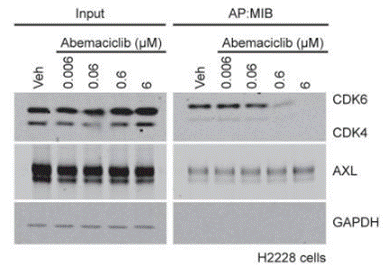
| Western blot | CDK6 / CDK4 / AXL GSK3β / CAMKII pan β-catenin p-Rb / Rb / p-EGFR / EGFR / p-HER2 / HER2 / p-HER3 / HER3 / p-P70S6K / P70S6K / p-S6RP / S6RP / Cyclin D1 |
|
29133594 |
Informazioni sullo studio clinico
(dati da https://clinicaltrials.gov, aggiornato il 2024-05-22)
| Numero NCT | Reclutamento | Condizioni | Sponsor/Collaboratori | Data di inizio | Fasi |
|---|---|---|---|---|---|
| NCT06139107 | Recruiting | Breast Cancer |
Mridula George MD|Rutgers The State University of New Jersey |
June 21 2024 | Phase 1 |
| NCT06259929 | Not yet recruiting | Breast Cancer |
Fondazione Oncotech |
April 1 2024 | Phase 2 |
Supporto tecnico
Istruzioni per la manipolazione
Tel: +1-832-582-8158 Ext:3
Per qualsiasi altra domanda, si prega di lasciare un messaggio.

I prodotti sono solo per uso di ricerca. Non per uso umano. Non vendiamo a pazienti.
©Copyright 2013 Selleck Chemicals. Tutti i diritti riservati.