
solo per uso di ricerca
ON123300 CDK Inibitore
N. Cat.: S8161
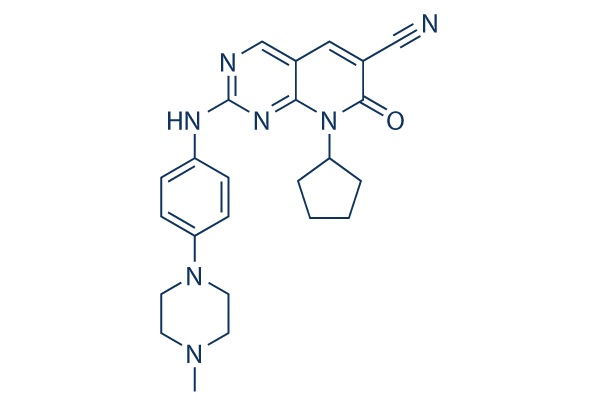
Struttura chimica
Peso molecolare: 429.52
Controllo Qualità (Quality Control)
Informazioni chimiche, conservazione e stabilità (Chemical Information, Storage & Stability)
| Peso molecolare | 429.52 | Formula | C24H27N7O |
Conservazione (Dalla data di ricezione) | |
|---|---|---|---|---|---|
| N. CAS | 1357470-29-1 | Scarica SDF | Conservazione delle soluzioni stock |
|
|
| Sinonimi | N/A | Smiles | CN1CCN(CC1)C2=CC=C(C=C2)NC3=NC=C4C=C(C(=O)N(C4=N3)C5CCCC5)C#N | ||
Solubilità (Solubility)
|
In vitro |
DMSO
: 29 mg/mL
(67.51 mM)
Water : Insoluble Ethanol : Insoluble |
Calcolatore di Molarità
|
In vivo |
|||||
Calcolatore di formulazione in vivo (Soluzione chiara)
Passo 1: Inserire le informazioni di seguito (Consigliato: Un animale aggiuntivo per tenere conto della perdita durante l'esperimento)
Passo 2: Inserire la formulazione in vivo (Questo è solo il calcolatore, non la formulazione. Contattateci prima se non c'è una formulazione in vivo nella sezione Solubilità.)
Risultati del calcolo:
Concentrazione di lavoro: mg/ml;
Metodo per preparare il liquido master di DMSO: mg farmaco predissolto in μL DMSO ( Concentrazione del liquido master mg/mL, Vi preghiamo di contattarci prima se la concentrazione supera la solubilità del DMSO del lotto del farmaco. )
Metodo per preparare la formulazione in vivo: Prendere μL DMSO liquido master, quindi aggiungereμL PEG300, mescolare e chiarire, quindi aggiungereμL Tween 80, mescolare e chiarire, quindi aggiungere μL ddH2O, mescolare e chiarire.
Metodo per preparare la formulazione in vivo: Prendere μL DMSO liquido master, quindi aggiungere μL Olio di mais, mescolare e chiarire.
Nota: 1. Si prega di assicurarsi che il liquido sia limpido prima di aggiungere il solvente successivo.
2. Assicurarsi di aggiungere il/i solvente/i in ordine. È necessario assicurarsi che la soluzione ottenuta, nell'aggiunta precedente, sia una soluzione limpida prima di procedere all'aggiunta del solvente successivo. Metodi fisici come il vortex, gli ultrasuoni o il bagno d'acqua calda possono essere utilizzati per facilitare la dissoluzione.
Meccanismo d'azione (Mechanism of Action)
| Targets/IC50/Ki |
CDK4/CyclinD1
(Cell-free assay) 3.87 nM
ARK5
(Cell-free assay) 4.95 nM
RET
(Cell-free assay) 9.2 nM
CDK6/CyclinD1
(Cell-free assay) 9.82 nM
Fyn
(Cell-free assay) 11 nM
PDGFRβ
(Cell-free assay) 26 nM
FGFR1
(Cell-free assay) 26 nM
PI3Kδ
(Cell-free assay) 144 nM
FGFR1
(Cell-free assay) 260 nM
|
|---|---|
| In vitro |
ON123300 inhibits U87 glioma cell proliferation with an IC50 3.4±0.1 μmol/L and reduces phosphorylation of Akt, yet it also unexpectedly induces Erk activation, both in a dose- and time-dependent manner that subsequently is attributed to relieving Akt mediated C-Raf S259 inactivation and activating a p70S6K-initiated PI3K-negative feedback loop. This compound also inhibits CDK4/6 and PI3K-δ and exhibits potent activity against mantle cell lymphomas (MCLs). It is a potent inhibitor of CDK4, with an IC50 of 3.8 nM, with little inhibitory activity against CDKs 1,2,5 and 8. MCL cell lines treated with this chemical accumulate in the G1 phase at lower concentrations (0.1-1.0μM), at higher concentrations of the compound, a large proportion of the cells progress through the S and G2/M phases of the cell cycle and eventually accumulate in the sub-G1 phase, suggesting an induction of apoptosis. It also inhibits the phosphorylation of pRb and p130 in a dose-dependent manner. This treatment results in inhibition of FOXO1 phosphorylation, a target of mTOR. |
| In vivo |
In a preclinical brain tumor model (U87MG), ON123300 shows high brain and brain tumor accumulation. Consistent with the in vitro studies, single agent this compound causes a dose-dependent suppression of phosphorylation of Akt as well as activation of Erk in brain tumors. It is highly bound (99.4%) to plasma proteins in mice and rapidly penetrates into brain. It has proficient BBB penetration and accumulates in normal brain. The pharmacokinetic profiles of plasma this chemical concentration are multiexponential and overall declines fairly rapidly with terminal elimination half-lives of 1.5 hours. Mouse xenograft assays show a strong inhibition of MCL tumor growth in this compound-treated animals. Safety studies in mice suggest that it is orally bio-available and is minimally toxic when administered orally or intraperitoneally. |
Riferimenti |
|
Informazioni sullo studio clinico (Clinical Trial Information)
(dati da https://clinicaltrials.gov, aggiornato il 2023-12-12)
| Numero NCT | Reclutamento | Condizioni | Sponsor/Collaboratori | Data di inizio | Fasi |
|---|---|---|---|---|---|
| NCT05705505 | UNKNOWN | Endometrioid Endometrial Cancer |
Traws Pharma, Inc. |
2023-03-29 | PHASE1; PHASE2 |
| NCT06351644 | TERMINATED | Relapsed and/or Refractory Multiple Myeloma |
Adriana Rossi |
2024-10-02 | PHASE1; PHASE2 |
| NCT04739293 | UNKNOWN | Solid Tumors, Adult |
Traws Pharma, Inc. |
2021-05-13 | PHASE1 |
| NCT06351644 | Not yet recruiting | Relapsed and/or Refractory Multiple Myeloma |
Adriana Rossi|Icahn School of Medicine at Mount Sinai |
2024-06-03 | Phase 1|Phase 2 |
| NCT04739293 | Recruiting | Solid Tumors Adult |
Traws Pharma Inc. |
2021-05-13 | Phase 1 |

I prodotti sono solo per uso di ricerca. Non per uso umano. Non vendiamo a pazienti.
©Copyright 2013 Selleck Chemicals. Tutti i diritti riservati.