
solo per uso di ricerca
Piceatannol Syk Inibitore
N. Cat.: S3026
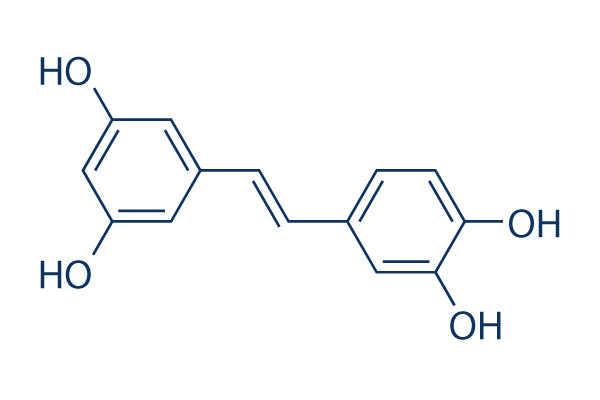
Struttura chimica
Peso molecolare: 244.24
Controllo Qualità (Quality Control)
| Target correlati | EGFR VEGFR JAK FGFR PDGFR Src HIF FLT3 HER2 FLT |
|---|---|
| Altro Syk Inibitori | R406 R406 (free base) PRT062607 (P505-15) HCl Entospletinib (GS-9973) BAY 61-3606 dihydrochloride PRT-060318 2HCl TAK-659 Hydrochloride Lanraplenib (GS-SYK) RO9021 R112 |
Coltura cellulare, trattamento e concentrazione di lavoro
(Cell Culture, Treatment & Working Concentration)
| Linee cellulari | Tipo di saggio | Concentrazione | Tempo di incubazione | Formulazione | Descrizione dell'attività | PMID |
|---|---|---|---|---|---|---|
| human lung mast cells | Function assay | Inhibition of SYK in human lung mast cells assessed as reduction in anti-IgE-stimulated histamine release, EC50=25 μM | ||||
| human A2780 cells | Proliferation assay | 2 days | Antiproliferative activity against human A2780 cells after 2 days by Alamar Blue assay, IC50=41 μM | |||
| mouse 3T3L1 cells | Function assay | 10 to 50 μM | 48 h | Reduction in triglyceride level in mouse 3T3L1 cells at 10 to 50 uM after 48 hrs | ||
| Clicca per visualizzare più dati sperimentali sulle linee cellulari | ||||||
Informazioni chimiche, conservazione e stabilità (Chemical Information, Storage & Stability)
| Peso molecolare | 244.24 | Formula | C14H12O4 |
Conservazione (Dalla data di ricezione) | |
|---|---|---|---|---|---|
| N. CAS | 10083-24-6 | Scarica SDF | Conservazione delle soluzioni stock |
|
|
| Sinonimi | Astringenin | Smiles | C1=CC(=C(C=C1C=CC2=CC(=CC(=C2)O)O)O)O | ||
Solubilità (Solubility)
|
In vitro |
DMSO
: 48 mg/mL
(196.52 mM)
Ethanol : 48 mg/mL Water : Insoluble |
Calcolatore di Molarità
|
In vivo |
|||||
Calcolatore di formulazione in vivo (Soluzione chiara)
Passo 1: Inserire le informazioni di seguito (Consigliato: Un animale aggiuntivo per tenere conto della perdita durante l'esperimento)
Passo 2: Inserire la formulazione in vivo (Questo è solo il calcolatore, non la formulazione. Contattateci prima se non c'è una formulazione in vivo nella sezione Solubilità.)
Risultati del calcolo:
Concentrazione di lavoro: mg/ml;
Metodo per preparare il liquido master di DMSO: mg farmaco predissolto in μL DMSO ( Concentrazione del liquido master mg/mL, Vi preghiamo di contattarci prima se la concentrazione supera la solubilità del DMSO del lotto del farmaco. )
Metodo per preparare la formulazione in vivo: Prendere μL DMSO liquido master, quindi aggiungereμL PEG300, mescolare e chiarire, quindi aggiungereμL Tween 80, mescolare e chiarire, quindi aggiungere μL ddH2O, mescolare e chiarire.
Metodo per preparare la formulazione in vivo: Prendere μL DMSO liquido master, quindi aggiungere μL Olio di mais, mescolare e chiarire.
Nota: 1. Si prega di assicurarsi che il liquido sia limpido prima di aggiungere il solvente successivo.
2. Assicurarsi di aggiungere il/i solvente/i in ordine. È necessario assicurarsi che la soluzione ottenuta, nell'aggiunta precedente, sia una soluzione limpida prima di procedere all'aggiunta del solvente successivo. Metodi fisici come il vortex, gli ultrasuoni o il bagno d'acqua calda possono essere utilizzati per facilitare la dissoluzione.
Meccanismo d'azione (Mechanism of Action)
| Targets/IC50/Ki |
Syk
(Cell-free assay) Lyn
(Cell-free assay) cAK
(Cell-free assay) 3 μM
PKC
(Cell-free assay) 8 μM
MLCK
(Cell-free assay) 12 μM
CDPK
(Cell-free assay) 19 μM
|
|---|---|
| In vitro |
Piceatannol displays ~10-fold selectivity for Syk over Lyn. This compound treatment in RBL-2H3 cells strongly inhibits the antigen-stimulated phosphorylation of Syk and of most other cellular proteins but not the receptor β or γ subunit, in a dose-dependent manner. It is also a potent inhibitor of histamine release in mast cells. Selective inhibition of Syk by this chemical blocks receptor-mediated down-stream cellular responses in mast cells including prevention of 1,4,5-IP3 synthesis, secretion and membrane ruffling and spreading. This compound also potently inhibits PKA, PKC, MLCK, and CDPK with IC50 of 3 μM, 8 μM, 12 μM, and 19 μM, respectively. It selectively prevents the IFNα-induced tyrosine phosphorylation of STAT3 and -5 but not STAT1 and -2, paralleled by the loss of Jak1 and IFNAR1 tyrosine phosphorylation but not Tyk2 and IFNAR2. This chemical potently induces apoptotic cell death in BJAB Burkitt-like lymphoma cells with ED50 of 25 μM, through the activation of caspase-3 and mitochondrial permeability transition independent of the CD95/Fas signaling pathway. It inhibits NF-κB activation induced by TNF, H2O2, PMA, LPS, okadaic acid, and ceramide. This compound suppresses the expression of TNF-induced NF-κB-dependent reporter gene and of matrix metalloprotease-9, cyclooxygenase-2, and cyclin D1 independent of Syk kinase, by blocking TNF-induced IκBα phosphorylation, p65 phosphorylation, p65 nuclear translocation, and IκBα kinase activation. It directly binds with PI3K in an ATP-competitive manner, and suppresses PI3K activity with anti-atherosclerotic effects more effectively than resveratrol. This chemical inhibits androgen-dependent (AD) and androgen-independent (AI) CaP cell proliferation, which is accompanied by reduced expression of mTOR and its key effectors AKT and eIF4EBP-1.
|
| Saggio chinasico |
Saggi di Proteina-Tirosina Chinasi In Vitro
|
|
La Syk ricombinante è espressa in cellule St9 infettate da baculovirus. I saggi dell'attività di Syk ricombinante vengono eseguiti utilizzando il peptide angiotensina I come substrato. Le attività enzimatiche della Syk ricombinante sono misurate dalla fosforilazione del peptide angiotensina I in presenza di varie concentrazioni di questo composto.
|
|
| In vivo |
Oral administration of Piceatannol induces a remarkable amelioration of the disruption of the colonic architecture, a significant reduction in colonic myeloperoxidase (MPO) activity, and a decrease in production of inflammatory mediators such as nitric oxide (NO), prostaglandin (PG) E2, and pro-inflammatory cytokines in BALB/c mice with dextran sulfate sodium (DSS)-induced colitis. This compound treatment inhibits the rises in blood glucose levels at early stages and improves the impaired glucose tolerance at late stages in type 2 diabetic model db/db mice.
|
Riferimenti |
|
Informazioni sullo studio clinico (Clinical Trial Information)
(dati da https://clinicaltrials.gov, aggiornato il 2023-11-14)
| Numero NCT | Reclutamento | Condizioni | Sponsor/Collaboratori | Data di inizio | Fasi |
|---|---|---|---|---|---|
| NCT06127381 | UNKNOWN | Acute Respiratory Distress Syndrome (ARDS) |
Gamaleya Research Institute of Epidemiology and Microbiology, Health Ministry of the Russian Federation |
2023-11 | PHASE1 |

I prodotti sono solo per uso di ricerca. Non per uso umano. Non vendiamo a pazienti.
©Copyright 2013 Selleck Chemicals. Tutti i diritti riservati.