
solo per uso di ricerca
R406 Inibitore di Syk/FLT3
N. Cat.S2194
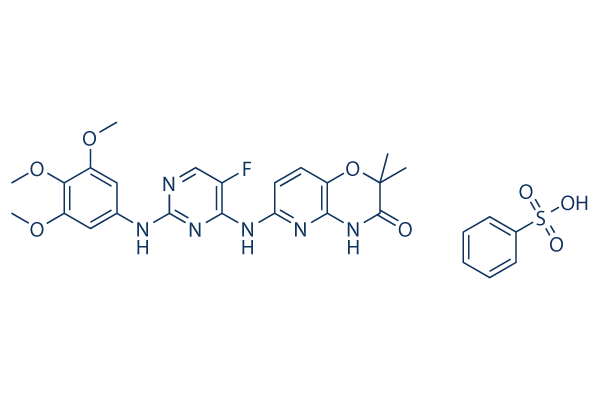
Struttura chimica
Peso molecolare: 628.63
Controllo Qualità
| Target correlati | EGFR VEGFR JAK PDGFR FGFR Src HIF FLT FLT3 HER2 |
|---|---|
| Altro Syk Inibitori | R406 (free base) PRT062607 (P505-15) HCl Entospletinib (GS-9973) Piceatannol BAY 61-3606 dihydrochloride PRT-060318 2HCl TAK-659 Hydrochloride Lanraplenib (GS-SYK) RO9021 R112 |
Coltura cellulare, trattamento e concentrazione di lavoro
| Linee cellulari | Tipo di saggio | Concentrazione | Tempo di incubazione | Formulazione | Descrizione dellattività | PMID |
|---|---|---|---|---|---|---|
| AMO-1 | Function Assay | 1 μM | 3 h | reduces migration | 26251761 | |
| U266 | Function Assay | 1 μM | 3 h | reduces migration | 26251761 | |
| Jeko-1 | Growth Inhibition Assay | 48 h | IC50=5.06826 μM | 25835755 | ||
| Mino | Growth Inhibition Assay | 48 h | IC50=5.70854 μM | 25835755 | ||
| Jeko-1 | Apoptosis Assay | 5 μM | 24 h | induces 25.1 ± 3.2 % apoptosis | 25835755 | |
| primary MCL | Apoptosis Assay | 2 µM | 24 h | increases significantly apoptosis | 25388373 | |
| PBMCs | Cell Viability Assay | 0-50 μM | 24 h | DMSO | inhibits cell viability dose dependently | 25127862 |
| PBMCs | Function Assay | 5 μM | 1 h | DMSO | decreases the cell migration | 25127862 |
| CFSE-CD4+ T | Growth Inhibition Assay | 0.0625-1 μM | 4 d | blocks proliferation of GVHD-derived CD4+ T cells and CD11b+ cells | 24679982 | |
| CFSE-CD11b+ | Growth Inhibition Assay | 0.0625-1 μM | 8 d | blocks proliferation of GVHD-derived CD4+ T cells and CD11b+ cells | 24679982 | |
| HMECs | Function Assay | 0-10 μM | 20 min | inhibits VEGF-stimulated release of NO | 24329544 | |
| AB5 | Apoptosis Assay | 0-2.5 μM | 48 h | DMSO | induces apoptosis | 23398911 |
| JB7 | Apoptosis Assay | 0-2.5 μM | 48 h | DMSO | induces apoptosis | 23398911 |
| AB5 | Growth Inhibition Assay | 0-2.5 μM | 48 h | DMSO | induces cell cycle arrest | 23398911 |
| JB7 | Growth Inhibition Assay | 0-2.5 μM | 48 h | DMSO | induces cell cycle arrest | 23398911 |
| RL | Function Assay | 2.5/5 μM | 24/48 h | DMSO | induces a potent decrease in MMP-9 mRNA expression | 21926965 |
| RL | Function Assay | 1/2.5 μM | 24 h | DMSO | reduces the activation of Akt and p70S6K | 21926965 |
| platelet | Function Assay | 1 μm | 5 min | inhibits FcγRIIA-mediated platelet aggregation | 21848694 | |
| platelet | Function Assay | 0.05/1/2.5 μM | 5 min | inhibits the signaling mechanisms downstream of FcγRIIA | 21848694 | |
| DoHH2 | Apoptosis Assay | 0/3/10 μM | 48 h | induces cell death significantly | 20875408 | |
| Jeko-1 | Apoptosis Assay | 0/3/10 μM | 48 h | induces cell death significantly | 20875408 | |
| Raji | Apoptosis Assay | 0/3/10 μM | 48 h | induces cell death significantly | 20875408 | |
| DHL4 | Apoptosis Assay | 0/1/4 μM | 96 h | induces apoptosis dose dependently | 18006696 | |
| LY7 | Apoptosis Assay | 0/1/4 μM | 96 h | induces apoptosis dose dependently | 18006696 | |
| LY3 | Apoptosis Assay | 0/1/4 μM | 96 h | induces apoptosis dose dependently | 18006696 | |
| DHL6 | Apoptosis Assay | 0/1/4 μM | 96 h | induces apoptosis dose dependently | 18006696 | |
| LY10 | Apoptosis Assay | 0/1/4 μM | 96 h | induces apoptosis dose dependently | 18006696 | |
| DHL10 | Apoptosis Assay | 0/1/4 μM | 96 h | induces apoptosis dose dependently | 18006696 | |
| Wsu-NHL | Apoptosis Assay | 0/1/4 μM | 96 h | induces apoptosis dose dependently | 18006696 | |
| LY18 | Apoptosis Assay | 0/1/4 μM | 96 h | induces apoptosis dose dependently | 18006696 | |
| LY1 | Apoptosis Assay | 0/1/4 μM | 96 h | induces apoptosis dose dependently | 18006696 | |
| DHL8 | Apoptosis Assay | 0/1/4 μM | 96 h | induces apoptosis dose dependently | 18006696 | |
| DHL4 | Apoptosis Assay | 4 μM | 96 h | induces cleavage of caspases 9 and 3, but not caspase 8 | 18006696 | |
| DHL6 | Apoptosis Assay | 4 μM | 96 h | induces cleavage of caspases 9 and 3, but not caspase 8 | 18006696 | |
| LY3 | Apoptosis Assay | 4 μM | 96 h | induces cleavage of caspases 9 and 3, but not caspase 8 | 18006696 | |
| LY7 | Apoptosis Assay | 4 μM | 96 h | induces cleavage of caspases 9 and 3, but not caspase 8 | 18006696 | |
| DHL4 | Function Assay | 4 μM | 16 h | inhibits tonic BLNK tyrosine phosphorylation | 18006696 | |
| LY7 | Function Assay | 4 μM | 16 h | inhibits tonic BLNK tyrosine phosphorylation | 18006696 | |
| LY3 | Function Assay | 4 μM | 16 h | inhibits tonic BLNK tyrosine phosphorylation | 18006696 | |
| DHL6 | Function Assay | 4 μM | 16 h | inhibits tonic BLNK tyrosine phosphorylation | 18006696 | |
| LY10 | Function Assay | 4 μM | 16 h | inhibits tonic BLNK tyrosine phosphorylation | 18006696 | |
| Wsu-NHL | Function Assay | 4 μM | 16 h | inhibits tonic BLNK tyrosine phosphorylation | 18006696 | |
| LY18 | Function Assay | 4 μM | 16 h | inhibits tonic BLNK tyrosine phosphorylation | 18006696 | |
| MV411 | Function assay | 72 hrs | Inhibition of Flt3 in human MV411 cells assessed as assessed as proliferation after 72 hrs incubation by spectrophotometry, EC50=0.01μM. | 24779514 | ||
| TF1 | Function assay | 1 hr | Inhibition of Jak2 in erythropoietin-stimulated human TF1 cells assessed as assessed as phospho-Stat5 after 1 hr incubation, EC50=0.013μM. | 24779514 | ||
| neutrophils | Function assay | Inhibition of SYK in human neutrophils cells assessed as reduction in FcepsilonR1/FcgammaR-mediated signaling responses, EC50=0.033μM. | 22257213 | |||
| SK-M-MC | Function assay | 1 hr | Inhibition of Ret in human SK-M-MC cells assessed as assessed as phosphorylation after 1 hr incubation, EC50=0.036μM. | 24779514 | ||
| mast cells | Function assay | 1 hr | Inhibition of cKit in stem cell factor-stimulated bone marrow derived mouse mast cells assessed as phosphorylation after 1 hr incubation, EC50=0.046μM. | 24779514 | ||
| B-cells | Function assay | Inhibition of SYK in human B-cells cells assessed as reduction in FcepsilonR1/FcgammaR-mediated signaling responses, EC50=0.048μM. | 22257213 | |||
| Ramos | Function assay | Inhibition of Syk in antihuman IgM-stimulated human Ramos cells assessed as decrease in BCR-mediated BLNK phosphorylation by cellular assay, EC50=0.053μM. | 24779514 | |||
| mesangial cells | Function assay | Inhibition of SYK in cultured human mesangial cells assessed as reduction in FcepsilonR1/FcgammaR-mediated signaling responses, EC50=0.056μM. | 22257213 | |||
| SK-N-SH | Function assay | Inhibition of Ret in human SK-N-SH cells, EC50=0.08μM. | 22257213 | |||
| mouse bone marrow cells | Function assay | Inhibition of IL3 dependent proliferation in C57/B16 mouse bone marrow cells using [3H]thymidine by liquid scintillation counting, IC50=0.147μM. | 24726806 | |||
| B-cells | Function assay | 1 hr | Inhibition of Syk in alphaIgM-stimulated human B cells assessed as cell proliferation after 1 hr incubation by flow cytometry, EC50=0.151μM. | 24779514 | ||
| THP1 | Function assay | Inhibition of SYK in human THP1 cells assessed as reduction in FcepsilonR1/FcgammaR-mediated signaling responses, EC50=0.171μM. | 22257213 | |||
| B-cells | Function assay | 1 hr | Inhibition of Syk in alphaIgM-stimulated human B cells assessed as CD86 expression after 1 hr incubation by flow cytometry, EC50=0.335μM. | 24779514 | ||
| Ramos | Function assay | Inhibition of Syk in anti IgM-stimulated human Ramos cells assessed as BLNK phosphorylation by cellular assay, IC50=0.457μM. | 24726806 | |||
| Rec1 | Function assay | 2.5 uM | 6 hrs | Inhibition of BTK phosphorylation in human Rec1 cells at 2.5 uM incubated for 6 hrs by Western blotting method | 25222877 | |
| Rec1 | Function assay | 2.5 uM | 6 hrs | Inhibition of Syk phosphorylation in human Rec1 cells at 2.5 uM incubated for 6 hrs by Western blotting method | 25222877 | |
| Rec1 | Function assay | 2.5 uM | 6 hrs | Inhibition of Lyn phosphorylation in human Rec1 cells at 2.5 uM incubated for 6 hrs by Western blotting method | 25222877 | |
| SJ-GBM2 | qHTS assay | qHTS of pediatric cancer cell lines to identify multiple opportunities for drug repurposing: Primary screen for SJ-GBM2 cells | 29435139 | |||
| A673 | qHTS assay | qHTS of pediatric cancer cell lines to identify multiple opportunities for drug repurposing: Primary screen for A673 cells | 29435139 | |||
| SK-N-MC | qHTS assay | qHTS of pediatric cancer cell lines to identify multiple opportunities for drug repurposing: Primary screen for SK-N-MC cells | 29435139 | |||
| NB-EBc1 | qHTS assay | qHTS of pediatric cancer cell lines to identify multiple opportunities for drug repurposing: Primary screen for NB-EBc1 cells | 29435139 | |||
| Saos-2 | qHTS assay | qHTS of pediatric cancer cell lines to identify multiple opportunities for drug repurposing: Primary screen for Saos-2 cells | 29435139 | |||
| OHS-50 | qHTS assay | qHTS of pediatric cancer cell lines to identify multiple opportunities for drug repurposing: Primary screen for OHS-50 cells | 29435139 | |||
| Rh41 | qHTS assay | qHTS of pediatric cancer cell lines to identify multiple opportunities for drug repurposing: Primary screen for Rh41 cells | 29435139 | |||
| Clicca per visualizzare più dati sperimentali sulle linee cellulari | ||||||
Informazioni chimiche, conservazione e stabilità
| Peso molecolare | 628.63 | Formula | C22H23FN6O5.C6H6O3S |
Conservazione (Dalla data di ricezione) | |
|---|---|---|---|---|---|
| N. CAS | 841290-81-1 | Scarica SDF | Conservazione delle soluzioni stock |
|
|
| Sinonimi | R406 besylate | Smiles | CC1(C(=O)NC2=C(O1)C=CC(=N2)NC3=NC(=NC=C3F)NC4=CC(=C(C(=C4)OC)OC)OC)C.C1=CC=C(C=C1)S(=O)(=O)O | ||
Solubilità
|
In vitro |
DMSO
: 100 mg/mL
(159.07 mM)
Water : Insoluble Ethanol : 0 mg/mL |
Calcolatore di Molarità
|
In vivo |
|||||
Calcolatore di formulazione in vivo (Soluzione chiara)
Passo 1: Inserire le informazioni di seguito (Consigliato: Un animale aggiuntivo per tenere conto della perdita durante lesperimento)
Passo 2: Inserire la formulazione in vivo (Questo è solo il calcolatore, non la formulazione. Contattateci prima se non cè una formulazione in vivo nella sezione Solubilità.)
Risultati del calcolo:
Concentrazione di lavoro: mg/ml;
Metodo per preparare il liquido master di DMSO: mg farmaco predissolto in μL DMSO ( Concentrazione del liquido master mg/mL, Vi preghiamo di contattarci prima se la concentrazione supera la solubilità del DMSO del lotto del farmaco. )
Metodo per preparare la formulazione in vivo: Prendere μL DMSO liquido master, quindi aggiungereμL PEG300, mescolare e chiarire, quindi aggiungereμL Tween 80, mescolare e chiarire, quindi aggiungere μL ddH2O, mescolare e chiarire.
Metodo per preparare la formulazione in vivo: Prendere μL DMSO liquido master, quindi aggiungere μL Olio di mais, mescolare e chiarire.
Nota: 1. Si prega di assicurarsi che il liquido sia limpido prima di aggiungere il solvente successivo.
2. Assicurarsi di aggiungere il/i solvente/i in ordine. È necessario assicurarsi che la soluzione ottenuta, nellaggiunta precedente, sia una soluzione limpida prima di procedere allaggiunta del solvente successivo. Metodi fisici come il vortex, gli ultrasuoni o il bagno dacqua calda possono essere utilizzati per facilitare la dissoluzione.
Meccanismo dazione
| Caratteristiche |
Lead drug candidate for rheumatoid arthritis.
|
|---|---|
| Targets/IC50/Ki |
Flt3
(Cell-free assay) Syk
(Cell-free assay) 41 nM
|
| In vitro |
R406 è un potente inibitore dell'attivazione della segnalazione del recettore Fc mediata da immunoglobulina E (IgE) e IgG. Questo composto inibisce la produzione e il rilascio indotti da anti-IgE di LTC4 e di citochine e chemochine, inclusi TNFα, IL-8 e GM-CSF. Inibisce la fosforilazione del linker del substrato di Syk per l'attivazione delle cellule T nei mastociti e della proteina linker delle cellule B/SLP65 nelle cellule B. Questa sostanza chimica si lega alla tasca di legame dell'ATP di Syk e inibisce la sua attività chinasica come inibitore competitivo dell'ATP con Ki di 30 nM. Blocca l'attivazione di monociti/macrofagi e neutrofili mediata da FcR Syk-dipendente e l'attivazione di linfociti B mediata da Bcr. Questo composto induce significativamente l'apoptosi delle cellule di leucemia linfatica cronica (LLC) in coculture di cellule nutrici e blocca la secrezione di CCL3 e CCL4 da parte delle cellule LLC in risposta all'attivazione del recettore dell'antigene delle cellule B (Bcr). È un potente inibitore della segnalazione e delle funzioni piastriniche avviate dal cross-linking di FcγRIIA da anticorpi specifici o da sieri di pazienti con HIT. |
| Saggio chinasico |
Saggio chinasico di polarizzazione di fluorescenza in vitro
|
|
R406 viene diluito in serie in DMSO e quindi diluito all'1% di DMSO in tampone chinasico (20 mM HEPES, pH 7,4, 5 mM MgCl2, 2 mM MnCl2, 1 mM DTT, 0,1 mg/mL BGG acetilato). ATP e substrato in tampone chinasico vengono aggiunti a temperatura ambiente, risultando in una concentrazione finale di DMSO dello 0,2%. Le reazioni chinasiche vengono eseguite in un volume finale di 20 µL contenente 5 mM di substrato peptidico HS1, 4 mM di ATP e avviate con l'aggiunta di 0,125 ng di Syk in tampone chinasico. La reazione è lasciata procedere per 40 minuti a temperatura ambiente. La reazione viene interrotta con l'aggiunta di 20 µL di miscela di quenching PTK contenente EDTA/anticorpo anti-fosfotirosina (1X finale)/tracciante fosfopeptidico fluorescente (0,5X finale) diluita in tampone di diluizione FP. La piastra viene incubata per 30 minuti al buio a temperatura ambiente e quindi letta su un lettore di piastre a polarizzazione di fluorescenza Polarion. I dati vengono convertiti in quantità di fosfopeptide presente utilizzando una curva di calibrazione generata per competizione con il competitore fosfopeptidico fornito nel kit di saggio tirosina chinasi. Per la determinazione dell'IC50, questo composto viene testato a undici concentrazioni e l'adattamento della curva viene eseguito mediante analisi di regressione non lineare.
|
|
| In vivo |
R406 riduce la reazione di Arthus passiva inversa cutanea di circa l'86% a 5 mg/kg nei topi trattati profilatticamente. Questo composto mostra anche efficacia nell'inibire l'infiammazione della zampa in modelli murini di artrite indotta da anticorpi. Non influisce negativamente sulla funzione dei macrofagi o dei neutrofili nelle risposte immunitarie innate e ha una tossicità immunitaria funzionale minima nonostante il suo effetto linfocitopenico. |
Riferimenti |
|
Applicazioni
| Metodi | Biomarcatori | Immagini | PMID |
|---|---|---|---|
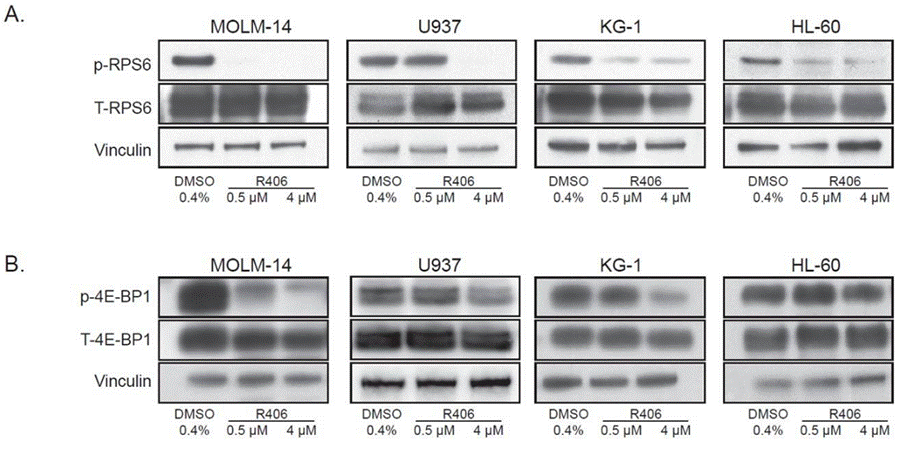
| Western blot | p-RPS6 / T-RPS6 / p-4E-BP1 / T-4E-BP1 p-MEK / T-MEK / p-ERK / T-ERK p-c-RAF / T-c-RAF p-AKT / T-AKT / p-mTOR / T-mTOR |
|
23535559 |
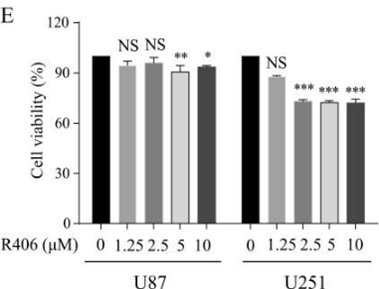
| Growth inhibition assay | Cell viability (U87, U251 cells) Cell viability (GSC lines) |
|
31043589 |
Informazioni sullo studio clinico
(dati da https://clinicaltrials.gov, aggiornato il 2024-05-22)
| Numero NCT | Reclutamento | Condizioni | Sponsor/Collaboratori | Data di inizio | Fasi |
|---|---|---|---|---|---|
| NCT01725230 | Completed | Rheumatoid Arthritis |
AstraZeneca |
November 2012 | Phase 1 |
| NCT01598571 | Completed | Healthy |
AstraZeneca |
May 2012 | Phase 1 |
| NCT01387308 | Completed | Healthy |
AstraZeneca |
August 2011 | Phase 1 |
| NCT01355354 | Completed | Healthy Volunteers|Rheumatoid Arthritis |
AstraZeneca |
June 2011 | Phase 1 |
Supporto tecnico
Istruzioni per la manipolazione
Tel: +1-832-582-8158 Ext:3
Per qualsiasi altra domanda, si prega di lasciare un messaggio.
Domande Frequenti
Domanda 1:
What’s the difference between S1533 and S2194?
Risposta:
S1533 and S2194 are two different forms of this compound. S1533 is the free base form, containing only its molecule without an acid added to it. S2194 has an additional C6H6O3S acid on it which makes the molecule a salt form. The free base and salt forms have same biology activities. Free base has a lower molecular weight and salt form has a better solubility in DMSO.

I prodotti sono solo per uso di ricerca. Non per uso umano. Non vendiamo a pazienti.
©Copyright 2013 Selleck Chemicals. Tutti i diritti riservati.