
solo per uso di ricerca
Luteolin ADC Cytotoxin inibitore
N. Cat.S2320
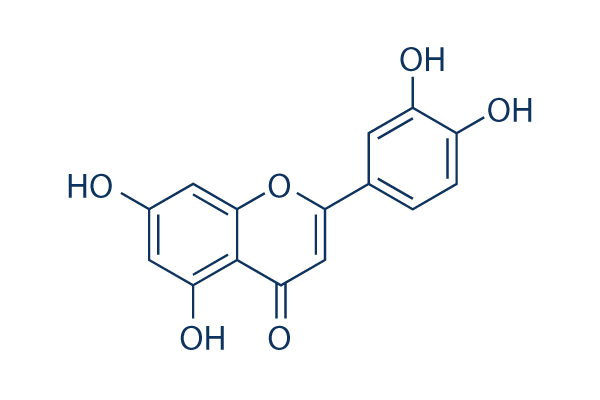
Struttura chimica
Peso molecolare: 286.24
Controllo Qualità
| Target correlati | Dehydrogenase HSP Transferase P450 (e.g. CYP17) PDE phosphatase PPAR Vitamin Carbohydrate Metabolism Mitochondrial Metabolism |
|---|---|
| Altro ADC Cytotoxin Inibitori | Triptolide SN-38 (+)-Bicuculline Rutin Artemisinin BHQ Pinocembrin Harmine hydrochloride Luteoloside Sacituzumab-govitecan |
Coltura cellulare, trattamento e concentrazione di lavoro
| Linee cellulari | Tipo di saggio | Concentrazione | Tempo di incubazione | Formulazione | Descrizione dellattività | PMID |
|---|---|---|---|---|---|---|
| mouse RAW264.7 cells | Function assay | 2 h | Inhibition of NO production in LPS-stimulated mouse RAW264.7 cells pre-incubated for 2 hrs before LPS stimulation for 24 hrs by Griess assay method, IC50=0.21 μM | |||
| HEK293 FS cells | Function assay | Inhibition of NOX4 expressed in HEK293 FS cells assessed as H2O2 production by H2O2/Tyr/LPO assay, IC50=0.85 μM | ||||
| CHO cells | Function assay | Agonist activity at rat DAT expressed in CHO cells, EC50=1.45 μM | ||||
| human MV4-11 cells | Cytotoxicity assay | 72 h | Cytotoxicity against human MV4-11 cells harboring FLT3 mutation after 72 hrs by tetrazolium based Ez CyTox cell viability assay, GI50=1.76 μM | |||
| HEK293 cells | Function assay | 24 h | Agonist activity at mouse PPARgamma expressed in HEK293 cells co-expressing with Gal4 reporter vector after 24 hrs by dual-luciferase reporter assay, EC50=2.3 μM | |||
| human U2OS cells | Function assay | 5 h | Agonist activity at GPR35 receptor in human U2OS cells coexpressing Gal4-VP16-TEV assessed as beta arrestin translocation after 5 hrs by beta lactamase reporter gene assay, EC50=3.2 μM | |||
| RBL-2H3 cells | Function assay | Inhibitory activity against IL-4 production in RBL-2H3 cells was determined, IC50=3.7 μM | ||||
| human mast cells | Function assay | Inhibition of SYK in human mast cells assessed as reduction in mast cell degranulation, EC50=4.5 μM | ||||
| human LNCAP cells | Function assay | Downregulation of prostate specific antigen secretion in human LNCAP cells, IC50=5 μM | ||||
| rat H9c2 cells | Function assay | 24 h | Cytoprotective activity against doxorubicin-induced cytotoxicity in rat H9c2 cells assessed as cell viability after 24 hrs by MTT assay, EC50=5.53 μM | |||
| human HT-29 cells | Function assay | 10 mins | Agonist activity at GPR35 receptor in human HT-29 cells after 10 mins by dynamic mass redistribution assay, EC50=7.24 μM | |||
| human RS4:11 cells | Cytotoxicity assay | 72 h | Cytotoxicity against human RS4:11 cells harboring wild type FLT3 after 72 hrs by tetrazolium based Ez CyTox cell viability assay, GI50=7.25 μM | |||
| NCI-H460 cells | Function assay | 2-20 h | Inhibition of ABCG2 expressed in human NCI-H460 cells assessed as inhibition of PhA accumulation after 2 to 20 hrs relative to fumitremorgin C, IC50=8.9 μM | |||
| human H9 cells | Function assay | 3 days | Antiviral activity against HIV1 3B infected in human H9 cells assessed as inhibition of viral replication after 3 days by p24 antigen capture assay, EC50=10 μM | |||
| MDCK cells | Cytotoxicity assay | Cytotoxicity against MDCK cells by MTT assay, CC50=12.44 μM | ||||
| mouse B16-4A5 cells | Function assay | 72 h | Inhibition of theophylline-stimulated melanogenesis in mouse B16-4A5 cells after 72 hrs, IC50=14 μM | |||
| K562 cells | Growth inhibition assay | 5 days | Growth inhibition of K562 cells by XTT assay after 5 days, IC50=14.65 μM | |||
| human H9 cells | Cytotoxicity assay | 3 days | Cytotoxicity against human H9 cells after 3 days, IC50=16 μM | |||
| human HT-29 cells | Function assay | 10 mins | Desensitization of GPR35 receptor in human HT-29 cells assessed as inhibition of zaprinast-induced dynamic mass redistribution after 10 mins, IC50=18.6 μM | |||
| human U937 cells | Proliferation assay | 72 h | Antiproliferative activity against human U937 cells after 72 hrs by WST-8 assay, IC50=20 μM | |||
| mouse HT22 cells | Function assay | 3 h | Neuroprotective activity in mouse HT22 cells assessed as t-BOOH-induced toxicity at 40 uM preincubated for 3 hrs followed by t-BOOH induction measured after 9 hrs by MTT assay | |||
| human THP1 cells | Function assay | 20 μM | 1 h | Downregulation of TPA-induced NOX2 mRNA expression in human THP1 cells at 20 uM incubated for 1 hr prior to TPA challenge measured after 24 hrs by RT-PCR analysis | ||
| MDA-MB-231 cells | Function assay | 5 μM | 16 h | Inhibition of PMA-stimulated NF-kappaB signaling (unknown origin) expressed in MDA-MB-231 cells at 5 uM incubated for 16 hrs by luciferase reporter gene assay | ||
| HL60 cells | Proliferation assay | 30 μM | 48 h | Antiproliferative activity against human HL60 cells at 30 uM after 48 hrs by MTS assay | ||
| Clicca per visualizzare più dati sperimentali sulle linee cellulari | ||||||
Informazioni chimiche, conservazione e stabilità
| Peso molecolare | 286.24 | Formula | C15H10O6 |
Conservazione (Dalla data di ricezione) | |
|---|---|---|---|---|---|
| N. CAS | 491-70-3 | Scarica SDF | Conservazione delle soluzioni stock |
|
|
Solubilità
|
In vitro |
DMSO
: 33 mg/mL
(115.28 mM)
Water : Insoluble Ethanol : Insoluble |
Calcolatore di Molarità
|
In vivo |
|||||
Calcolatore di formulazione in vivo (Soluzione chiara)
Passo 1: Inserire le informazioni di seguito (Consigliato: Un animale aggiuntivo per tenere conto della perdita durante lesperimento)
Passo 2: Inserire la formulazione in vivo (Questo è solo il calcolatore, non la formulazione. Contattateci prima se non cè una formulazione in vivo nella sezione Solubilità.)
Risultati del calcolo:
Concentrazione di lavoro: mg/ml;
Metodo per preparare il liquido master di DMSO: mg farmaco predissolto in μL DMSO ( Concentrazione del liquido master mg/mL, Vi preghiamo di contattarci prima se la concentrazione supera la solubilità del DMSO del lotto del farmaco. )
Metodo per preparare la formulazione in vivo: Prendere μL DMSO liquido master, quindi aggiungereμL PEG300, mescolare e chiarire, quindi aggiungereμL Tween 80, mescolare e chiarire, quindi aggiungere μL ddH2O, mescolare e chiarire.
Metodo per preparare la formulazione in vivo: Prendere μL DMSO liquido master, quindi aggiungere μL Olio di mais, mescolare e chiarire.
Nota: 1. Si prega di assicurarsi che il liquido sia limpido prima di aggiungere il solvente successivo.
2. Assicurarsi di aggiungere il/i solvente/i in ordine. È necessario assicurarsi che la soluzione ottenuta, nellaggiunta precedente, sia una soluzione limpida prima di procedere allaggiunta del solvente successivo. Metodi fisici come il vortex, gli ultrasuoni o il bagno dacqua calda possono essere utilizzati per facilitare la dissoluzione.
Meccanismo dazione
| Targets/IC50/Ki |
PDE2
(Cell-free assay) 6.4 μM(Ki)
PDE5
(Cell-free assay) 9.5 μM(Ki)
PDE4
(Cell-free assay) 11.1 μM(Ki)
PDE3
(Cell-free assay) 13.9 μM(Ki)
PDE1
(Cell-free assay) 15.0 μM(Ki)
|
|---|---|
| In vitro |
Luteolin è un flavonoide presente in Terminalia chebula, che è un inibitore non selettivo della fosfodiesterasi PDE per PDE1-5 con Ki di 15,0 μM, 6,4 μM, 13,9 μM, 11,1 μM e 9,5 μM, rispettivamente. Questo composto inibisce la produzione di TNF-alfa stimolata da LPS con un IC50 inferiore a 1 μM. Inibisce la fosforilazione di Akt indotta da LPS, così come di IkappaBalpha. |
| In vivo |
DL50: Topi >2500mg/kg (i.g.) |
Riferimenti |
|
Applicazioni
| Metodi | Biomarcatori | Immagini | PMID |
|---|---|---|---|
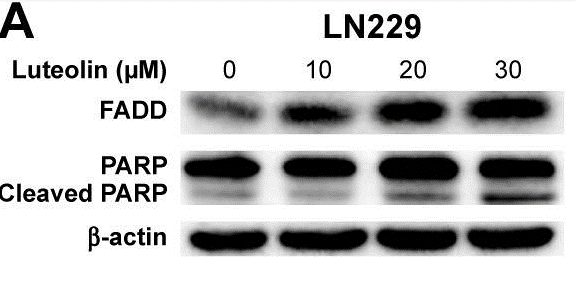
| Western blot | FADD / PARP / Cleaved PARP Caspase-3 / Cleaved Caspase-3 / Caspase-8 / Cleaved Caspase-8 ERK / p-ERK / JNK / p-JNK / p38 / p-p38 / Bax / Bcl-2 p-VEGFR2 / p-mTOR / pS6K1 / p70S6K1 / pAKT / AKT / MMP-2 / MMP-9 p21 / Survivin / Cyclin D1 DNMT1 / DMNT3A / DNMT3B TET1 / TET2 / TET3 |
|
30992674 |
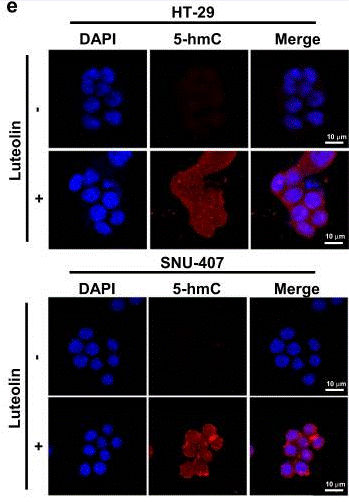
| Immunofluorescence | 5-hmC |
|
30988303 |
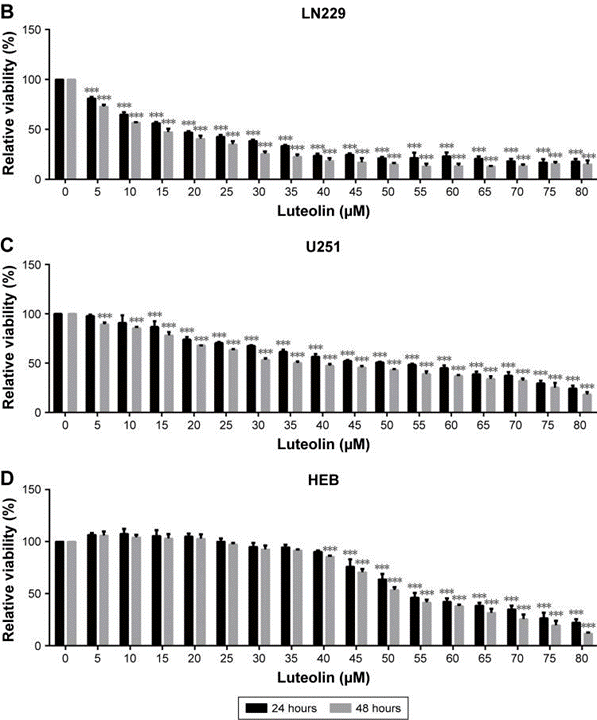
| Growth inhibition assay | Cell viability |
|
30992674 |
Supporto tecnico
Istruzioni per la manipolazione
Tel: +1-832-582-8158 Ext:3
Per qualsiasi altra domanda, si prega di lasciare un messaggio.
Domande Frequenti
Domanda 1:
Would you please suggest a suitable vehicle to dissolve it for in vivo i.p. use?
Risposta:
Formula: 5% DMSO+40% PEG 300+5% Tween80+ddH2O, working Solution concentration: up to 7.5mg/ml, stable for 30min.

I prodotti sono solo per uso di ricerca. Non per uso umano. Non vendiamo a pazienti.
©Copyright 2013 Selleck Chemicals. Tutti i diritti riservati.