
solo per uso di ricerca
ZSTK474 PI3K inibitore
N. Cat.S1072
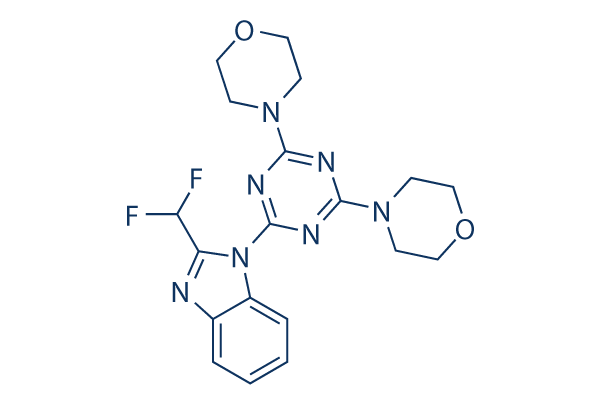
Struttura chimica
Peso molecolare: 417.41
Controllo Qualità
| Target correlati | Akt mTOR GSK-3 ATM/ATR DNA-PK AMPK PDPK1 PTEN PP2A PDK |
|---|---|
| Altro PI3K Inibitori | GDC-0077 (Inavolisib) SAR405 Quercetin (Sophoretin) LY294002 XL147 analogue Tersolisib (STX-478) Buparlisib (BKM120) 740 Y-P (PDGFR 740Y-P) GO-203 TFA Eganelisib (IPI-549) |
Coltura cellulare, trattamento e concentrazione di lavoro
| Linee cellulari | Tipo di saggio | Concentrazione | Tempo di incubazione | Formulazione | Descrizione dellattività | PMID |
|---|---|---|---|---|---|---|
| Sf21 insect cells | Function assay | 1 h | Inhibition of bovine recombinant PI3K p110delta expressed in Sf21 insect cells using phosphatidylinositol as substrate after 1 hr by phosphoimaging, IC50=0.7 nM | |||
| human HCT116 cells | Function assay | 15 mins | Inhibition of PIK3CA H1047R mutant-mediated cell signaling in human HCT116 cells expressing PTEN assessed as inhibition of insulin-induced pAkt/PKB phosphorylation at Thr308 treated for 15 mins before insulin challenge measured after 5 mins by immunoblotting, IC50=78 nM | |||
| human LNCAP cells | Proliferation assay | 3 days | Antiproliferative activity against human LNCAP cells after 3 days by MTS assay, IC50=0.21 μM | |||
| human NZB5 cells | Proliferation assay | 5 days | Antiproliferative activity against human NZB5 cells expressing wild type p110alpha assessed as incorporation of [3H]thymidine after 5 days, IC50=0.22 μM | |||
| human NZOV9 cells | Proliferation assay | 5 days | Antiproliferative activity against human NZOV9 cells expressing p110alpha kinase Y1021C mutant assessed as incorporation of [3H]thymidine after 5 days, IC50=0.29 μM | |||
| human MDA-MB-468 cells | Cytotoxic assay | 48 h | Cytotoxicity against PTEN-deficient human MDA-MB-468 cells assessed as inhibition of cell growth after 48 hrs by Cell Titer 96 assay | |||
| human A549 cells | Function assay | 10 μM | 1 h | Inhibition of PI3K in human A549 cells assessed as reduction in pAkt level at 10 uM after 1 hr by Western blotting analysis | ||
| human DMS114 cells | Growth inhibition assay | Growth inhibition of human DMS114 cells | ||||
| human MKN74 cells | Growth inhibition assay | Growth inhibition of human MKN74 cells | ||||
| human SNB78 cells | Growth inhibition assay | Growth inhibition of human SNB78 cells | ||||
| human St-4 cells | Growth inhibition assay | Growth inhibition of human St-4 cells | ||||
| human DU145 cells | Growth inhibition assay | Growth inhibition of human DU145 cells | ||||
| human LOXIMVI cells | Growth inhibition assay | Growth inhibition of human LOXIMVI cells | ||||
| human PC3 cells | Growth inhibition assay | Growth inhibition of human PC3 cells | ||||
| human LOXIMVI cells | Growth inhibition assay | Growth inhibition of human LOXIMVI cells | ||||
| human OVCAR3 cells | Growth inhibition assay | Growth inhibition of human OVCAR3 cells | ||||
| human SKOV3 cells | Growth inhibition assay | Growth inhibition of human SKOV3 cells | ||||
| human KM12 cells | Growth inhibition assay | Growth inhibition of human KM12 cells | ||||
| human HT-29 cells | Growth inhibition assay | Growth inhibition of human HT-29 cells | ||||
| human HCT15 cells | Growth inhibition assay | Growth inhibition of human HCT15 cells | ||||
| human NCI-H226 cells | Growth inhibition assay | Growth inhibition of human NCI-H226 cells | ||||
| human NCI-H522 cells | Growth inhibition assay | Growth inhibition of human NCI-H522 cells | ||||
| human A549 cells | Growth inhibition assay | Growth inhibition of human A549 cells | ||||
| human HCC2998 cells | Growth inhibition assay | Growth inhibition of human HCC2998 cells | ||||
| human SNB75 cells | Growth inhibition assay | Growth inhibition of human SNB75 cells | ||||
| human OVCAR4 cells | Growth inhibition assay | Growth inhibition of human OVCAR4 cells | ||||
| human OVCAR5 cells | Growth inhibition assay | Growth inhibition of human OVCAR5 cells | ||||
| human OVCAR8 cells | Growth inhibition assay | Growth inhibition of human OVCAR8 cells | ||||
| human SKOV3 cells | Growth inhibition assay | Growth inhibition of human SKOV3 cells | ||||
| human ACHN cells | Growth inhibition assay | Growth inhibition of human ACHN cells | ||||
| Clicca per visualizzare più dati sperimentali sulle linee cellulari | ||||||
Informazioni chimiche, conservazione e stabilità
| Peso molecolare | 417.41 | Formula | C19H21F2N7O2 |
Conservazione (Dalla data di ricezione) | |
|---|---|---|---|---|---|
| N. CAS | 475110-96-4 | Scarica SDF | Conservazione delle soluzioni stock |
|
|
| Sinonimi | N/A | Smiles | C1COCCN1C2=NC(=NC(=N2)N3C4=CC=CC=C4N=C3C(F)F)N5CCOCC5 | ||
Solubilità
|
In vitro |
DMSO
: 15 mg/mL
(35.93 mM)
Water : Insoluble Ethanol : Insoluble |
Calcolatore di Molarità
|
In vivo |
|||||
Calcolatore di formulazione in vivo (Soluzione chiara)
Passo 1: Inserire le informazioni di seguito (Consigliato: Un animale aggiuntivo per tenere conto della perdita durante lesperimento)
Passo 2: Inserire la formulazione in vivo (Questo è solo il calcolatore, non la formulazione. Contattateci prima se non cè una formulazione in vivo nella sezione Solubilità.)
Risultati del calcolo:
Concentrazione di lavoro: mg/ml;
Metodo per preparare il liquido master di DMSO: mg farmaco predissolto in μL DMSO ( Concentrazione del liquido master mg/mL, Vi preghiamo di contattarci prima se la concentrazione supera la solubilità del DMSO del lotto del farmaco. )
Metodo per preparare la formulazione in vivo: Prendere μL DMSO liquido master, quindi aggiungereμL PEG300, mescolare e chiarire, quindi aggiungereμL Tween 80, mescolare e chiarire, quindi aggiungere μL ddH2O, mescolare e chiarire.
Metodo per preparare la formulazione in vivo: Prendere μL DMSO liquido master, quindi aggiungere μL Olio di mais, mescolare e chiarire.
Nota: 1. Si prega di assicurarsi che il liquido sia limpido prima di aggiungere il solvente successivo.
2. Assicurarsi di aggiungere il/i solvente/i in ordine. È necessario assicurarsi che la soluzione ottenuta, nellaggiunta precedente, sia una soluzione limpida prima di procedere allaggiunta del solvente successivo. Metodi fisici come il vortex, gli ultrasuoni o il bagno dacqua calda possono essere utilizzati per facilitare la dissoluzione.
Meccanismo dazione
| Caratteristiche |
First orally administered PI3K inhibitor used in vivo.
|
|---|---|
| Targets/IC50/Ki |
PI3Kδ
(Cell-free assay) 4.6 nM
PI3Kα
(Cell-free assay) 16 nM
PI3K
(Cell-free assay) 37 nM
PI3Kβ
(Cell-free assay) 44 nM
PI3Kγ
(Cell-free assay) 49 nM
|
| In vitro |
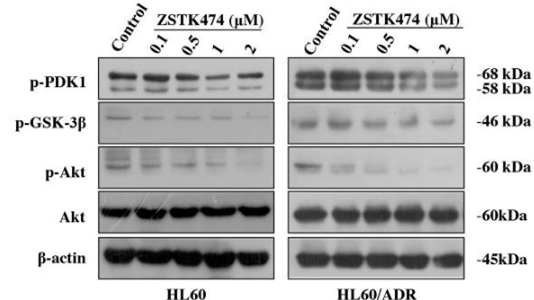
ZSTK474 a 1 μM riduce potentemente l'attività di PI3K al 4,7% del livello di controllo, mentre LY2194002 riduce l'attività solo al 44,6% del controllo. Questo composto inibisce le attività delle p110β, -γ e -δ ricombinanti con IC50 di 17 nM, 53 nM e 6 nM, rispettivamente. Mostra una potente attività antiproliferativa contro un pannello di 39 linee cellulari di cancro umano con una GI50 media di 0,32 μM, più efficacemente rispetto a LY294002 o wortmannin con una GI50 media di 7,4 μM o 10 μM, rispettivamente. Questo trattamento chimico a 1 μM blocca il ruffling della membrana e la generazione di PIP3 indotta dal fattore di crescita derivato dalle piastrine in fibroblasti embrionali murini (MEF). A 10 μM induce l'apoptosi nelle cellule OVCAR3 e induce un arresto completo della fase G1 ma non l'apoptosi nelle cellule A549. Questo trattamento con il composto a 0,5 μM diminuisce significativamente il livello di Akt e GSK-3β fosforilati, così come l'espressione della proteina ciclina D1. Inibisce anche la fosforilazione di altri componenti di segnalazione a valle coinvolti nella regolazione della proliferazione cellulare, inclusi FKHRL1, FKHR, TSC-2, mTOR e p70S6K in modo dose-dipendente. Questa sostanza chimica non inibisce mTOR a 0,1 μM, e anche a una concentrazione di 100 μM, inibisce l'attività di mTOR meno del 40%. Blocca la migrazione cellulare indotta da VEGF e la formazione di tubi nelle cellule endoteliali della vena ombelicale umana (HUVEC), e inibisce l'espressione di HIF-1α e la secrezione di VEGF nelle cellule RXF-631L, esibendo una potente attività antiangiogenica in vitro. Questo trattamento con il composto inibisce la produzione di IFNγ e IL-17 nelle cellule T attivate dalla concanavalina A e inibisce la proliferazione e la produzione di PGE(2) da parte delle cellule sinoviali simili a fibroblasti (FLS). |
| Saggio chinasico |
Inibizione dell'attività di PI3K
|
|
Le cellule A549 vengono lisate in un tampone contenente 20 mM Tris-HCl (pH 7,5), 150 mM NaCl, 5 mM EDTA e 1% Igepal CA-630, i lisati vengono centrifugati a 20.000 g e 4 °C per 10 minuti e i surnatanti vengono utilizzati come lisato cellulare (proteina = 2-4 mg/mL). Per immunoprecipitare la PI3K, 200 μL di lisato cellulare vengono incubati con anticorpo policlonale anti-p85 e proteina G-agarosio (5 μL). Le PI3Kα, PI3Kβ e PI3Kδ possono essere immunoprecipitate dall'anticorpo policlonale anti-p85. Le sfere di agarosio contenenti gli immunoprecipitati vengono lavate due volte con il tampone A (20 mM Tris-HCl a pH 7,5, 150 mM NaCl, 5 mM EDTA e 1% Igepal CA-630), una volta con il tampone B (500 mM LiCl e 100 mM Tris-HCl a pH 7,5), una volta con acqua distillata e una volta con il tampone C (100 mM NaCl e 20 mM Tris-HCl a pH 7,5). Gli immunoprecipitati vengono sospesi in 20 μL di tampone C contenente fosfatidilinositolo a 200 μg/mL. La miscela viene preincubata con concentrazioni crescenti di questo composto a 25 °C per 5 minuti. Vengono aggiunti [γ-32P]ATP (2 μCi per miscela di saggio; concentrazione finale, 20 μM) e MgCl2 (concentrazione finale, 20 mM) per avviare la reazione. La miscela di reazione viene incubata a 25 °C per 20 minuti. I prodotti fosforilati del fosfatidilinositolo vengono separati mediante cromatografia su strato sottile e visualizzati mediante autoradiografia. La regione del fosfatidilinositolo-3-fosfato viene raschiata dalla piastra e la radioattività viene misurata anche con spettroscopia a scintillazione liquida. Il livello di inibizione di questa sostanza chimica viene determinato come la percentuale di conteggi di 32P per minuto ottenuti senza questo composto.
|
|
| In vivo |
La somministrazione orale di ZSTK474 inibisce la crescita dei tumori di melanoma B16F10 di topo impiantati sottocute in modo dose-dipendente, producendo una regressione tumorale del 28,5%, 7,1% o 4,9% al giorno 14 a 100, 200 o 400 mg/kg, rispettivamente, il che è superiore a quello dei quattro principali farmaci antitumorali alle loro rispettive dosi massime tollerabili con una regressione tumorale del 96%, 35,7%, 24% o 68,3%, rispettivamente. Questo trattamento con il composto a 400 mg/kg inibisce completamente la crescita di xenotrapianti A549, PC-3 e WiDr nei topi e induce la regressione dei tumori xenotrapiantati A549. Inibisce significativamente la crescita tumorale nel modello di xenotrapianto RXF-631L, correlato a un numero significativamente ridotto di microvasi nei topi trattati. La somministrazione orale di questa sostanza chimica migliora la progressione dell'artrite indotta da adiuvante (AIA) nei ratti.
|
Riferimenti |
|
Applicazioni
| Metodi | Biomarcatori | Immagini | PMID |
|---|---|---|---|
| Western blot | p-PDK1 / p-GSK3β / p-AKT / AKT P-gp / MRP1 p-Rb / p27 / Cyclin D1 HIF-1α / HIF-1β |
|
28388564 |
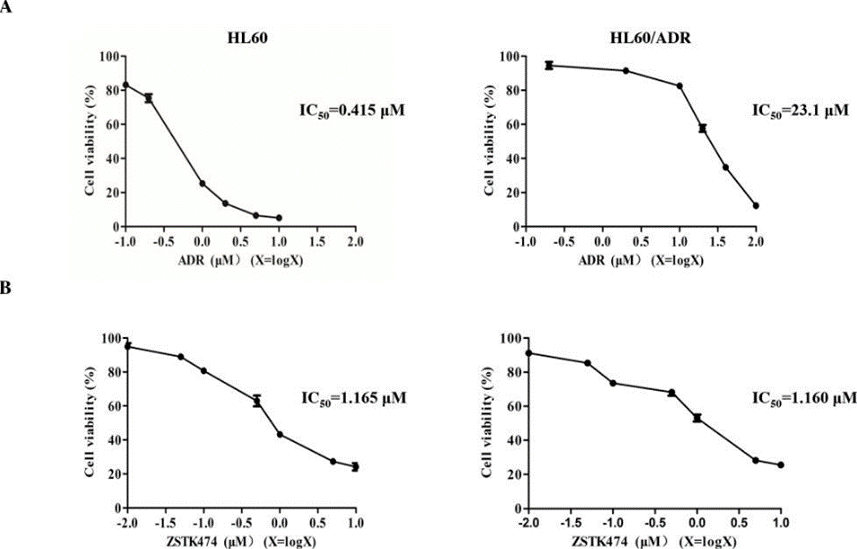
| Growth inhibition assay | Cell viability |
|
28388564 |
Supporto tecnico
Istruzioni per la manipolazione
Tel: +1-832-582-8158 Ext:3
Per qualsiasi altra domanda, si prega di lasciare un messaggio.

I prodotti sono solo per uso di ricerca. Non per uso umano. Non vendiamo a pazienti.
©Copyright 2013 Selleck Chemicals. Tutti i diritti riservati.