
solo per uso di ricerca
Ralimetinib (LY2228820) dimesylate p38 MAPK inibitore
N. Cat.S1494
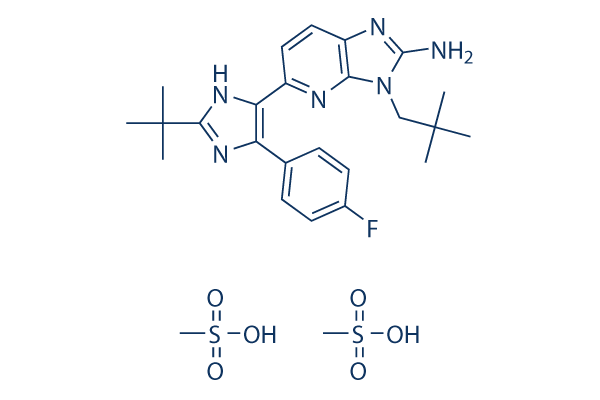
Struttura chimica
Peso molecolare: 612.74
Controllo Qualità
| Target correlati | ERK Raf JNK MEK Ras KRas S6 Kinase MAP4K TAK1 Mixed Lineage Kinase |
|---|---|
| Altro p38 MAPK Inibitori | SB202190 SB203580 (Adezmapimod) PH-797804 Doramapimod (BIRB 796) VX-702 Losmapimod SB239063 Neflamapimod (VX-745) BMS-582949 Skepinone-L |
Coltura cellulare, trattamento e concentrazione di lavoro
| Linee cellulari | Tipo di saggio | Concentrazione | Tempo di incubazione | Formulazione | Descrizione dellattività | PMID |
|---|---|---|---|---|---|---|
| RPMI-8226 | Kinase assay | ~800 nM | DMSO | inhibits phosphorylation of HSP27 | 18397345 | |
| U266 | Kinase assay | ~800 nM | DMSO | inhibits phosphorylation of HSP27 | 18397345 | |
| MM.1S | Kinase assay | ~800 nM | DMSO | inhibits phosphorylation of HSP27 | 18397345 | |
| RPMI-Dox40 | Kinase assay | ~800 nM | DMSO | inhibits phosphorylation of HSP27 | 18397345 | |
| RPMI-LR5 | Kinase assay | ~800 nM | DMSO | inhibits phosphorylation of HSP27 | 18397345 | |
| INA-6 | Kinase assay | ~800 nM | DMSO | inhibits phosphorylation of HSP27 | 18397345 | |
| RPMI-8226 | Cytoxicity assay | ~1000 nM | DMSO | no significant cytotoxicity | 18397345 | |
| U266 | Cytoxicity assay | ~1000 nM | DMSO | no significant cytotoxicity | 18397345 | |
| MM.1S | Cytoxicity assay | ~1000 nM | DMSO | no significant cytotoxicity | 18397345 | |
| RPMI-Dox40 | Cytoxicity assay | ~1000 nM | DMSO | no significant cytotoxicity | 18397345 | |
| RPMI-LR5 | Cytoxicity assay | ~1000 nM | DMSO | no significant cytotoxicity | 18397345 | |
| INA-6 | Cytoxicity assay | ~1000 nM | DMSO | no significant cytotoxicity | 18397345 | |
| CD14+ | Function assay | ~800 nM | DMSO | inhibits osteoclastogenesis from CD14 positive cells | 18397345 | |
| U-87-MG | Function assay | 1 μM | DMSO | reduces tumor-driven cord formation | 23335506 | |
| MDA-MB-231 | Function assay | 1 μM | DMSO | reduces tumor-driven cord formation | 23335506 | |
| A-2780 | Function assay | 1 μM | DMSO | reduces tumor-driven cord formation | 23335506 | |
| SK-OV-3 | Function assay | 1 μM | DMSO | reduces tumor-driven cord formation | 23335506 | |
| LXFA-629 | Function assay | 1 μM | DMSO | reduces tumor-driven cord formation | 23335506 | |
| NCI-H1650 | Function assay | 1 μM | DMSO | reduces tumor-driven cord formation | 23335506 | |
| PC-3 | Function assay | 1 μM | DMSO | reduces tumor-driven cord formation | 23335506 | |
| RAW264.7 | Function assay | ~20 μM | DMSO | inhibits Anisomycin-stimulated MK2 phosphorylation with IC50 of 35.3 nM | 24356814 | |
| mouse peritoneal macrophages | Function assay | ~20 μM | DMSO | LPS/IFN-γ–stimulated TNF-α production with IC50 of 6.3 nM | 24356814 | |
| A549 | Function assay | ~20 μM | DMSO | inhibits LPS-induced CXCL8 production with IC50 of 144.9 nM | 24356814 | |
| MDA-231 | Function assay | ~10 μM | suppresses DKK-1 expression | 26407843 | ||
| MCF-7 | Function assay | ~10 μM | suppresses DKK-1 expression | 26407843 | ||
| MDA-435 | Function assay | ~10 μM | suppresses DKK-1 expression | 26407843 | ||
| PC3 | Function assay | ~10 μM | DMSO | suppresses DKK-1 expression | 26913608 | |
| TC32 | qHTS assay | qHTS of pediatric cancer cell lines to identify multiple opportunities for drug repurposing: Primary screen for TC32 cells | 29435139 | |||
| A673 | qHTS assay | qHTS of pediatric cancer cell lines to identify multiple opportunities for drug repurposing: Primary screen for A673 cells | 29435139 | |||
| DAOY | qHTS assay | qHTS of pediatric cancer cell lines to identify multiple opportunities for drug repurposing: Primary screen for DAOY cells | 29435139 | |||
| BT-37 | qHTS assay | qHTS of pediatric cancer cell lines to identify multiple opportunities for drug repurposing: Primary screen for BT-37 cells | 29435139 | |||
| RD | qHTS assay | qHTS of pediatric cancer cell lines to identify multiple opportunities for drug repurposing: Primary screen for RD cells | 29435139 | |||
| BT-12 | qHTS assay | qHTS of pediatric cancer cell lines to identify multiple opportunities for drug repurposing: Primary screen for BT-12 cells | 29435139 | |||
| NB1643 | qHTS assay | qHTS of pediatric cancer cell lines to identify multiple opportunities for drug repurposing: Primary screen for NB1643 cells | 29435139 | |||
| OHS-50 | qHTS assay | qHTS of pediatric cancer cell lines to identify multiple opportunities for drug repurposing: Primary screen for OHS-50 cells | 29435139 | |||
| Rh41 | qHTS assay | qHTS of pediatric cancer cell lines to identify multiple opportunities for drug repurposing: Primary screen for Rh41 cells | 29435139 | |||
| Rh30 | qHTS assay | qHTS of pediatric cancer cell lines to identify multiple opportunities for drug repurposing: Primary screen for Rh30 cells | 29435139 | |||
| Clicca per visualizzare più dati sperimentali sulle linee cellulari | ||||||
Informazioni chimiche, conservazione e stabilità
| Peso molecolare | 612.74 | Formula | C24H29FN6.2CH4O3S |
Conservazione (Dalla data di ricezione) | |
|---|---|---|---|---|---|
| N. CAS | 862507-23-1 | Scarica SDF | Conservazione delle soluzioni stock |
|
|
| Sinonimi | N/A | Smiles | CC(C)(C)CN1C2=C(C=CC(=N2)C3=C(N=C(N3)C(C)(C)C)C4=CC=C(C=C4)F)N=C1N.CS(=O)(=O)O.CS(=O)(=O)O | ||
Solubilità
|
In vitro |
Water : 123 mg/mL
DMSO
: 35 mg/mL
(57.12 mM)
Ethanol : 3 mg/mL |
Calcolatore di Molarità
|
In vivo |
|||||
Calcolatore di formulazione in vivo (Soluzione chiara)
Passo 1: Inserire le informazioni di seguito (Consigliato: Un animale aggiuntivo per tenere conto della perdita durante lesperimento)
Passo 2: Inserire la formulazione in vivo (Questo è solo il calcolatore, non la formulazione. Contattateci prima se non cè una formulazione in vivo nella sezione Solubilità.)
Risultati del calcolo:
Concentrazione di lavoro: mg/ml;
Metodo per preparare il liquido master di DMSO: mg farmaco predissolto in μL DMSO ( Concentrazione del liquido master mg/mL, Vi preghiamo di contattarci prima se la concentrazione supera la solubilità del DMSO del lotto del farmaco. )
Metodo per preparare la formulazione in vivo: Prendere μL DMSO liquido master, quindi aggiungereμL PEG300, mescolare e chiarire, quindi aggiungereμL Tween 80, mescolare e chiarire, quindi aggiungere μL ddH2O, mescolare e chiarire.
Metodo per preparare la formulazione in vivo: Prendere μL DMSO liquido master, quindi aggiungere μL Olio di mais, mescolare e chiarire.
Nota: 1. Si prega di assicurarsi che il liquido sia limpido prima di aggiungere il solvente successivo.
2. Assicurarsi di aggiungere il/i solvente/i in ordine. È necessario assicurarsi che la soluzione ottenuta, nellaggiunta precedente, sia una soluzione limpida prima di procedere allaggiunta del solvente successivo. Metodi fisici come il vortex, gli ultrasuoni o il bagno dacqua calda possono essere utilizzati per facilitare la dissoluzione.
Meccanismo dazione
| Targets/IC50/Ki |
p38α
(Cell-free assay) 7 nM
|
|---|---|
| In vitro |
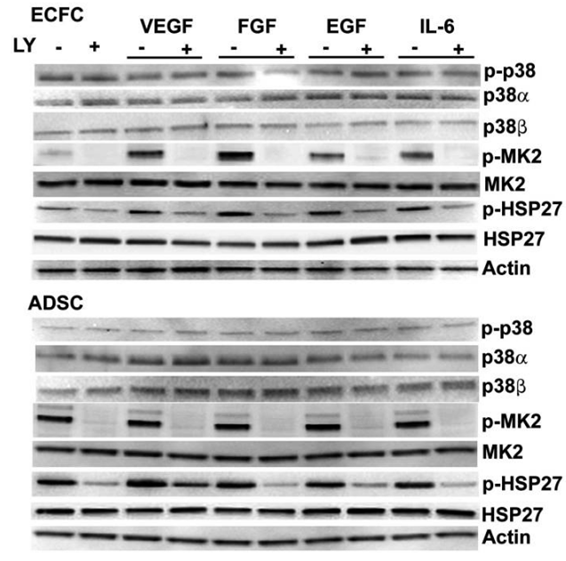
LY2228820 inibisce la p38α, così come il livello di fosfoMAPKAPK-2 (pMK2) nelle cellule RAW 264.7, con valori di IC50 di 7 nM e 34,3 nM, rispettivamente. Inoltre, LY2228820 inibisce la formazione di TNFα indotta da lipopolisaccaride (LPS) nei macrofagi peritoneali murini, con un'IC50 di 5,2 nM. Nelle cellule di mieloma multiplo (MM), incluse INA6, RPMI-8226, U266 e RPMI-Dox40, LY2228820 (200 nM–800 nM) blocca significativamente la segnalazione di p38MAPK, come rivelato dalla sua inibizione della fosforilazione di HSP27, un bersaglio a valle della p38MAPK, senza influenzare il livello di espressione di HSP27. LY2228820 (200 nM–400 nM) migliora la citotossicità e l'apoptosi, ma LY2228820 da solo non inibisce la crescita delle cellule MM.1S. LY2228820 (200 nM–800 nM) inibisce anche la secrezione di IL-6 e MIP-1α nelle cellule stromali di midollo osseo a lungo termine (LT-BMSC), nelle cellule mononucleate di midollo osseo (BMMNC), nelle cellule CD138+, CD138− del sangue periferico (PB) o nelle cellule CD14+ del PB. LY2228820 (400 nM–800 nM) blocca anche l'osteoclastogenesi da cellule CD14+. |
| Saggio chinasico |
Inibizione di p38α
|
|
L'inibizione di p38α è determinata usando p38α umana ricombinante in un protocollo standard di legame su filtro che utilizza ATP[γ-33P] e il peptide 21-mero di EGFR come substrato. L'inibizione funzionale del TNFα nei macrofagi peritoneali murini è determinata usando la stimolazione con LPS in presenza di LY2228820. Per valutare l'attività di p38α nelle cellule più direttamente, le cellule RAW 264.7 vengono trattate con LY2228820 e quindi stimolate con anisomicina. Il livello di attività di p38α viene rilevato utilizzando un anticorpo fosfoMAPKAPK-2 (pMK2) (Thr 334) che reagisce con un residuo specificamente fosforilato da p38α.
|
|
| In vivo |
Nei topi indotti da LPS, LY2228820 inibisce efficacemente la formazione di TNFα con una dose minima efficace soglia (TMED50) inferiore a 1 mg/kg. In un modello di ratto con artrite indotta da collagene (CIA), LY2228820 mostra potenti effetti sul gonfiore delle zampe, l'erosione ossea e la distruzione della cartilagine, con una dose minima efficace soglia (TMED50) di 1,5 mg/kg. |
Riferimenti |
|
Applicazioni
| Metodi | Biomarcatori | Immagini | PMID |
|---|---|---|---|
| Western blot | p-p38 / p38α / p38β / p-MK2 / MK2 / p-HSP27 / HSP27 p-S6K |
|
23335506 |
Informazioni sullo studio clinico
(dati da https://clinicaltrials.gov, aggiornato il 2024-05-22)
| Numero NCT | Reclutamento | Condizioni | Sponsor/Collaboratori | Data di inizio | Fasi |
|---|---|---|---|---|---|
| NCT02860780 | Completed | Advanced Cancer|Metastatic Cancer|Colorectal Cancer|Non-small Cell Lung Cancer |
Eli Lilly and Company |
August 10 2016 | Phase 1 |
| NCT02364206 | Completed | Adult Glioblastoma |
Centre Jean Perrin|National Cancer Institute France|ARC Foundation for Cancer Research |
June 8 2015 | Phase 1|Phase 2 |
| NCT02322853 | Terminated | Postmenopausal|Metastatic Breast Cancer |
Centre Francois Baclesse|National Cancer Institute France|ARC Foundation for Cancer Research |
January 2015 | Phase 2 |
| NCT01393990 | Completed | Advanced Cancer |
Eli Lilly and Company |
September 4 2008 | Phase 1 |
Supporto tecnico
Istruzioni per la manipolazione
Tel: +1-832-582-8158 Ext:3
Per qualsiasi altra domanda, si prega di lasciare un messaggio.

I prodotti sono solo per uso di ricerca. Non per uso umano. Non vendiamo a pazienti.
©Copyright 2013 Selleck Chemicals. Tutti i diritti riservati.