
solo per uso di ricerca
GSK461364 PLK inibitore
N. Cat.S2193
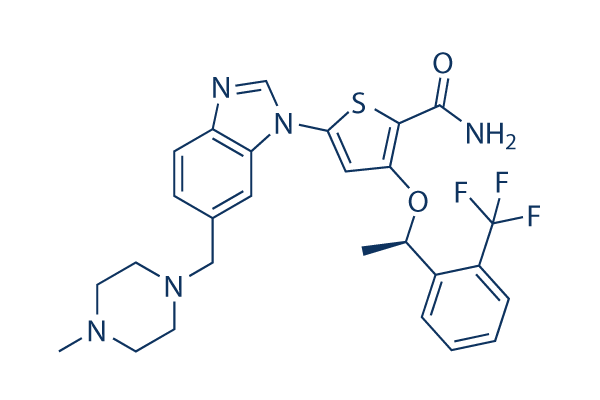
Struttura chimica
Peso molecolare: 543.6
Controllo Qualità
Coltura cellulare, trattamento e concentrazione di lavoro
| Linee cellulari | Tipo di saggio | Concentrazione | Tempo di incubazione | Formulazione | Descrizione dellattività | PMID |
|---|---|---|---|---|---|---|
| human MV4-11 cells | Cytotoxicity assay | 24 h | Cytotoxicity against human MV4-11 cells after 24 hrs by CellTiter-Blue assay, GI50=0.679 μM | 26191363 | ||
| HEK293T | Antiproliferative assay | 72 hrs | Antiproliferative activity against HEK293T cells measured after 72 hrs by CellTiter-Blue assay, IC50=0.001μM | 28792760 | ||
| MDA-MB-231 | Antiproliferative assay | 72 hrs | Antiproliferative activity against human MDA-MB-231 cells measured after 72 hrs by CellTiter-Blue assay, IC50=0.001μM | 28792760 | ||
| MM1S | Antiproliferative assay | 72 hrs | Antiproliferative activity against human MM1S cells measured after 72 hrs by CellTiter-Blue assay, IC50=0.001μM | 28792760 | ||
| MDA-MB-23 | Function assay | 6 hrs | Inhibition of PLK1 in human MDA-MB-23 cells assessed as decrease in TCTP phosphorylation after 6 hrs by Western blot method, IC50<0.1μM | 28792760 | ||
| HEK293T | Function assay | 6 hrs | Inhibition of PLK1 in HEK293T cells assessed as decrease in TCTP phosphorylation after 6 hrs by Western blot method, IC50<0.1μM | 28792760 | ||
| TC32 | qHTS assay | qHTS of pediatric cancer cell lines to identify multiple opportunities for drug repurposing: Primary screen for TC32 cells | 29435139 | |||
| SJ-GBM2 | qHTS assay | qHTS of pediatric cancer cell lines to identify multiple opportunities for drug repurposing: Primary screen for SJ-GBM2 cells | 29435139 | |||
| A673 | qHTS assay | qHTS of pediatric cancer cell lines to identify multiple opportunities for drug repurposing: Primary screen for A673 cells | 29435139 | |||
| SK-N-MC | qHTS assay | qHTS of pediatric cancer cell lines to identify multiple opportunities for drug repurposing: Primary screen for SK-N-MC cells | 29435139 | |||
| BT-37 | qHTS assay | qHTS of pediatric cancer cell lines to identify multiple opportunities for drug repurposing: Primary screen for BT-37 cells | 29435139 | |||
| NB-EBc1 | qHTS assay | qHTS of pediatric cancer cell lines to identify multiple opportunities for drug repurposing: Primary screen for NB-EBc1 cells | 29435139 | |||
| U-2 OS | qHTS assay | qHTS of pediatric cancer cell lines to identify multiple opportunities for drug repurposing: Primary screen for U-2 OS cells | 29435139 | |||
| SK-N-SH | qHTS assay | qHTS of pediatric cancer cell lines to identify multiple opportunities for drug repurposing: Primary screen for SK-N-SH cells | 29435139 | |||
| NB1643 | qHTS assay | qHTS of pediatric cancer cell lines to identify multiple opportunities for drug repurposing: Primary screen for NB1643 cells | 29435139 | |||
| LAN-5 | qHTS assay | qHTS of pediatric cancer cell lines to identify multiple opportunities for drug repurposing: Primary screen for LAN-5 cells | 29435139 | |||
| BT-12 | qHTS assay | qHTS of pediatric cancer cell lines to identify multiple opportunities for drug repurposing: Primary screen for BT-12 cells | 29435139 | |||
| Rh18 | qHTS assay | qHTS of pediatric cancer cell lines to identify multiple opportunities for drug repurposing: Primary screen for Rh18 cells | 29435139 | |||
| OHS-50 | qHTS assay | qHTS of pediatric cancer cell lines to identify multiple opportunities for drug repurposing: Primary screen for OHS-50 cells | 29435139 | |||
| NB1643 | qHTS assay | qHTS of pediatric cancer cell lines to identify multiple opportunities for drug repurposing: Confirmatory screen for NB1643 cells | 29435139 | |||
| A673 | qHTS assay | qHTS of pediatric cancer cell lines to identify multiple opportunities for drug repurposing: Confirmatory screen for A673 cells) | 29435139 | |||
| SK-N-MC | qHTS assay | qHTS of pediatric cancer cell lines to identify multiple opportunities for drug repurposing: Confirmatory screen for SK-N-MC cells | 29435139 | |||
| BT-12 | qHTS assay | qHTS of pediatric cancer cell lines to identify multiple opportunities for drug repurposing: Confirmatory screen for BT-12 cells | 29435139 | |||
| LAN-5 | qHTS assay | qHTS of pediatric cancer cell lines to identify multiple opportunities for drug repurposing: Confirmatory screen for LAN-5 cells | 29435139 | |||
| NB-EBc1 | qHTS assay | qHTS of pediatric cancer cell lines to identify multiple opportunities for drug repurposing: Confirmatory screen for NB-EBc1 cells | 29435139 | |||
| SJ-GBM2 | qHTS assay | qHTS of pediatric cancer cell lines to identify multiple opportunities for drug repurposing: Confirmatory screen for SJ-GBM2 cells | 29435139 | |||
| BT-37 | qHTS assay | qHTS of pediatric cancer cell lines to identify multiple opportunities for drug repurposing: Confirmatory screen for BT-37 cells | 29435139 | |||
| TC32 | qHTS assay | qHTS of pediatric cancer cell lines to identify multiple opportunities for drug repurposing: Confirmatory screen for TC32 cells | 29435139 | |||
| MG 63 (6-TG R) | qHTS assay | qHTS of pediatric cancer cell lines to identify multiple opportunities for drug repurposing: Confirmatory screen for MG 63 (6-TG R) cells | 29435139 | |||
| fibroblast cells | qHTS assay | qHTS of pediatric cancer cell lines to identify multiple opportunities for drug repurposing: Confirmatory screen for control Hh wild type fibroblast cells | 29435139 | |||
| Rh41 | qHTS assay | qHTS of pediatric cancer cell lines to identify multiple opportunities for drug repurposing: Confirmatory screen for Rh41 cells | 29435139 | |||
| Rh18 | qHTS assay | qHTS of pediatric cancer cell lines to identify multiple opportunities for drug repurposing: Confirmatory screen for Rh18 cells | 29435139 | |||
| Rh30 | qHTS assay | qHTS of pediatric cancer cell lines to identify multiple opportunities for drug repurposing: Confirmatory screen for Rh30 cells | 29435139 | |||
| OHS-50 | qHTS assay | qHTS of pediatric cancer cell lines to identify multiple opportunities for drug repurposing: Confirmatory screen for OHS-50 cells | 29435139 | |||
| SK-N-SH | qHTS assay | qHTS of pediatric cancer cell lines to identify multiple opportunities for drug repurposing: Confirmatory screen for SK-N-SH cells | 29435139 | |||
| Clicca per visualizzare più dati sperimentali sulle linee cellulari | ||||||
Informazioni chimiche, conservazione e stabilità
| Peso molecolare | 543.6 | Formula | C27H28F3N5O2S |
Conservazione (Dalla data di ricezione) | |
|---|---|---|---|---|---|
| N. CAS | 929095-18-1 | Scarica SDF | Conservazione delle soluzioni stock |
|
|
| Sinonimi | GSK461364A | Smiles | CC(C1=CC=CC=C1C(F)(F)F)OC2=C(SC(=C2)N3C=NC4=C3C=C(C=C4)CN5CCN(CC5)C)C(=O)N | ||
Solubilità
|
In vitro |
Ethanol : 30 mg/mL
DMSO
: 10 mg/mL
(18.39 mM)
Water : Insoluble |
Calcolatore di Molarità
|
In vivo |
|||||
Calcolatore di formulazione in vivo (Soluzione chiara)
Passo 1: Inserire le informazioni di seguito (Consigliato: Un animale aggiuntivo per tenere conto della perdita durante lesperimento)
Passo 2: Inserire la formulazione in vivo (Questo è solo il calcolatore, non la formulazione. Contattateci prima se non cè una formulazione in vivo nella sezione Solubilità.)
Risultati del calcolo:
Concentrazione di lavoro: mg/ml;
Metodo per preparare il liquido master di DMSO: mg farmaco predissolto in μL DMSO ( Concentrazione del liquido master mg/mL, Vi preghiamo di contattarci prima se la concentrazione supera la solubilità del DMSO del lotto del farmaco. )
Metodo per preparare la formulazione in vivo: Prendere μL DMSO liquido master, quindi aggiungereμL PEG300, mescolare e chiarire, quindi aggiungereμL Tween 80, mescolare e chiarire, quindi aggiungere μL ddH2O, mescolare e chiarire.
Metodo per preparare la formulazione in vivo: Prendere μL DMSO liquido master, quindi aggiungere μL Olio di mais, mescolare e chiarire.
Nota: 1. Si prega di assicurarsi che il liquido sia limpido prima di aggiungere il solvente successivo.
2. Assicurarsi di aggiungere il/i solvente/i in ordine. È necessario assicurarsi che la soluzione ottenuta, nellaggiunta precedente, sia una soluzione limpida prima di procedere allaggiunta del solvente successivo. Metodi fisici come il vortex, gli ultrasuoni o il bagno dacqua calda possono essere utilizzati per facilitare la dissoluzione.
Meccanismo dazione
| Caratteristiche |
Demonstrates >390-fold selectivity for Plk1 relative to Plk2 and Plk3.
|
|---|---|
| Targets/IC50/Ki |
PLK1
(Cell-free assay) 2.2 nM(Ki)
|
| In vitro |
GSK461364 inibisce la proliferazione delle linee cellulari tumorali da molteplici origini con tossicità minima nelle cellule umane non in divisione. Il silenziamento dell'RNA di p53 WT aumenta l'attività antiproliferativa di questo composto. Poiché molte terapie antitumorali tendono ad essere più efficaci nei pazienti con p53 WT, la maggiore sensibilità dei tumori deficienti in p53 a questa sostanza chimica potrebbe potenzialmente offrire un'opportunità per trattare i tumori refrattari ad altre chemioterapie, nonché una terapia di prima linea per questi genotipi. Questo composto è un tiofene ammide che inibisce l'enzima Plk1 purificato in vitro con un Ki di 2 nM e ha una selettività >100 volte maggiore per Plk1 rispetto a Plk2 e Plk3. È un potente inibitore della proliferazione cellulare che causa un'inibizione della crescita del 50% (GI50) inferiore a 100 nM nella maggior parte delle linee cellulari testate con tossicità limitata contro le cellule umane non proliferanti. L'inibizione della progressione del Cell Cycle è concentrazione-dipendente con un ritardo iniziale in fase G2 a concentrazioni elevate di questo agente e un arresto in fase M a concentrazioni più basse. Attualmente, è in una sperimentazione di escalation di dose per la prima volta nell'uomo. Le linee cellulari con mutazioni nel gene TP53 tendevano ad essere più sensibili a questo composto, e l'inibizione della risposta p53 mediante silenziamento dell'RNA conferisce una maggiore sensibilità in alcune cellule p53 wild-type (WT). Inoltre, queste linee cellulari più sensibili hanno anche livelli aumentati di instabilità cromosomica, una caratteristica associata alle mutazioni di TP53. Nei test preclinici, questa sostanza chimica mostra attività antiproliferativa contro molteplici (>120) linee cellulari tumorali e inibisce potentemente la proliferazione di oltre l'83% e il 91% di queste linee cellulari, con valori di IC50 inferiori a 50 e 100 nM, rispettivamente. |
| Saggio chinasico |
Saggi enzimatici
|
|
Le reazioni di chinasi vengono eseguite in un volume di saggio finale di 10 μL utilizzando il kit di saggio Z-Lyte (peptide Ser/Thr 16). In breve, le reazioni contengono 50 mM HEPES (pH 7,5), 10 mM MgCl2, 1 mM EGTA, 1 mM DTT, 0,01% Brij 35, 0,01 mg/mL caseina, 200 μM ATP, 200 μM peptide Polo Box (NH2-MAGPMQS[pT]PLNGAKK-OH) e 6 nM Plk1 ricombinante (H6-tev-PLK 1-603). Plk1 viene preincubato per 60 minuti con 0-1 μM GSK461364. Le reazioni vengono quindi avviate con l'aggiunta di 2 μM di peptide. Dopo 15 minuti a 23 °C, le reazioni vengono bloccate e processate secondo il protocollo Z'-Lyte e lette su un lettore di piastre EnVision. I valori di fluorescenza grezzi vengono convertiti in concentrazione di prodotto formato utilizzando standard di substrato e prodotto. Poiché la potenza di inibizione per questo composto è osservata variare in funzione della concentrazione di ATP in modo coerente con un modo di inibizione competitivo dell'ATP, viene determinato un limite superiore per il Ki per questa sostanza chimica.
|
|
| In vivo |
L'inibizione della crescita delle colture cellulari da parte di GSK461364 può essere citostatica o citotossica, ma porta alla regressione tumorale in modelli di tumore xenograft con una corretta pianificazione della dose. Questo composto mostra una chiara attività antitumorale nei modelli di xenograft di tumori umani. Mostra un arresto mitotico dose-dipendente negli xenograft murini, che correla con gli effetti sulla crescita tumorale. La somministrazione intraperitoneale di questa sostanza chimica provoca regressione o ritardo della crescita tumorale in diversi modelli di xenograft, inclusi gli xenograft di Colo205. La soppressione di Plk1 in vivo utilizzando questo agente si traduce in un arresto mitotico con figure mitotiche aberranti consistenti in fusi mitotici monopolari o collassati. |
Riferimenti |
|
Applicazioni
| Metodi | Biomarcatori | Immagini | PMID |
|---|---|---|---|
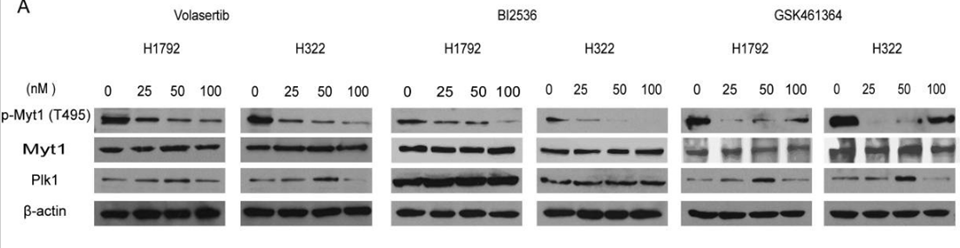
| Western blot | p-Myt1 / Myt1 / Plk1 |
|
26597303 |
Informazioni sullo studio clinico
(dati da https://clinicaltrials.gov, aggiornato il 2024-05-22)
| Numero NCT | Reclutamento | Condizioni | Sponsor/Collaboratori | Data di inizio | Fasi |
|---|---|---|---|---|---|
| NCT00536835 | Completed | Lymphoma Non-Hodgkin |
GlaxoSmithKline |
August 16 2007 | Phase 1 |
Supporto tecnico
Istruzioni per la manipolazione
Tel: +1-832-582-8158 Ext:3
Per qualsiasi altra domanda, si prega di lasciare un messaggio.
Domande Frequenti
Domanda 1:
I would like to know whether the recommended in vivo formulation will be suitable for i.p. injections of it.
Risposta:
It is a suspension in 1% DMSO+30% polyethylene glycol+1% Tween 80 at 30mg/ml, and is fine for oral gavage.

I prodotti sono solo per uso di ricerca. Non per uso umano. Non vendiamo a pazienti.
©Copyright 2013 Selleck Chemicals. Tutti i diritti riservati.