
solo per uso di ricerca
Istradefylline Adenosine Receptor antagonista
N. Cat.S2790
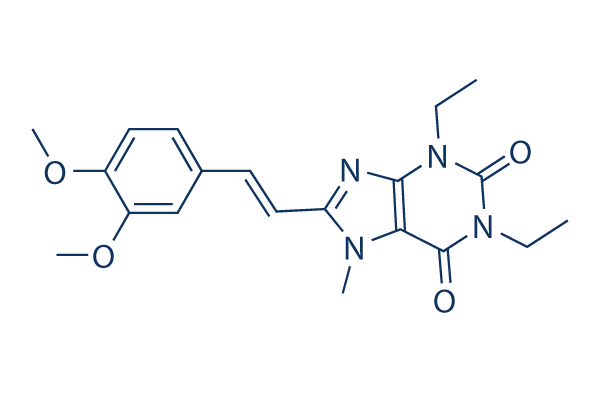
Struttura chimica
Peso molecolare: 384.43
Controllo Qualità
- Citato in Nature Medicine per la sua qualità superiore
- COA
- NMR
- SDS
- Scheda tecnica
| Target correlati | CXCR Hedgehog/Smoothened PKA Adrenergic Receptor AChR 5-HT Receptor Histamine Receptor Dopamine Receptor Ras KRas |
|---|---|
| Altro Adenosine Receptor Inibitori | Reversine CGS 21680 HCl ZM241385 SCH58261 Etrumadenant (AB928) A2AR antagonist 1 Ciforadenant (CPI-444) Imaradenant (AZD4635) DPCPX Proxyphylline |
Informazioni chimiche, conservazione e stabilità
| Peso molecolare | 384.43 | Formula | C20H24N4O4 |
Conservazione (Dalla data di ricezione) | |
|---|---|---|---|---|---|
| N. CAS | 155270-99-8 | Scarica SDF | Conservazione delle soluzioni stock |
|
|
| Sinonimi | KW-6002 | Smiles | CCN1C2=C(C(=O)N(C1=O)CC)N(C(=N2)C=CC3=CC(=C(C=C3)OC)OC)C | ||
Solubilità
|
In vitro |
DMSO
: 6 mg/mL
(15.6 mM)
Water : Insoluble Ethanol : Insoluble |
Calcolatore di Molarità
|
In vivo |
|||||
Calcolatore di formulazione in vivo (Soluzione chiara)
Passo 1: Inserire le informazioni di seguito (Consigliato: Un animale aggiuntivo per tenere conto della perdita durante lesperimento)
Passo 2: Inserire la formulazione in vivo (Questo è solo il calcolatore, non la formulazione. Contattateci prima se non cè una formulazione in vivo nella sezione Solubilità.)
Risultati del calcolo:
Concentrazione di lavoro: mg/ml;
Metodo per preparare il liquido master di DMSO: mg farmaco predissolto in μL DMSO ( Concentrazione del liquido master mg/mL, Vi preghiamo di contattarci prima se la concentrazione supera la solubilità del DMSO del lotto del farmaco. )
Metodo per preparare la formulazione in vivo: Prendere μL DMSO liquido master, quindi aggiungereμL PEG300, mescolare e chiarire, quindi aggiungereμL Tween 80, mescolare e chiarire, quindi aggiungere μL ddH2O, mescolare e chiarire.
Metodo per preparare la formulazione in vivo: Prendere μL DMSO liquido master, quindi aggiungere μL Olio di mais, mescolare e chiarire.
Nota: 1. Si prega di assicurarsi che il liquido sia limpido prima di aggiungere il solvente successivo.
2. Assicurarsi di aggiungere il/i solvente/i in ordine. È necessario assicurarsi che la soluzione ottenuta, nellaggiunta precedente, sia una soluzione limpida prima di procedere allaggiunta del solvente successivo. Metodi fisici come il vortex, gli ultrasuoni o il bagno dacqua calda possono essere utilizzati per facilitare la dissoluzione.
Meccanismo dazione
| Targets/IC50/Ki |
Adenosine A2A receptor
2.2 nM(Ki)
|
|---|---|
| In vitro |
L'affinità di Istradefylline per l'A2AR è 70 volte maggiore di quella per il recettore A1 con Ki di 2,2 nM rispetto a 150 nM. L'esposizione di astrociti striatali primari di ratto a questo composto porta all'abolizione concentrazione-dipendente dell'induzione di astrogliosi da bFGF in vitro. Le affinità di legame (Ki) di questa sostanza chimica per il recettore A1, il recettore A2A e il recettore A3 nell'uomo sono >287 nM, 9,12 nM e >681 nM, rispettivamente; per il recettore A1 e il recettore A2A nel ratto sono 50,9 nM e 1,57 nM, rispettivamente; e per il recettore A1 e il recettore A2A nel topo sono 105,02 nM e 1,87 nM, rispettivamente. |
| In vivo |
Istradefylline inverte la catalessia indotta da CGS21680 e da reserpina con una ED50 di 0,05 mg/kg e 0,26 mg/kg, rispettivamente. Questo composto è oltre 10 volte più potente in questi modelli rispetto ad altri antagonisti dell'adenosina e farmaci agonisti della dopamina. L'amministrazione di questa sostanza chimica in combinazione con LevoDOPA (50 mg/kg) esercita effetti prominenti sulla catalessia indotta da aloperidolo e da reserpina. L'amministrazione orale di questo composto a 10 mg/kg a marmoset comuni trattati con MPTP produce un aumento dell'attività locomotoria a circa il doppio di quella del controllo e migliora la disabilità motoria. L'amministrazione di questa sostanza chimica (10 mg/kg, po, 90 minuti prima di SKF80723/quinpirole/LevoDOPA) in combinazione con SKF80723 (1 mg/kg, ip), quinpirole (0,06 mg/kg ip) o LevoDOPA (2,5 mg/kg po) produce un effetto additivo significativo sull'attività locomotoria e sul miglioramento della disabilità motoria, ma non sulla discinesia. Nel modello murino MPTP, questo composto attenua significativamente la deplezione di dopamina striatale in diverse condizioni. Il pretrattamento con questa sostanza chimica (3,3 mg/kg, i.p.) prima di una singola dose di MPTP attenua le deplezioni parziali di dopamina e DOPAC misurate negli striati 1 settimana dopo. L'amministrazione orale di questo composto protegge dalla perdita di cellule neuronali dopaminergiche nigrali indotta da 6-idrossidopamina nei ratti e previene la perdita funzionale delle terminazioni nervose dopaminergiche nello striato e la conseguente gliosi causata da MPTP nei topi. Il trattamento cronico con questo composto non migliora i deficit di inversione nei ratti con deplezione di dopamina. I movimenti tremolanti della mascella indotti da pimozide sono significativamente ridotti dalla co-somministrazione di questa sostanza chimica o di tropicamide. Gli aumenti indotti da pimozide nell'espressione di c-Fos striatale ventrolaterale sono ridotti da una dose comportamentalmente efficace di questo composto, a differenza della tropicamide che in realtà aumenta l'espressione di c-Fos nei ratti trattati con pimozide. |
Riferimenti |
|
Informazioni sullo studio clinico
(dati da https://clinicaltrials.gov, aggiornato il 2024-05-22)
| Numero NCT | Reclutamento | Condizioni | Sponsor/Collaboratori | Data di inizio | Fasi |
|---|---|---|---|---|---|
| NCT05885360 | Active not recruiting | Parkinson Disease|Tremor |
Georgetown University|Kyowa Kirin Inc. |
January 20 2023 | Phase 4 |
| NCT02610231 | Completed | Idiopathic Parkinson''s Disease |
Kyowa Kirin Co. Ltd.|Kyowa Hakko Kirin Pharma Inc. |
December 2015 | Phase 3 |
| NCT02256033 | Completed | Hepatic Impairment |
Kyowa Kirin Co. Ltd.|Kyowa Hakko Kirin Pharma Inc. |
August 2014 | Phase 1 |
| NCT00455507 | Completed | Parkinson''s Disease |
Kyowa Kirin Co. Ltd. |
March 2007 | Phase 2 |
Supporto tecnico
Istruzioni per la manipolazione
Tel: +1-832-582-8158 Ext:3
Per qualsiasi altra domanda, si prega di lasciare un messaggio.

I prodotti sono solo per uso di ricerca. Non per uso umano. Non vendiamo a pazienti.
©Copyright 2013 Selleck Chemicals. Tutti i diritti riservati.