
solo per uso di ricerca
Dronedarone HCl Potassium Channel inibitore
N. Cat.S2114
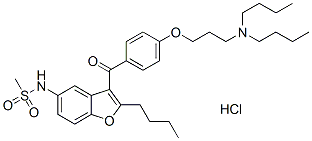
Struttura chimica
Peso molecolare: 593.22
Controllo Qualità
- Citato in Nature Medicine per la sua qualità superiore
- COA
- NMR
- SDS
- Scheda tecnica
| Target correlati | CFTR CRM1 CD markers AChR Calcium Channel Sodium Channel GABA Receptor TRP Channel ATPase GluR |
|---|---|
| Altro Potassium Channel Inibitori | TRAM-34 Nicorandil ML133 HCl Sophocarpine Hydralazine HCl Nigericin Gliquidone E-4031 dihydrochloride PAP-1 Ajmaline |
Informazioni chimiche, conservazione e stabilità
| Peso molecolare | 593.22 | Formula | C31H44N2O5S.HCl |
Conservazione (Dalla data di ricezione) | |
|---|---|---|---|---|---|
| N. CAS | 141625-93-6 | Scarica SDF | Conservazione delle soluzioni stock |
|
|
| Sinonimi | SR33589 | Smiles | CCCCC1=C(C2=C(O1)C=CC(=C2)NS(=O)(=O)C)C(=O)C3=CC=C(C=C3)OCCCN(CCCC)CCCC.Cl | ||
Solubilità
|
In vitro |
DMSO
: 80 mg/mL
(134.85 mM)
Ethanol : 40 mg/mL Water : Insoluble |
Calcolatore di Molarità
|
In vivo |
|||||
Calcolatore di formulazione in vivo (Soluzione chiara)
Passo 1: Inserire le informazioni di seguito (Consigliato: Un animale aggiuntivo per tenere conto della perdita durante lesperimento)
Passo 2: Inserire la formulazione in vivo (Questo è solo il calcolatore, non la formulazione. Contattateci prima se non cè una formulazione in vivo nella sezione Solubilità.)
Risultati del calcolo:
Concentrazione di lavoro: mg/ml;
Metodo per preparare il liquido master di DMSO: mg farmaco predissolto in μL DMSO ( Concentrazione del liquido master mg/mL, Vi preghiamo di contattarci prima se la concentrazione supera la solubilità del DMSO del lotto del farmaco. )
Metodo per preparare la formulazione in vivo: Prendere μL DMSO liquido master, quindi aggiungereμL PEG300, mescolare e chiarire, quindi aggiungereμL Tween 80, mescolare e chiarire, quindi aggiungere μL ddH2O, mescolare e chiarire.
Metodo per preparare la formulazione in vivo: Prendere μL DMSO liquido master, quindi aggiungere μL Olio di mais, mescolare e chiarire.
Nota: 1. Si prega di assicurarsi che il liquido sia limpido prima di aggiungere il solvente successivo.
2. Assicurarsi di aggiungere il/i solvente/i in ordine. È necessario assicurarsi che la soluzione ottenuta, nellaggiunta precedente, sia una soluzione limpida prima di procedere allaggiunta del solvente successivo. Metodi fisici come il vortex, gli ultrasuoni o il bagno dacqua calda possono essere utilizzati per facilitare la dissoluzione.
Meccanismo dazione
| Targets/IC50/Ki |
Potassium channel
Sodium channel
Calcium channel
|
|---|---|
| In vitro |
Il dronedarone riduce l'incidenza delle depolarizzazioni precoci e tardive evocate da 1 mM di Dofetilide e 0,2 mM di Strofantidina nelle fibre di Purkinje. Il dronedarone (10 mM) riduce marcatamente la corrente di calcio di tipo L (76,5%) e la componente rapida della corrente di potassio rettificatrice ritardata (97%) nei miociti ventricolari. Il dronedarone inibisce l'attività dei canali I(K(ACh)) registrati da patch applicati a cellule, riducendo la probabilità di apertura del canale (da 0,56 a 0,11) senza modificare la conduttanza del singolo canale in cellule singole isolate dal tessuto del nodo senoatriale (SAN) di cuori di coniglio. Il dronedarone mostra un'inibizione stato-dipendente della corrente rapida del canale Na(+) con un IC50 di 0,7 μM nei miociti ventricolari di cavia, quando il potenziale di mantenimento (V (hold)) è di -80 mV. Il dronedarone blocca le correnti di Ca(2+) evocate da impulsi rettangolari a V (hold) = -40 mV con un valore di IC50 di 0,4 μM, mentre a V (hold) = -80 mV, il dronedarone (10 μM) blocca solo il 20% della corrente.
|
| In vivo |
Il dronedarone aumenta la durata del potenziale d'azione in cuori normali di ratti. Il dronedarone riduce la corrente K(+) tardiva sostenuta, I(K) (o Isus) del 69%. Il dronedarone induce solo un blocco tonico di I(K). Il dronedarone induce un debole aumento della corrente transitoria rapida verso l'esterno, I(to), nei ratti dopo infarto miocardico.
|
Riferimenti |
|
Informazioni sullo studio clinico
(dati da https://clinicaltrials.gov, aggiornato il 2024-05-22)
| Numero NCT | Reclutamento | Condizioni | Sponsor/Collaboratori | Data di inizio | Fasi |
|---|---|---|---|---|---|
| NCT01430806 | Unknown status | ICD|ICD SHOCKS|DRONEDARONE |
Rabin Medical Center |
October 2011 | Not Applicable |
| NCT01266681 | Unknown status | Atrial Fibrillation |
Eastbourne General Hospital |
March 2011 | Not Applicable |
| NCT01199081 | Completed | Atrial Fibrillation |
Sanofi |
October 2010 | Phase 4 |
| NCT01213368 | Completed | Atrial Fibrillation |
Sanofi |
September 2010 | Phase 2 |
| NCT01140581 | Completed | Atrial Fibrillation |
Sanofi |
September 2010 | Phase 4 |
| NCT01070667 | Unknown status | Paroxysmal Atrial Fibrillation |
Eastbourne General Hospital |
March 2010 | Phase 4 |
Supporto tecnico
Istruzioni per la manipolazione
Tel: +1-832-582-8158 Ext:3
Per qualsiasi altra domanda, si prega di lasciare un messaggio.

I prodotti sono solo per uso di ricerca. Non per uso umano. Non vendiamo a pazienti.
©Copyright 2013 Selleck Chemicals. Tutti i diritti riservati.