
solo per uso di ricerca
ARS-853 KRas inibitore
N. Cat.S8156
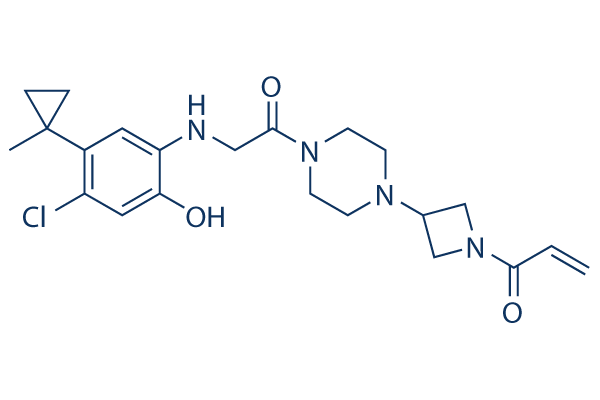
Struttura chimica
Peso molecolare: 432.94
Controllo Qualità
| Target correlati | CDK HSP PD-1/PD-L1 ROCK Wee1 DNA/RNA Synthesis Microtubule Associated Ras Aurora Kinase Casein Kinase |
|---|---|
| Altro KRas Inibitori | RMC-7977 Daraxonrasib (RMC-6236) MRTX1133 Zoldonrasib (RMC-9805) BI-2852 Adagrasib (MRTX849) HRS-4642 ARS-1620 BI-3406 BAY-293 |
Informazioni chimiche, conservazione e stabilità
| Peso molecolare | 432.94 | Formula | C22H29ClN4O3 |
Conservazione (Dalla data di ricezione) | |
|---|---|---|---|---|---|
| N. CAS | 1629268-00-3 | Scarica SDF | Conservazione delle soluzioni stock |
|
|
| Sinonimi | N/A | Smiles | CC1(CC1)C2=CC(=C(C=C2Cl)O)NCC(=O)N3CCN(CC3)C4CN(C4)C(=O)C=C | ||
Solubilità
|
In vitro |
DMSO
: 86 mg/mL
(198.64 mM)
Ethanol : 7 mg/mL Water : Insoluble |
Calcolatore di Molarità
|
In vivo |
|||||
Calcolatore di formulazione in vivo (Soluzione chiara)
Passo 1: Inserire le informazioni di seguito (Consigliato: Un animale aggiuntivo per tenere conto della perdita durante lesperimento)
Passo 2: Inserire la formulazione in vivo (Questo è solo il calcolatore, non la formulazione. Contattateci prima se non cè una formulazione in vivo nella sezione Solubilità.)
Risultati del calcolo:
Concentrazione di lavoro: mg/ml;
Metodo per preparare il liquido master di DMSO: mg farmaco predissolto in μL DMSO ( Concentrazione del liquido master mg/mL, Vi preghiamo di contattarci prima se la concentrazione supera la solubilità del DMSO del lotto del farmaco. )
Metodo per preparare la formulazione in vivo: Prendere μL DMSO liquido master, quindi aggiungereμL PEG300, mescolare e chiarire, quindi aggiungereμL Tween 80, mescolare e chiarire, quindi aggiungere μL ddH2O, mescolare e chiarire.
Metodo per preparare la formulazione in vivo: Prendere μL DMSO liquido master, quindi aggiungere μL Olio di mais, mescolare e chiarire.
Nota: 1. Si prega di assicurarsi che il liquido sia limpido prima di aggiungere il solvente successivo.
2. Assicurarsi di aggiungere il/i solvente/i in ordine. È necessario assicurarsi che la soluzione ottenuta, nellaggiunta precedente, sia una soluzione limpida prima di procedere allaggiunta del solvente successivo. Metodi fisici come il vortex, gli ultrasuoni o il bagno dacqua calda possono essere utilizzati per facilitare la dissoluzione.
Meccanismo dazione
| Targets/IC50/Ki |
K-Ras(G12C)
(in H358 cells) 2.5 μM
|
|---|---|
| In vitro |
Il trattamento delle cellule KRASG12C con ARS-853 ha portato a un'inibizione dose-dipendente e quasi completa del pulldown di KRAS mediato da CRAF-RBD (RBD) da lisati, con un IC50 di circa 1 μmol/L. Il trattamento delle cellule H358 con questo composto ha comportato una significativa perdita delle interazioni KRAS–CRAF. Coerentemente con uno stato inattivo di KRASG12C una volta legato a questa sostanza chimica, la segnalazione a valle attraverso le vie MAPK (inclusi pMEK, pERK e pRSK) e PI3K (pAKT) è stata inibita in cellule H358 e altre linee cellulari KRASG12C. L'inibizione del pulldown di RAF-RBD e della segnalazione a valle di KRAS è stata sostenuta per un periodo di 72 ore, accompagnata da un arresto del ciclo cellulare in G1, dalla perdita dell'espressione di Cyclin D1 e Rb e da un aumento dell'inibitore del ciclo cellulare p27 KIP1. Inoltre, nelle cellule H358 sono stati osservati segni distintivi dell'apoptosi, inclusi PARP clivata e aumenti del DNA sub-diploide, a seguito del trattamento con questo composto. Non sono stati osservati effetti sul legame di RAF-RBD o sulla segnalazione a valle nelle cellule A549 (KRASG12S), e gli effetti inibitori di esso nelle cellule H358 potrebbero essere stati recuperati dall'espressione ectopica di KRASG12V. KRASG12C è il bersaglio covalente più potente di questa sostanza chimica tra oltre 2.700 proteine cellulari e si riscontra costantemente che non esercita effetti sulla segnalazione o sulla crescita cellulare in cellule non KRASG12C a concentrazioni fino a 10 volte superiori alla sua potenza su KRASG12C. Reagisce solo con lo stato inattivo (legato al GDP), ma non con lo stato attivo (legato al GTP), di KRAS. Questo composto ha ridotto i livelli di KRAS-GTP e la fosforilazione di ERK nelle cellule renali embrionali umane 293 (HEK293) o nelle cellule H358 ingegnerizzate per esprimere KRASG12C ma non in quelle che esprimevano KRASG12C/A59G. Intrappola KRASG12C in una conformazione legata al GDP abbassando la sua affinità per i fattori di scambio nucleotidici.
|
Riferimenti |
|
Supporto tecnico
Istruzioni per la manipolazione
Tel: +1-832-582-8158 Ext:3
Per qualsiasi altra domanda, si prega di lasciare un messaggio.

I prodotti sono solo per uso di ricerca. Non per uso umano. Non vendiamo a pazienti.
©Copyright 2013 Selleck Chemicals. Tutti i diritti riservati.