
solo per uso di ricerca
AMD3465 hexahydrobromide CXCR Antagonista
N. Cat.: S2879
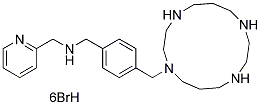
Struttura chimica
Peso molecolare: 896.07
Controllo Qualità (Quality Control)
- Citato in Nature Medicine per la sua qualità superiore
- COA
- NMR
- HPLC
- SDS
- Scheda tecnica
| Target correlati | Hedgehog/Smoothened PKA Adrenergic Receptor AChR 5-HT Receptor Histamine Receptor Dopamine Receptor Ras KRas GPR |
|---|---|
| Altro CXCR Inibitori | AZD5069 SB 225002 Reparixin (Repertaxin) WZ811 Navarixin (SCH-527123) LIT-927 SX-682 AMG 487 SB 265610 LY2510924 |
Informazioni chimiche, conservazione e stabilità (Chemical Information, Storage & Stability)
| Peso molecolare | 896.07 | Formula | C24H38N6.6HBr |
Conservazione (Dalla data di ricezione) | |
|---|---|---|---|---|---|
| N. CAS | 185991-07-5 | Scarica SDF | Conservazione delle soluzioni stock |
|
|
| Sinonimi | N/A | Smiles | C1CNCCNCCCN(CCNC1)CC2=CC=C(C=C2)CNCC3=CC=CC=N3.Br.Br.Br.Br.Br.Br | ||
Solubilità (Solubility)
|
In vitro |
Water : 98 mg/mL
DMSO
: 2 mg/mL
(2.23 mM)
Ethanol : Insoluble |
Calcolatore di Molarità
|
In vivo |
|||||
Calcolatore di formulazione in vivo (Soluzione chiara)
Passo 1: Inserire le informazioni di seguito (Consigliato: Un animale aggiuntivo per tenere conto della perdita durante l'esperimento)
Passo 2: Inserire la formulazione in vivo (Questo è solo il calcolatore, non la formulazione. Contattateci prima se non c'è una formulazione in vivo nella sezione Solubilità.)
Risultati del calcolo:
Concentrazione di lavoro: mg/ml;
Metodo per preparare il liquido master di DMSO: mg farmaco predissolto in μL DMSO ( Concentrazione del liquido master mg/mL, Vi preghiamo di contattarci prima se la concentrazione supera la solubilità del DMSO del lotto del farmaco. )
Metodo per preparare la formulazione in vivo: Prendere μL DMSO liquido master, quindi aggiungereμL PEG300, mescolare e chiarire, quindi aggiungereμL Tween 80, mescolare e chiarire, quindi aggiungere μL ddH2O, mescolare e chiarire.
Metodo per preparare la formulazione in vivo: Prendere μL DMSO liquido master, quindi aggiungere μL Olio di mais, mescolare e chiarire.
Nota: 1. Si prega di assicurarsi che il liquido sia limpido prima di aggiungere il solvente successivo.
2. Assicurarsi di aggiungere il/i solvente/i in ordine. È necessario assicurarsi che la soluzione ottenuta, nell'aggiunta precedente, sia una soluzione limpida prima di procedere all'aggiunta del solvente successivo. Metodi fisici come il vortex, gli ultrasuoni o il bagno d'acqua calda possono essere utilizzati per facilitare la dissoluzione.
Meccanismo d'azione (Mechanism of Action)
| Targets/IC50/Ki |
CXCR4
|
|---|---|
| In vitro |
AMD3465 blocks the binding of CXCL12 with IC50 of 18 nM in SupT1 cells. AMD3465 inhibits CXCL12-induced calcium signaling in SupT1 cells with IC50 of 17 nM and also inhibits MAPK phosphorylation. While AMD3465 couldn't block the intracellular calcium fluxes elicited by the CCR5 ligands RANTES, LD78β and MIP-1β in U87.CD4.CCR5 cells. AMD3465 suppresses CXCL12-induced chemotaxis of human T-lymphoid SupT1 cells and prevents chemokine-induced internalization of CXCR4 in U87.CD4 cells. Moreover, AMD3465 proves active against the X4 HIV-1 strains IIIB, NL4.3, RF and HE with IC50 from 6-12 nM. AMD3465 suppresses the HIV-2 strains ROD and EHO with IC50 of 12.3 nM. AMD3465 inhibits SDF-1αligand binding with Ki of 41.7 nM sing the CCRF-CEM cell line. Inhibition of CXCR4 signaling pathways by AMD3465 is demonstrated by inhibition of SDF-1α stimulated calcium flux and GTP binding with IC50 of 12.07 nM and 10.38 nM, respectively. Furthermore AMD3465 is able to inhibit CXCR4-mediated physiological response, cell chemotaxis, with IC50 of 8.7 nM. In addition, AMD3465 has no inhibitory effect on either MIP1α, MCP-1, TARC, RANTES, MIP-3β, or IP10 mediated calcium flux, ligands for CCR1, CCR2b, CCR4, CCR5, CCR7 and CXCR3 respectively, or LTB4 binding to BLT1, thus indicating that AMD3465 is a selective inhibitor of CXCR4 over other chemokine receptors. In a separate study AMD3465 is shown to inhibit SDF-1-mediated CXCR4 internalization in cells expressing GFP-linked CXCR4, and does not cause receptor internalization when incubated with the cells alone.
|
| In vivo |
The pharmacokinetics of AMD3465 is investigated in mice and dogs. Absorption is rapid following subcutaneous administration. AMD3465 is cleared from dog plasma in a biphasic manner with a terminal half-life of 1.56-4.63 h. AMD3465 shows 100% bioavailability following subcutaneous administration by comparison of exposure to the intravenous and subcutaneous doses. AMD3465 causes leukocytosis when administered subcutaneously in mice and dogs, with peak mobilization occurring between 0.5 h and 1.5 h following subcutaneous dosing in mice and with maximum peak plasma concentration of compound preceding peak mobilization in dogs, indicating that AMD3465 has the potential to mobilize hematopoietic stem cells. AMD3465 abrogates type-2 granuloma formation and eosinophil mobilization at the 6 and 30 mg/kg doses. AMD3465 treatment could cause an ~90% reduction in CXCR4 transcript levels in lungs with type-2 lesions.
|
Riferimenti |
|

I prodotti sono solo per uso di ricerca. Non per uso umano. Non vendiamo a pazienti.
©Copyright 2013 Selleck Chemicals. Tutti i diritti riservati.