
solo per uso di ricerca
ABT-751 (E7010) Microtubule Associated inibitore
N. Cat.S1165
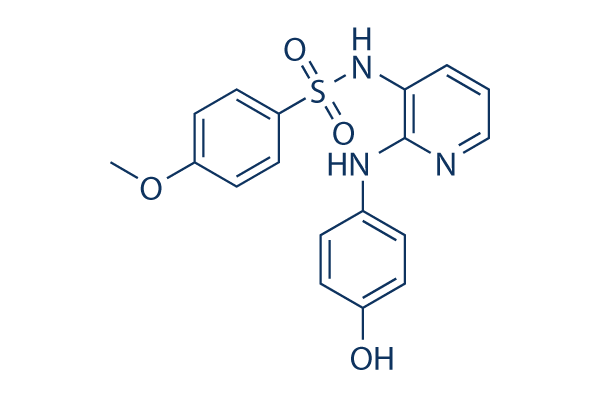
Struttura chimica
Peso molecolare: 371.41
Controllo Qualità
- Citato in Nature Medicine per la sua qualità superiore
- COA
- NMR
- SDS
- Scheda tecnica
| Target correlati | Akt Wnt/beta-catenin PKC HSP ROCK Integrin Bcr-Abl Actin FAK Kinesin |
|---|---|
| Altro Microtubule Associated Inibitori | Nocodazole MMAF Patupilone (Epothilone B) Lexibulin (CYT997) CW069 Combretastatin A4 Epothilone A TAI-1 Cucurbitacin B INH1 |
Coltura cellulare, trattamento e concentrazione di lavoro
| Linee cellulari | Tipo di saggio | Concentrazione | Tempo di incubazione | Formulazione | Descrizione dellattività | PMID |
|---|---|---|---|---|---|---|
| HCT-15 cell | Proliferation assay | Antiproliferative activity against human colon carcinoma HCT-15 cell line(MDR(-)), IC50=0.34 μM | ||||
| HCT116-C9 cell | Function assay | Effective concentration to inhibit cell proliferation by 50% relative to untreated control cell after 72 hr of continuous exposure in HCT116-C9 cell line, IC50=0.9 μM | ||||
| NCI-H460 cell | Proliferation assay | Antiproliferative activity against human lung carcinoma NCI-H460 cell line (MDR(+)), IC50=0.35 μM | ||||
| P388 cell line | Function assay | 72 h | Effective concentration to inhibit cell proliferation by 50% relative to untreated control cell after 72 hr of continuous exposure in P388 cell line, IC50=0.19 μM | |||
| P388/4.0 r-M cell line | Function assay | 72 h | Effective concentration to inhibit cell proliferation by 50% relative to untreated control cell after 72 hr of continuous exposure in P388/4.0 r-M cell line, IC50=15 μM | |||
| human HL60 cells | Proliferation assay | Antiproliferative activity against human HL60 cells, IC50=0.34 μM | ||||
| HeLa cells | Cytotoxicity assay | 48-72 h | Cytotoxicity against human HeLa cells after 48 to 72 hrs by WAT-1 assay, IC50=0.27 μM | |||
| MDR1 cells | Cytotoxicity assay | 48-72 h | Cytotoxicity against human NCI-ADR-RES expressing MDR1 cells after 48 to 72 hrs by WAT-1 assay, IC50=0.29 μM | |||
| Jurkat cells | Function assay | 24 h | Cell cycle arrest in human Jurkat cells assessed as accumulation at G2/M phase after 24 hrs using propidium iodide staining by FACS analysis, IC50=0.16 μM | |||
| SW620 cells | Cytotoxicity assay | 48-72 h | Cytotoxicity against human SW620 cells after 48 to 72 hrs by WAT-1 assay, IC50=0.19 μM | |||
| A2780 cells | Cytotoxicity assay | 48-72 h | Cytotoxicity against human A2780 cells after 48 to 72 hrs by WAT-1 assay, IC50=0.17 μM | |||
| HT-29 cells | Proliferation assay | 72 h | Antiproliferative activity against human HT-29 cells after 72 hrs by MTT assay, IC50=0.21 μM | |||
| HUVEC | Function assay | 100-1000 nM | 4 h | Induction of vascular disrupting activity in HUVEC assessed as VEGF-induced tube formation at 100 to 1000 nM after 4 hrs by microscopic analysis | ||
| H460 cells | Cytotoxicity assay | 72 h | Cytotoxicity against human H460 cells assessed as growth inhibition after 72 hrs by methylene blue staining-based assay, IC50=0.2177 μM | |||
| MKN45 cells | Cytotoxicity assay | 72 h | Cytotoxicity against human MKN45 cells assessed as growth inhibition after 72 hrs by methylene blue staining-based assay, IC50=0.166 μM | |||
| HT-29 cells | Cytotoxicity assay | 72 h | Cytotoxicity against human HT-29 cells assessed as growth inhibition after 72 hrs by methylene blue staining-based assay, IC50=0.3387 μM | |||
| human A549 cells | Cytotoxicity assay | 48 h | Cytotoxicity against human A549 cells after 48 hrs by MTT assay, IC50=1.31 μM | |||
| ACHN cells | Cytotoxicity assay | 48 h | Cytotoxicity against human ACHN cells after 48 hrs by MTT assay, IC50=2.13 μM | |||
| MCF7 cells | Cytotoxicity assay | 48 h | Cytotoxicity against human MCF7 cells after 48 hrs by MTT assay, IC50=1.25 μM | |||
| HT-29 cells | Cytotoxicity assay | 48 h | Cytotoxicity against human HT-29 cells after 48 hrs by MTT assay, IC50=1.62 μM | |||
| A549 cells | Proliferation assay | 24 h | Antiproliferative activity against human A549 cells assessed as growth inhibition after 24 hrs by SRB assay, GI50=1.31 μM | |||
| human MCF7 cells | Proliferation assay | 24 h | Antiproliferative activity against human MCF7 cells assessed as growth inhibition after 24 hrs by SRB assay, GI50=1.25 μM | |||
| KB-S15 cells | Cytotoxicity assay | 72 h | Cytotoxicity against human KB-S15 cells overexpressing P-gp170/MDR assessed as growth inhibition after 72 hrs by methylene blue staining-based assay, IC50=0.206 μM | |||
| KB-7d cells | Cytotoxicity assay | 72 h | Cytotoxicity against human KB-7d cells overexpressing MRP assessed as growth inhibition after 72 hrs by methylene blue staining-based assay, IC50=0.205 μM | |||
| KB-VIN10 cells | Cytotoxicity assay | 72 h | Cytotoxicity against human KB-VIN10 cells overexpressing P-gp170/MDR assessed as growth inhibition after 72 hrs by methylene blue staining-based assay, IC50=0.227 μM | |||
| human PC3 cells | Cytotoxicity assay | 48 h | Cytotoxicity against human PC3 cells assessed as growth inhibition after 48 hrs by sulforhodamine B assay, GI50=0.62 μM | |||
| human AsPC1 cells | Cytotoxicity assay | 48 h | Cytotoxicity against human AsPC1 cells assessed as growth inhibition after 48 hrs by sulforhodamine B assay, GI50=4.11 μM | |||
| human A549 cells | Cytotoxicity assay | 48 h | Cytotoxicity against human A549 cells assessed as growth inhibition after 48 hrs by sulforhodamine B assay, GI50=5.33 μM | |||
| Hep3B cells | Cytotoxicity assay | 48 h | Cytotoxicity against human Hep3B cells assessed as growth inhibition after 48 hrs by sulforhodamine B assay, GI50=0.84 μM | |||
| KB cells | Cytotoxicity assay | 72 h | Cytotoxicity against human KB cells assessed as growth inhibition after 72 hrs by methylene blue staining-based assay, IC50=0.2513 μM | |||
| DU145 cells | Proliferation assay | 24 h | Antiproliferative activity against human DU145 cells assessed as growth inhibition after 24 hrs by SRB assay, GI50=1.81 μM | |||
| DU145 cells | Cytotoxicity assay | 48 h | Cytotoxicity against human DU145 cells after 48 hrs by MTT assay, GI50=1.81 μM | |||
| human SKBR3 cells | Growth inhibition assay | 48 h | Growth inhibition of human SKBR3 cells after 48 hrs by MTT assay, IC50=0.74 μM | |||
| Clicca per visualizzare più dati sperimentali sulle linee cellulari | ||||||
Informazioni chimiche, conservazione e stabilità
| Peso molecolare | 371.41 | Formula | C18H17N3O4S |
Conservazione (Dalla data di ricezione) | |
|---|---|---|---|---|---|
| N. CAS | 141430-65-1 | Scarica SDF | Conservazione delle soluzioni stock |
|
|
| Sinonimi | N/A | Smiles | COC1=CC=C(C=C1)S(=O)(=O)NC2=C(N=CC=C2)NC3=CC=C(C=C3)O | ||
Solubilità
|
In vitro |
DMSO
: 74 mg/mL
(199.24 mM)
Ethanol : 12 mg/mL Water : Insoluble |
Calcolatore di Molarità
|
In vivo |
|||||
Calcolatore di formulazione in vivo (Soluzione chiara)
Passo 1: Inserire le informazioni di seguito (Consigliato: Un animale aggiuntivo per tenere conto della perdita durante lesperimento)
Passo 2: Inserire la formulazione in vivo (Questo è solo il calcolatore, non la formulazione. Contattateci prima se non cè una formulazione in vivo nella sezione Solubilità.)
Risultati del calcolo:
Concentrazione di lavoro: mg/ml;
Metodo per preparare il liquido master di DMSO: mg farmaco predissolto in μL DMSO ( Concentrazione del liquido master mg/mL, Vi preghiamo di contattarci prima se la concentrazione supera la solubilità del DMSO del lotto del farmaco. )
Metodo per preparare la formulazione in vivo: Prendere μL DMSO liquido master, quindi aggiungereμL PEG300, mescolare e chiarire, quindi aggiungereμL Tween 80, mescolare e chiarire, quindi aggiungere μL ddH2O, mescolare e chiarire.
Metodo per preparare la formulazione in vivo: Prendere μL DMSO liquido master, quindi aggiungere μL Olio di mais, mescolare e chiarire.
Nota: 1. Si prega di assicurarsi che il liquido sia limpido prima di aggiungere il solvente successivo.
2. Assicurarsi di aggiungere il/i solvente/i in ordine. È necessario assicurarsi che la soluzione ottenuta, nellaggiunta precedente, sia una soluzione limpida prima di procedere allaggiunta del solvente successivo. Metodi fisici come il vortex, gli ultrasuoni o il bagno dacqua calda possono essere utilizzati per facilitare la dissoluzione.
Meccanismo dazione
| Caratteristiche |
An orally bioavailable tubulin-binding and antimitotic sulfonamide.
|
|---|---|
| Targets/IC50/Ki |
Microtubules
|
| In vitro |
In vitro, ABT-751 (E7010) mostra una citotossicità selettiva con valori di IC50 di 0,6–2,6 μM nel neuroblastoma e 0,7–4,6 μM in altre linee cellulari di tumori solidi. Inoltre, esibisce anche un effetto selettivo sui microtubuli dinamici e risparmia i microtubuli stabili, il che spiega la persistenza di tubuli polimerizzati positivi per l'α-tubulina acetilata e detirosinata alla sua concentrazione IC90.
|
| In vivo |
In questo modello di xenotrapianto Calu-6, ABT-751 (E7010) come agente singolo a 100 e 75 mg/kg/giorno mostra una significativa attività antitumorale, mentre in combinazione con cisplatino, mostra un miglioramento dose-dipendente nel ritardo della crescita. Nel modello di xenotrapianto del colon HT-29, questo composto mostra anche una significativa attività antitumorale come agente singolo e ha prodotto un miglioramento dose-dipendente nel ritardo della crescita in combinazione con 5-FU. Nei cani con linfoma, mostra le tossicità dose-limitanti che includono vomito, diarrea, anoressia o una combinazione di questi con una dose massima tollerata (MTD) di 350 mg/m2 PO ogni 24 ore. Inoltre, l'AUC media e la Cmax per ABT-751 alla MTD di 350 mg/m2 sono rispettivamente 5,55 μg-ora/mL e 0,9 μg/mL.
|
Riferimenti |
|
Informazioni sullo studio clinico
(dati da https://clinicaltrials.gov, aggiornato il 2024-05-22)
| Numero NCT | Reclutamento | Condizioni | Sponsor/Collaboratori | Data di inizio | Fasi |
|---|---|---|---|---|---|
| NCT00436852 | Completed | Disseminated Neuroblastoma|Recurrent Neuroblastoma |
Children''s Oncology Group|National Cancer Institute (NCI) |
January 2007 | Phase 2 |
| NCT00735878 | Terminated | Non Small Cell Lung Cancer|Lung Cancer |
Konstantin Dragnev|Abbott|Dartmouth-Hitchcock Medical Center |
September 2004 | Phase 1|Phase 2 |
Supporto tecnico
Istruzioni per la manipolazione
Tel: +1-832-582-8158 Ext:3
Per qualsiasi altra domanda, si prega di lasciare un messaggio.

I prodotti sono solo per uso di ricerca. Non per uso umano. Non vendiamo a pazienti.
©Copyright 2013 Selleck Chemicals. Tutti i diritti riservati.