Wnt proteins form a family of highly conserved secreted signaling molecules that regulate cell-to-cell interactions during embryogenesis. Wnt signalling pathway plays a key role in the development of CSC(Cancer stem cell) and it may be a significant step in the development of a large number of tomours. As currently understood, Wnt proteins bind to receptors of the Frizzled and LRP families on the cell surface. [show the full text]

Wnt/beta-catenin inibitori/attivatori (Wnt/beta-catenin Inhibitors/Activators)
Altro Stem Cells & Wnt Inibitori
| N. Cat. | Nome del prodotto | Informazioni | Citazioni di utilizzo del prodotto | Validazioni del prodotto |
|---|---|---|---|---|
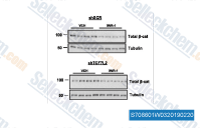
| S7086 | IWR-1-endo | IWR-1-endo (endo-IWR 1, IWR-1) è un inibitore della via Wnt con IC50 di 180 nM in cellule L che esprimono Wnt3A, induce i livelli della proteina Axin2 e promuove la fosforilazione della β-catenina stabilizzando i complessi di distruzione impalcati da Axin. |
|
|
| S8968 | PRI-724 (Foscenvivint) | Foscenvivint (PRI-724) è un potente e specifico inibitore che interrompe l'interazione tra β-catenina e CBP. |
|
|
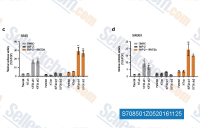
| S7085 | IWP-2 | IWP-2 è un inibitore del processamento e della secrezione di Wnt con un IC50 di 27 nM in un saggio senza cellule, blocco selettivo della palmitoilazione di Wnt mediata da Porcn, non influenza Wnt/β-catenina in generale e non mostra alcun effetto contro le risposte cellulari stimolate da Wnt. IWP-2 inibisce specificamente CK1δ. |
|
|
| S0733 | Tegatrabetan (BC-2059) | Tegatrabetan (BC-2059, Tegavivint), un antagonista della β-Catenina, interrompe il legame della β-catenina con la proteina scaffold transducina β-like 1 (TBL1) e la degradazione proteasomica, portando a una diminuzione dei livelli nucleari di β-catenina. |
|
|
| S3842 | Isoquercitrin | Isoquercitrin (Hirsutrin, 3-Glucosylquercetin, Quercetin 3-o-glucopyranoside), un composto flavonoide con attività antitumorale isolato da Bidens bipinnata L, è un inibitore di Wnt/ A-catenina che agisce a valle della traslocazione nucleare della A-catenina. |
|
|
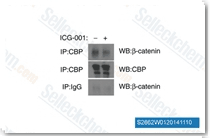
| S2662 | ICG-001 | ICG-001 antagonizza la trascrizione mediata da Wnt/β-catenina/TCF e si lega specificamente alla proteina legante CREB (CBP) con un IC50 di 3 μM, ma non è il coattivatore trascrizionale correlato p300. ICG-001 induce l'apoptosi. |
|
|
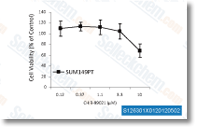
| S1263 | CHIR-99021 (Laduviglusib) | Laduviglusib (CHIR-99021, CT99021) è un inibitore di GSK-3α e GSK-3β con valori di IC50 di 10 nM e 6,7 nM, rispettivamente. Non mostra reattività crociata contro le chinasi ciclina-dipendenti (CDK) e mostra una selettività 350 volte superiore verso GSK-3β rispetto alle CDK. Questo composto funziona come attivatore di Wnt/β-catenin e induce l'autophagy. |
|
|
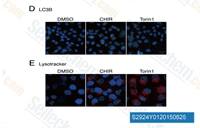
| S2924 | Laduviglusib (CHIR-99021) Hydrochloride | Laduviglusib (CHIR-99021; CT99021) HCl è il cloridrato di CHIR-99021, che è un inibitore di GSK-3α/β con IC50 di 10 nM/6,7 nM; CHIR-99021 mostra una selettività maggiore di 500 volte per GSK-3 rispetto ai suoi omologhi più stretti Cdc2 ed ERK2. CHIR-99021 è un potente attivatore farmacologico della via di segnalazione Wnt/beta-catenin. CHIR-99021 recupera significativamente l'autophagy indotta dalla luce e aumenta GR, RORα e le proteine correlate all'autofagia. |
|
|
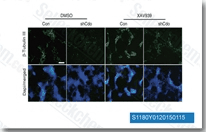
| S1180 | XAV-939 | XAV-939 (NVP-XAV939) inibisce selettivamente la trascrizione mediata da Wnt/β-catenina attraverso l'inibizione di tankyrase1/2 con IC50 di 11 nM/4 nM in saggi acellulari, regola i livelli di axina e non influenza CRE, NF-κB o TGF-β. |
|
|
| S5992 | Heparan Sulfate | Heparan sulfate (HS, Heparitin sulfate, Alpha-idosane, HHS 5, N-Acetylheparan Sulfate, Suleparoid, Tavidan), un costituente dei proteoglicani HS (HSPG), è un polisaccaride lineare presente sulla superficie cellulare. Heparan sulfate influenza l'affinità di legame delle cellule dell'epitelio intestinale (IEC) al Wnt, promuovendo così l'attivazione della segnalazione canonica di Wnt e facilitando la rigenerazione delle cripte dell'intestino tenue dopo una lesione epiteliale. |
|
|
The Wnt/β-catenin signalling pathway is an important mechanism of study for researchers of human diseases as it plays a role in oncology when overactivated, however, reduced signalling of this pathway also results in abnormal bone development and neurodegenerative illnesses. Depending on the indication of use, development of inhibitors or activators of the Wnt/β-catenin signalling pathway is an important area of focus.
Normally, regulation of the Wnt/β-catenin signalling pathway occurs by a large protein assembly called the β-catenin destruction complex that maintains low concentrations of β-catenin in the cytoplasm, and consequently in the nucleus. The β-catenin destruction complex is comprised of glycogen synthase kinase 3 (GSK3α/ GSK3β), casein kinase Iα (CKIα), Axin1/Axin2 scaffolding, and adenomatous polyposis coli (APC) – a tumor suppressor protein. Recruitment of β-catenin to the destruction complex leads to the phosphorylation of β-catenin N-terminus residues by CKIα and GSK3, following which ubiquitination and degradation events occur. Sequestering β-catenin at several N-terminal serine and threonine residues to the β-catenin destruction complex are Axin and APC. Similarly, it is believed these constituents of the β-catenin destruction complex regulate β-catenin efflux from the nucleus. The low concentration of β-catenin in the cell restricts β-catenin to the essential role of cadherin-mediated cell adhesion. An additional mechanism controlling the expression of Wnt signalling in the cell involves the inhibition of Wnt specific gene transcription by the T-cell factor (TCF) family of proteins.[1]
Activation of the Wnt/β-catenin signalling pathway is signified by the formation of a “Wnt signalosome” – a large protein complex that develops following the recognition of Wnt protein on the cell surface by a set of proteins called the seven-pass transmembrane Frizzled (Fz) family and its co-receptor, low density lipoprotein receptor related protein (LRP5/LRP6).ii The Wnt signalosome inhibits the activity of the β-catenin destruction complex by recruiting several components of the destruction complex to the membrane. As a consequence, the buildup of β-catenin’s unphosphorylated form results in the cytoplasm and subsequently in the nucleus. It is in the nucleus where rising concentrations of β-catenin combine with TCF proteins to transform this protein from an inhibitory protein to an activator of Wnt-signalling pathway by encouraging the transcription of the Wnt-responsive gene.[1]
Among cancer research, Wnt/β-catenin signalling is an area of focus since loss-of-function mutations in the APC gene results in β-catenin stabilization. Deletions within a chromosomal region containing the APC gene is understood to be associated with a hereditary disease known as familial adenomatous polyposis that yield intestinal polyps in large numbers that ultimately gives rise to tumors. Alternatively, mutations that promote gain-of-function of the APC gene inhibit the β-catenin destruction complex from limiting β-catenin concentrations in the cell. Additionally, some cancers have been correlated to a loss of Axin1 or Axin2 function. Overexpression of the Wnt/ β-catenin signalling pathway results in the constitutive activation of c-myc, and is most commonly linked to colorectal cancer.[2]
Since the Wnt/β-catenin signalling pathway plays a critical role in cancer, clinical research has yielded several new targets that may positively influence Wnt/β-catenin signalling where its absence is related to disease. Potential new drug targets include two lipid kinases that were found with the accumulation of β-catenin among HEK293T cells transfected with short inhibitory RNAs (siRNAs) targeting human kinases, these include: (1) phosphatidylinositol 4-kinase type IIα (PI4KIIα), and (2) phosphatidylinositol-4-phosphate 5-kinase type Iβ (PIP5Kiβ). Additionally, three human homologs of Drosophila PAR-1 can also provide useful drug targets as these elements activate Wnt/β-catenin signalling pathway as well.[2]
There are many enzymes involved in the Wnt/β-catenin signalling pathway and knowing whether activation or repression is best suited will determine the molecular strategy to explore for therapeutic benefit.

I prodotti sono solo per uso di ricerca. Non per uso umano. Non vendiamo a pazienti.
©Copyright 2013 Selleck Chemicals. Tutti i diritti riservati.