
solo per uso di ricerca
GW3965 Hydrochloride Agonista LXR
N. Cat.S2630
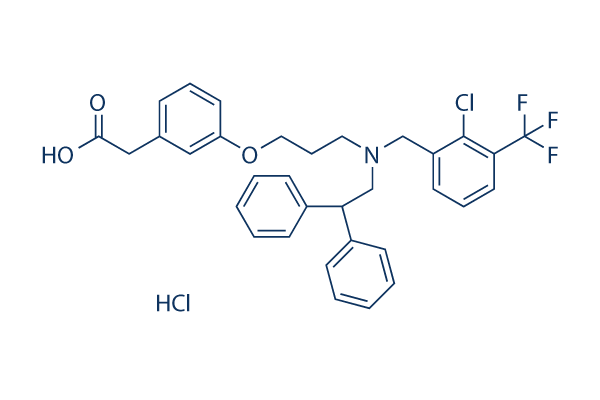
Struttura chimica
Peso molecolare: 618.51
Controllo Qualità
Prodotti spesso usati con GW3965 Hydrochloride
| Target correlati | Dehydrogenase HSP Transferase P450 (e.g. CYP17) PDE phosphatase PPAR Vitamin Carbohydrate Metabolism Mitochondrial Metabolism |
|---|---|
| Altro Liver X Receptor Inibitori | T0901317 LXR-623 (WAY-252623) GSK2033 SR9243 Abequolixron (RGX-104) AZ876 GSK3987 Desmosterol |
Coltura cellulare, trattamento e concentrazione di lavoro
| Linee cellulari | Tipo di saggio | Concentrazione | Tempo di incubazione | Formulazione | Descrizione dellattività | PMID |
|---|---|---|---|---|---|---|
| HEK293 | 10 uM | 20 hrs | Activation of human LXRalpha expressed in HEK293 cells co-expressing human RXRalpha at 10 uM after 20 hrs by luciferase reporter gene assay | 28006909 | ||
| HEK293 | 10 uM | 20 hrs | Activation of rat LXRbeta expressed in HEK293 cells co-expressing human RXRalpha at 10 uM after 20 hrs by luciferase reporter gene assay | 28006909 | ||
| THP1 | Function assay | Induction of cholesterol efflux in THP1 cells, EC50 = 0.01 μM. | 17587573 | |||
| THP1 | Function assay | 18 hrs | Induction of cholesterol efflux in THP1 cells after 18 hrs, EC50 = 0.01 μM. | 17416521 | ||
| COS7 | Function assay | 16 hrs | Agonist activity at human LXRbeta receptor transfected in COS7 cells after 16 hrs by reporter transactivation assay, EC50 = 0.015 μM. | 17587573 | ||
| COS7 | Function assay | Activation of LXRbeta co-transfected in COS7 cells with RXRalpha by reporter transactivation assay, EC50 = 0.015 μM. | 17416521 | |||
| THP1 | Antiinflammatory assay | 6 hrs | Antiinflammatory activity against human THP1 cells assessed as inhibition of LPS-stimulated IL6 production after 6 hrs by ELISA, IC50 = 0.02 μM. | 18800767 | ||
| THP1 | Function assay | Agonist activity at GAL-linked human LXRbeta expressed in THP1 cells assessed as stimulation of co-activator recruitment by FRET assay, EC50 = 0.027 μM. | 17665897 | |||
| RAW264.7 | Function assay | 24 hrs | Induction of [3H]cholesterol efflux in mouse RAW264.7 cells loaded with acetylated-LDL after 24 hrs, EC50 = 0.029 μM. | 19717304 | ||
| THP1 | Function assay | Stimulation of [3H]cholesterol efflux in human THP1 foam cells loaded with ac-LDL, EC50 = 0.031 μM. | 18973288 | |||
| CV1 | Function assay | Antagonist activity at LXRbeta ligand binding domain assessed as inhibition of T1317-induced transcriptional activity in african green monkey CV1 cells co-transfected with Gal4-SRC1 by luciferase reporter assay, IC50 = 0.03981 μM. | 20345102 | |||
| THP1 | Function assay | Agonist activity at GAL-linked human LXRalpha expressed in THP1 cells assessed as stimulation of coactivator recruitment by FRET assay, EC50 = 0.097 μM. | 17665897 | |||
| CV1 | Function assay | Antagonist activity at LXRalpha ligand binding domain assessed as inhibition of T1317-induced transcriptional activity in african green monkey CV1 cells co-transfected with Gal4-SRC1 by luciferase reporter assay, IC50 = 0.1 μM. | 20345102 | |||
| SH-SY5Y | Function assay | 24 hrs | Agonist activity at human LXRbeta expressed in human SH-SY5Y cells co-transfected with Gal4-LBD after 24 hrs by luciferase reporter gene assay, EC50 = 0.13 μM. | 19264481 | ||
| HepG2 | Function assay | Effect on SREBP1c gene expression in human HepG2 cells, EC50 = 0.21 μM. | 18973288 | |||
| HuH7 | Function assay | Agonist activity at human recombinant LXRbeta ligand binding domain in human HuH7 cells co-transfected with fused Gal4-DBD by transactivation assay, EC50 = 0.31 μM. | 18973288 | |||
| SH-SY5Y | Function assay | 24 hrs | Agonist activity at human LXRalpha expressed in human SH-SY5Y cells co-transfected with Gal4-LBD after 24 hrs by luciferase reporter gene assay, EC50 = 0.31 μM. | 19264481 | ||
| CHO | Function assay | Agonist activity at human LXR beta receptor expressed in CHO cells by reporter assay, EC50 = 0.41 μM. | 17034119 | |||
| CHOK1 | Function assay | 24 hrs | Agonist activity at Gal4-tagged LXRbeta (unknown origin) expressed in CHOK1 cells after 24 hrs by luciferase reporter gene assay, EC50 = 0.42 μM. | 25677664 | ||
| THP1 | Function assay | Effect on ABCA1 gene expression in human differentiated THP1 cells, EC50 = 0.434 μM. | 18973288 | |||
| CV1 | Function assay | Agonist activity at LXRbeta ligand binding domain-mediated transcriptional activity in african green monkey CV1 cells co-transfected with Gal4-SRC1 by luciferase reporter assay, EC50 = 0.50119 μM. | 20345102 | |||
| HuH7 | Function assay | Agonist activity at human recombinant LXRalpha ligand binding domain in human HuH7 cells co-transfected with fused Gal4-DBD by transactivation assay, EC50 = 0.66 μM. | 18973288 | |||
| CV1 | Function assay | Agonist activity at LXRalpha ligand binding domain-mediated transcriptional activity in african green monkey CV1 cells co-transfected with Gal4-SRC1 by luciferase reporter assay, EC50 = 0.79433 μM. | 20345102 | |||
| CHOK1 | Function assay | 24 hrs | Agonist activity at Gal4-tagged LXRalpha (unknown origin) expressed in CHOK1 cells after 24 hrs by luciferase reporter gene assay, EC50 = 1.3 μM. | 25677664 | ||
| HepG2 | Function assay | Effect on triglyceride accumulation in human HepG2 cells, EC50 = 2.002 μM. | 18973288 | |||
| HepG2 | Function assay | 500 nM | Inhibition of 2-(3-(3-((2-chloro-3-(trifluoromethyl)benzyl)(2,2-diphenylethyl)amino)propoxy)phenyl)acetic acid-induced srebp1c mRNA expression in human HepG2 cells at 500 nM | 18800767 | ||
| HepG2 | Function assay | 500 nM | Inhibition of 2-(3-(3-((2-chloro-3-(trifluoromethyl)benzyl)(2,2-diphenylethyl)amino)propoxy)phenyl)acetic acid-induced fas mRNA expression in human HepG2 cells at 500 nM | 18800767 | ||
| RAW264.7 | Function assay | 1 uM | Reduction of LPS-stimulated iNOS gene expression in mouse RAW264.7 cells expressing LXRalpha at 1 uM by luciferase reporter gene assay | 18800767 | ||
| RAW264.7 | Function assay | 1 uM | Inhibition of LPS-stimulated nuclear co-repressor release from iNOS promoter in mouse RAW264.7 cells at 1 uM by RT-PCR | 18800767 | ||
| HeLa | Function assay | 1 uM | Induction of LXRbeta SUMOylation by SUMO2 in human HeLa cells at 1 uM by Western blot analysis | 18800767 | ||
| HeLa | Function assay | 1 uM | Induction of LXRbeta SUMOylation by SUMO3 in human HeLa cells at 1 uM by Western blot analysis | 18800767 | ||
| HeLa | Function assay | 1 uM | Induction of LXRalpha SUMOylation by SUMO3 in human HeLa cells at 1 uM by Western blot analysis | 18800767 | ||
| DAOY | qHTS assay | qHTS of pediatric cancer cell lines to identify multiple opportunities for drug repurposing: Primary screen for DAOY cells | 29435139 | |||
| SJ-GBM2 | qHTS assay | qHTS of pediatric cancer cell lines to identify multiple opportunities for drug repurposing: Primary screen for SJ-GBM2 cells | 29435139 | |||
| A673 | qHTS assay | qHTS of pediatric cancer cell lines to identify multiple opportunities for drug repurposing: Primary screen for A673 cells | 29435139 | |||
| SK-N-MC | qHTS assay | qHTS of pediatric cancer cell lines to identify multiple opportunities for drug repurposing: Primary screen for SK-N-MC cells | 29435139 | |||
| BT-37 | qHTS assay | qHTS of pediatric cancer cell lines to identify multiple opportunities for drug repurposing: Primary screen for BT-37 cells | 29435139 | |||
| NB-EBc1 | qHTS assay | qHTS of pediatric cancer cell lines to identify multiple opportunities for drug repurposing: Primary screen for NB-EBc1 cells | 29435139 | |||
| SK-N-SH | qHTS assay | qHTS of pediatric cancer cell lines to identify multiple opportunities for drug repurposing: Primary screen for SK-N-SH cells | 29435139 | |||
| BT-12 | qHTS assay | qHTS of pediatric cancer cell lines to identify multiple opportunities for drug repurposing: Primary screen for BT-12 cells | 29435139 | |||
| OHS-50 | qHTS assay | qHTS of pediatric cancer cell lines to identify multiple opportunities for drug repurposing: Primary screen for OHS-50 cells | 29435139 | |||
| RD | qHTS assay | qHTS of pediatric cancer cell lines to identify multiple opportunities for drug repurposing: Primary screen for RD cells | 29435139 | |||
| MG 63 (6-TG R) | qHTS assay | qHTS of pediatric cancer cell lines to identify multiple opportunities for drug repurposing: Primary screen for MG 63 (6-TG R) cells | 29435139 | |||
| Rh30 | qHTS assay | qHTS of pediatric cancer cell lines to identify multiple opportunities for drug repurposing: Primary screen for Rh30 cells | 29435139 | |||
| Rh41 | qHTS assay | qHTS of pediatric cancer cell lines to identify multiple opportunities for drug repurposing: Primary screen for Rh41 cells | 29435139 | |||
| Clicca per visualizzare più dati sperimentali sulle linee cellulari | ||||||
Informazioni chimiche, conservazione e stabilità
| Peso molecolare | 618.51 | Formula | C33H31ClF3NO3.HCl |
Conservazione (Dalla data di ricezione) | |
|---|---|---|---|---|---|
| N. CAS | 405911-17-3 | Scarica SDF | Conservazione delle soluzioni stock |
|
|
| Sinonimi | N/A | Smiles | C1=CC=C(C=C1)C(CN(CCCOC2=CC=CC(=C2)CC(=O)O)CC3=C(C(=CC=C3)C(F)(F)F)Cl)C4=CC=CC=C4.Cl | ||
Solubilità
|
In vitro |
DMSO
: 100 mg/mL
(161.67 mM)
Water : Insoluble Ethanol : Insoluble |
Calcolatore di Molarità
|
In vivo |
|||||
Calcolatore di formulazione in vivo (Soluzione chiara)
Passo 1: Inserire le informazioni di seguito (Consigliato: Un animale aggiuntivo per tenere conto della perdita durante lesperimento)
Passo 2: Inserire la formulazione in vivo (Questo è solo il calcolatore, non la formulazione. Contattateci prima se non cè una formulazione in vivo nella sezione Solubilità.)
Risultati del calcolo:
Concentrazione di lavoro: mg/ml;
Metodo per preparare il liquido master di DMSO: mg farmaco predissolto in μL DMSO ( Concentrazione del liquido master mg/mL, Vi preghiamo di contattarci prima se la concentrazione supera la solubilità del DMSO del lotto del farmaco. )
Metodo per preparare la formulazione in vivo: Prendere μL DMSO liquido master, quindi aggiungereμL PEG300, mescolare e chiarire, quindi aggiungereμL Tween 80, mescolare e chiarire, quindi aggiungere μL ddH2O, mescolare e chiarire.
Metodo per preparare la formulazione in vivo: Prendere μL DMSO liquido master, quindi aggiungere μL Olio di mais, mescolare e chiarire.
Nota: 1. Si prega di assicurarsi che il liquido sia limpido prima di aggiungere il solvente successivo.
2. Assicurarsi di aggiungere il/i solvente/i in ordine. È necessario assicurarsi che la soluzione ottenuta, nellaggiunta precedente, sia una soluzione limpida prima di procedere allaggiunta del solvente successivo. Metodi fisici come il vortex, gli ultrasuoni o il bagno dacqua calda possono essere utilizzati per facilitare la dissoluzione.
Meccanismo dazione
| Targets/IC50/Ki |
hLXRβ
(Cell-free assay) 30 nM(EC50)
LXRα/SRC1 LiSA
(Cell-free assay) 125 nM(EC50)
hLXRα
(Cell-free assay) 190 nM(EC50)
|
|---|---|
| In vitro |
GW3965 recluta il coattivatore 1 del recettore steroideo al LXRα umano con EC50 di 125 nM in un saggio di rilevamento del ligando senza cellule. GW3965 mostra una potente attività antagonista contro hLXRα e hLXRβ in saggi cellulari con EC50 di 190 nM e 30 nM, rispettivamente. Inoltre, GW3965 mostra anche un'eccellente selettività rispetto ad altri recettori nucleari. Nelle isole pancreatiche umane, GW3965 (1 μM) riduce l'espressione di citochine pro-infiammatorie selezionate, tra cui IL-8, proteina chemiotattica dei monociti-1 e fattore tissutale. |
| In vivo |
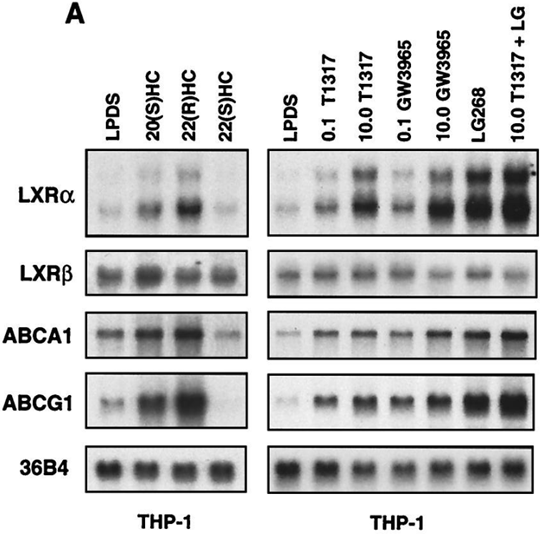
Nei topi, GW3965 a una dose di 10 mg/kg aumenta l'espressione di ABCA1 di 8 volte e aumenta i livelli circolanti di HDL del 30% con un Cmax di 12,7 μg/mL e una t1/2 di 2 ore. GW3965 (10 mg/kg) induce l'espressione di ABCA1 e ABCG1 e mostra una potente attività antiaterogenica sia nei topi LDLR−/− che apoE−/−. Nei ratti maschi Sprague-Dawley, GW3965 riduce gli aumenti della pressione sanguigna mediati dall'Ang II e diminuisce l'espressione genica del recettore Ang II vascolare. Nel modello murino di glioblastoma, GW3965 provoca la degradazione di LDLR mediata da un degradatore inducibile di LDLR, un'aumentata espressione del trasportatore di efflusso del colesterolo ABCA1 e quindi promuove potentemente la morte delle cellule tumorali. |
Riferimenti |
|
Applicazioni
| Metodi | Biomarcatori | Immagini | PMID |
|---|---|---|---|
| Western blot | LXRα / LXRβ / ABCA1 / ABCG1 Skp2 / pEGFR / EGFR / pERK / ERK |
|
11604492 |
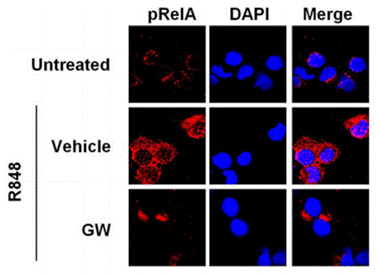
| Immunofluorescence | pRelA LAMP-1 / LDLR |
|
26635040 |
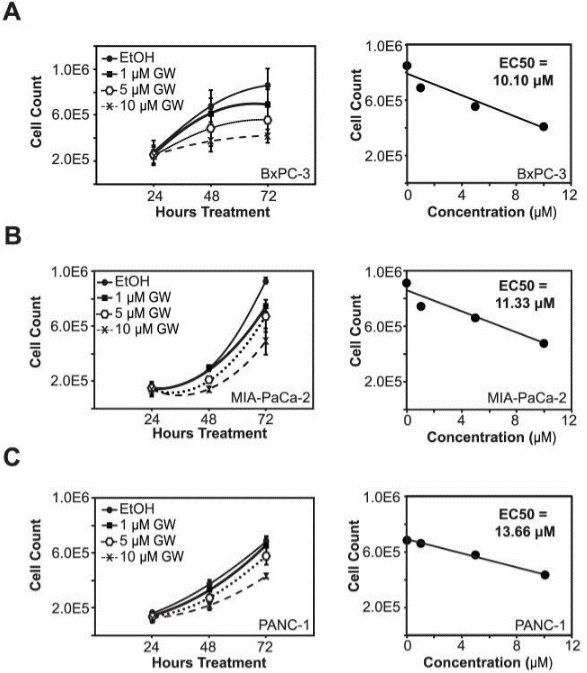
| Growth inhibition assay | Cell viability |
|
25184494 |
Supporto tecnico
Istruzioni per la manipolazione
Tel: +1-832-582-8158 Ext:3
Per qualsiasi altra domanda, si prega di lasciare un messaggio.
Domande Frequenti
Domanda 1:
How to formulate it for mouse in vivo experiment?
Risposta:
It can be dissolved in 2% DMSO/30% PEG 300/dd H2O at 10 mg/mL as a homogeneous suspension. This vehicle is suitable for oral gavage to mice.

I prodotti sono solo per uso di ricerca. Non per uso umano. Non vendiamo a pazienti.
©Copyright 2013 Selleck Chemicals. Tutti i diritti riservati.