
solo per uso di ricerca
Go 6983 PKC inibitore
N. Cat.S2911
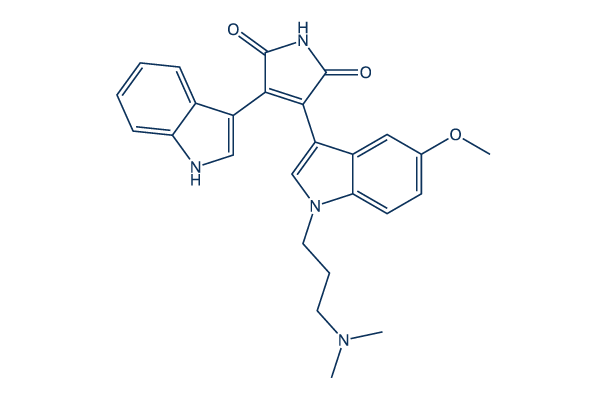
Struttura chimica
Peso molecolare: 442.51
Controllo Qualità
Coltura cellulare, trattamento e concentrazione di lavoro
| Linee cellulari | Tipo di saggio | Concentrazione | Tempo di incubazione | Formulazione | Descrizione dellattività | PMID |
|---|---|---|---|---|---|---|
| PC12 | Function assay | 0.5 μM | GO6983 blocked the effect of PMA on the activation of Akt and MAPK induced by IGF-1 | 10788447 | ||
| PC-3 | Function assay | 1 μM | 2 h | Gö6983 abrogates the TPA-induced RGFR transactivation response | 15897236 | |
| HCT116 | Function assay | 2 μM | 8 h | attenuated PMA-induced FLIP mRNA expression | 16052516 | |
| HT29 | Function assay | 2 μM | 8 h | attenuated PMA-induced FLIP mRNA expression | 16052516 | |
| KM20 | Function assay | 2 μM | 8 h | attenuated PMA-induced FLIP mRNA expression | 16052516 | |
| KM12C | Function assay | 2 μM | 8 h | attenuated PMA-induced FLIP mRNA expression | 16052516 | |
| Caco-2 | Function assay | 2 μM | 8 h | completely attenuated PMA-induced FLIP mRNA expression | 16052516 | |
| A549 | Function assay | 10 μM | 1 h | markedly inhibited ATPγS-stimulated NADPH oxidase activity and H2O2 and/or ROS generation | 23326583 | |
| HeLa | Function assay | 2 μM | 48 h | suppressed the effect of PMA on apicularen A-induced cytotoxicity | 24447339 | |
| A673 | qHTS assay | qHTS of pediatric cancer cell lines to identify multiple opportunities for drug repurposing: Primary screen for A673 cells | 29435139 | |||
| NB-EBc1 | qHTS assay | qHTS of pediatric cancer cell lines to identify multiple opportunities for drug repurposing: Primary screen for NB-EBc1 cells | 29435139 | |||
| SK-N-SH | qHTS assay | qHTS of pediatric cancer cell lines to identify multiple opportunities for drug repurposing: Primary screen for SK-N-SH cells | 29435139 | |||
| LAN-5 | qHTS assay | qHTS of pediatric cancer cell lines to identify multiple opportunities for drug repurposing: Primary screen for LAN-5 cells | 29435139 | |||
| NB1643 | qHTS assay | qHTS of pediatric cancer cell lines to identify multiple opportunities for drug repurposing: Confirmatory screen for NB1643 cells | 29435139 | |||
| SK-N-MC | qHTS assay | qHTS of pediatric cancer cell lines to identify multiple opportunities for drug repurposing: Confirmatory screen for SK-N-MC cells | 29435139 | |||
| LAN-5 | qHTS assay | qHTS of pediatric cancer cell lines to identify multiple opportunities for drug repurposing: Confirmatory screen for LAN-5 cells | 29435139 | |||
| DAOY | qHTS assay | qHTS of pediatric cancer cell lines to identify multiple opportunities for drug repurposing: Confirmatory screen for DAOY cells | 29435139 | |||
| BT-37 | qHTS assay | qHTS of pediatric cancer cell lines to identify multiple opportunities for drug repurposing: Confirmatory screen for BT-37 cells | 29435139 | |||
| TC32 | qHTS assay | qHTS of pediatric cancer cell lines to identify multiple opportunities for drug repurposing: Confirmatory screen for TC32 cells | 29435139 | |||
| Rh41 | qHTS assay | qHTS of pediatric cancer cell lines to identify multiple opportunities for drug repurposing: Confirmatory screen for Rh41 cells | 29435139 | |||
| Rh30 | qHTS assay | qHTS of pediatric cancer cell lines to identify multiple opportunities for drug repurposing: Confirmatory screen for Rh30 cells | 29435139 | |||
| OHS-50 | qHTS assay | qHTS of pediatric cancer cell lines to identify multiple opportunities for drug repurposing: Confirmatory screen for OHS-50 cells | 29435139 | |||
| SK-N-SH | qHTS assay | qHTS of pediatric cancer cell lines to identify multiple opportunities for drug repurposing: Confirmatory screen for SK-N-SH cells | 29435139 | |||
| HEK293 | Function assay | Inhibition of Cav1.2 calcium current measured using whole cell patch clamp in human HEK293 cells transfected with rabbit L-type calcium channel subunits, IC50 = 20 μM. | ChEMBL | |||
| Clicca per visualizzare più dati sperimentali sulle linee cellulari | ||||||
Informazioni chimiche, conservazione e stabilità
| Peso molecolare | 442.51 | Formula | C26H26N4O3 |
Conservazione (Dalla data di ricezione) | |
|---|---|---|---|---|---|
| N. CAS | 133053-19-7 | Scarica SDF | Conservazione delle soluzioni stock |
|
|
| Sinonimi | GOE 6983, Gö 6983 | Smiles | CN(C)CCCN1C=C(C2=C1C=CC(=C2)OC)C3=C(C(=O)NC3=O)C4=CNC5=CC=CC=C54 | ||
Solubilità
|
In vitro |
DMSO
: 89 mg/mL
(201.12 mM)
Water : Insoluble Ethanol : Insoluble |
Calcolatore di Molarità
|
In vivo |
|||||
Calcolatore di formulazione in vivo (Soluzione chiara)
Passo 1: Inserire le informazioni di seguito (Consigliato: Un animale aggiuntivo per tenere conto della perdita durante lesperimento)
Passo 2: Inserire la formulazione in vivo (Questo è solo il calcolatore, non la formulazione. Contattateci prima se non cè una formulazione in vivo nella sezione Solubilità.)
Risultati del calcolo:
Concentrazione di lavoro: mg/ml;
Metodo per preparare il liquido master di DMSO: mg farmaco predissolto in μL DMSO ( Concentrazione del liquido master mg/mL, Vi preghiamo di contattarci prima se la concentrazione supera la solubilità del DMSO del lotto del farmaco. )
Metodo per preparare la formulazione in vivo: Prendere μL DMSO liquido master, quindi aggiungereμL PEG300, mescolare e chiarire, quindi aggiungereμL Tween 80, mescolare e chiarire, quindi aggiungere μL ddH2O, mescolare e chiarire.
Metodo per preparare la formulazione in vivo: Prendere μL DMSO liquido master, quindi aggiungere μL Olio di mais, mescolare e chiarire.
Nota: 1. Si prega di assicurarsi che il liquido sia limpido prima di aggiungere il solvente successivo.
2. Assicurarsi di aggiungere il/i solvente/i in ordine. È necessario assicurarsi che la soluzione ottenuta, nellaggiunta precedente, sia una soluzione limpida prima di procedere allaggiunta del solvente successivo. Metodi fisici come il vortex, gli ultrasuoni o il bagno dacqua calda possono essere utilizzati per facilitare la dissoluzione.
Meccanismo dazione
| Targets/IC50/Ki |
PKCγ
(Cell-free assay) 6 nM
PKCα
(Cell-free assay) 7 nM
PKCβ
(Cell-free assay) 7 nM
PKCδ
(Cell-free assay) 10 nM
PKCζ
(Cell-free assay) 60 nM
|
|---|---|
| In vitro |
Go 6983 (300 μM) sopprime l'autofosforilazione di PKCμ con una riduzione del 20% in cellule NIH3T3 trasfettate con PKCμ. Nei cuori riperfusi con PMN e questo composto (100 nM), la pressione sviluppata del ventricolo sinistro (LVDP) e il tasso di recupero della LVDP recuperano rispettivamente all'89% e al 74% dei valori basali, significativamente più alti rispetto ai soli PMN. Questa sostanza chimica (100 nM) riduce significativamente l'adesione dei PMN all'endotelio e l'infiltrazione nel miocardio rispetto ai cuori con Ischemia seguita da riperfusione (I/R)+PMN, e inibisce significativamente il rilascio di superossido dai PMN del 90%. Attenua la disfunzione contrattile cardiaca post-I/R in presenza di PMN, il che può essere correlato in parte alla diminuita produzione di superossido. Questo inibitore inibisce significativamente il rilascio di superossido indotto dall'antigene dai leucociti di pazienti precedentemente sensibilizzati al polline degli alberi. Ha inibito l'accumulo intracellulare di Ca(2+) nel tessuto vascolare umano, suggerendo un meccanismo per le sue proprietà vasodilatatrici. Questo composto (1 μM) combinato con Ro-31-8425 (390 nM) inibisce leggermente l'attività PLD2 indotta dall'Angiotensina II nelle PGSMC. È un inibitore di PKC isoforma-specifico che mira al sito di legame dell'ATP. Inibisce l'attività di ΔPfPKB con una IC50 di 1 μM. Nelle cellule trattate con questa sostanza chimica (5 μM), il numero di anelli nel ciclo successivo è nettamente inferiore rispetto alle colture di controllo. Questo trattamento (5 μM) porta a una diminuzione di quasi il 60% nella formazione di nuovi anelli nelle colture di P. falciparum. |
| Saggio chinasico |
Saggio di legame
|
|
Le reazioni di fosforilazione vengono eseguite in un volume totale di 100 μL, contenente tampone C (50 mM Tris-HCl, pH 7,5, 10 mM β-mercaptoetanolo), 4 mM MgCl2, 10 μg di PS, 100 nM di TPA, 5 μL di un estratto cellulare di Sf158 come fonte di PKCμ ricombinante o di estratti cellulari di Sf9 come fonte di altri isoenzimi PKC ricombinanti, 10 μg di syntide 2 come substrato e 35 μM di ATP contenente 1 μCi di [γ-32P]ATP. In alcuni esperimenti PS e TPA vengono omessi o vengono aggiunti vari inibitori alle concentrazioni indicate nel testo. Dopo incubazione per 10 minuti a 30℃, la reazione viene interrotta trasferendo 50 μL della miscela di saggio su un pezzo quadrato di carta di fosfocellulosa da 20 mm, che viene lavato 3 volte in acqua deionizzata e due volte in acetone. La radioattività su ogni carta viene determinata mediante conteggio a scintillazione liquida.
|
|
| In vivo |
Go6983 (22,0 μg/topo, i.v.) inibisce fortemente la metastasi tumorale del 51,2 % in un modello murino di tumore polmonare B16BL6. |
Riferimenti |
|
Applicazioni
| Metodi | Biomarcatori | Immagini | PMID |
|---|---|---|---|
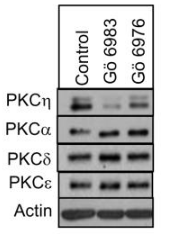
| Western blot | PKCη / PKCα / PKCδ / PKCε |
|
22892130 |
Supporto tecnico
Istruzioni per la manipolazione
Tel: +1-832-582-8158 Ext:3
Per qualsiasi altra domanda, si prega di lasciare un messaggio.

I prodotti sono solo per uso di ricerca. Non per uso umano. Non vendiamo a pazienti.
©Copyright 2013 Selleck Chemicals. Tutti i diritti riservati.