
solo per uso di ricerca
Prucalopride 5-HT Receptor agonista
N. Cat.S2875
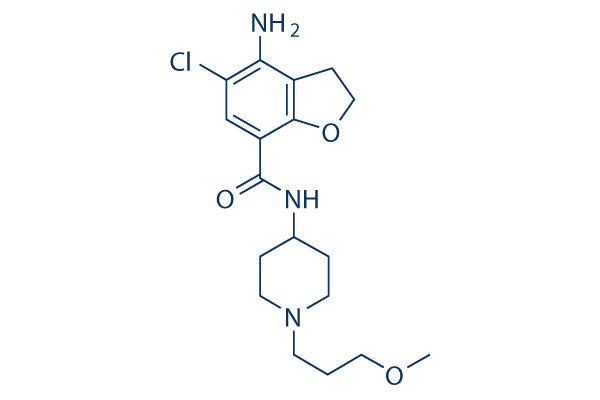
Struttura chimica
Peso molecolare: 367.87
Controllo Qualità
| Target correlati | Adrenergic Receptor AChR COX Calcium Channel Histamine Receptor Dopamine Receptor GABA Receptor TRP Channel Cholinesterase (ChE) GluR |
|---|---|
| Altro 5-HT Receptor Inibitori | WAY-100635 Maleate Serotonin (5-HT) HCl Puerarin BRL-15572 Dihydrochloride SB269970 HCl Ketanserin RS-127445 Nuciferine Flopropione BRL-54443 |
Informazioni chimiche, conservazione e stabilità
| Peso molecolare | 367.87 | Formula | C18H26ClN3O3 |
Conservazione (Dalla data di ricezione) | |
|---|---|---|---|---|---|
| N. CAS | 179474-81-8 | Scarica SDF | Conservazione delle soluzioni stock |
|
|
| Sinonimi | R-93877 | Smiles | COCCCN1CCC(CC1)NC(=O)C2=CC(=C(C3=C2OCC3)N)Cl | ||
Solubilità
|
In vitro |
DMSO
: 74 mg/mL
(201.15 mM)
Ethanol : 74 mg/mL Water : Insoluble |
Calcolatore di Molarità
|
In vivo |
|||||
Calcolatore di formulazione in vivo (Soluzione chiara)
Passo 1: Inserire le informazioni di seguito (Consigliato: Un animale aggiuntivo per tenere conto della perdita durante lesperimento)
Passo 2: Inserire la formulazione in vivo (Questo è solo il calcolatore, non la formulazione. Contattateci prima se non cè una formulazione in vivo nella sezione Solubilità.)
Risultati del calcolo:
Concentrazione di lavoro: mg/ml;
Metodo per preparare il liquido master di DMSO: mg farmaco predissolto in μL DMSO ( Concentrazione del liquido master mg/mL, Vi preghiamo di contattarci prima se la concentrazione supera la solubilità del DMSO del lotto del farmaco. )
Metodo per preparare la formulazione in vivo: Prendere μL DMSO liquido master, quindi aggiungereμL PEG300, mescolare e chiarire, quindi aggiungereμL Tween 80, mescolare e chiarire, quindi aggiungere μL ddH2O, mescolare e chiarire.
Metodo per preparare la formulazione in vivo: Prendere μL DMSO liquido master, quindi aggiungere μL Olio di mais, mescolare e chiarire.
Nota: 1. Si prega di assicurarsi che il liquido sia limpido prima di aggiungere il solvente successivo.
2. Assicurarsi di aggiungere il/i solvente/i in ordine. È necessario assicurarsi che la soluzione ottenuta, nellaggiunta precedente, sia una soluzione limpida prima di procedere allaggiunta del solvente successivo. Metodi fisici come il vortex, gli ultrasuoni o il bagno dacqua calda possono essere utilizzati per facilitare la dissoluzione.
Meccanismo dazione
| Targets/IC50/Ki |
5-HT4A
2.5 nM(Ki)
5-HT4B
8 nM(Ki)
|
|---|---|
| In vitro |
Il Prucalopride induce contrazioni in modo concentrazione-dipendente con un pEC50 di 7,5. Questo composto (1 mM) amplifica significativamente la contrazione di rimbalzo del colon prossimale di cavia dopo stimolazione con campo elettrico. Induce il rilassamento della preparazione di esofago di ratto della tunica muscularis mucosae di esofago di ratto con un pEC50 di 7,8, producendo una curva concentrazione-risposta monofasica.
|
| In vivo |
Il numero di evacuazioni intestinali complete per settimana è del 30,9% per coloro che ricevono 2 mg di Prucalopride e del 28,4% per coloro che ricevono 4 mg di questo composto, rispetto al 12,0% nel gruppo placebo. Il 47,3% dei pazienti che ricevono 2 mg di questo composto e il 46,6% di quelli che ricevono 4 mg di esso hanno un aumento del numero di evacuazioni intestinali spontanee e complete di una o più per settimana, in media, rispetto al 25,8% nel gruppo placebo. Questo composto (2 mg o 4 mg) migliora significativamente tutti gli altri endpoint di efficacia secondari, inclusa la soddisfazione dei pazienti per la loro funzione intestinale e il trattamento e la loro percezione della gravità dei loro sintomi di stitichezza. Esso (4 mg al giorno) accelera lo svuotamento gastrico complessivo e il transito nell'intestino tenue nei pazienti con stitichezza senza un disturbo dell'evacuazione rettale. Questa sostanza chimica (4 mg al giorno) tende ad accelerare il transito colico complessivo con un transito colico complessivo e uno svuotamento del colon ascendente significativamente più rapidi. Proporzioni più elevate di pazienti trattati con questo composto 2 mg (19,5%), 4 mg (23,6%) hanno tre o più evacuazioni intestinali complete spontanee (SCBM)/settimana rispetto al placebo (9,6%). Migliora anche significativamente gli endpoint secondari di efficacia e qualità della vita, inclusa la proporzione di pazienti con un aumento di una o più SCBM/settimana, la completezza dell'evacuazione, la gravità percepita della malattia e l'efficacia del trattamento e la qualità della vita. Questo composto altera i modelli di motilità contrattile del colon in modo dose-dipendente stimolando contrazioni raggruppate ad alta ampiezza nel colon prossimale e inibendo l'attività contrattile nel colon distale di cani a digiuno. Provoca anche una diminuzione dose-dipendente del tempo alla prima contrazione migrante gigante (GMC); a dosi più elevate di questa sostanza chimica, la prima GMC si verifica generalmente entro la prima mezz'ora dopo il trattamento.
|
Riferimenti |
|
Informazioni sullo studio clinico
(dati da https://clinicaltrials.gov, aggiornato il 2024-05-22)
| Numero NCT | Reclutamento | Condizioni | Sponsor/Collaboratori | Data di inizio | Fasi |
|---|---|---|---|---|---|
| NCT04838522 | Recruiting | Chronic Constipation |
Takeda|UC San Diego Human Milk Research Biorepository |
March 2 2022 | -- |
| NCT04429802 | Completed | Gastrointestinal Motility Disorder|Dyspepsia |
Universitaire Ziekenhuizen KU Leuven |
September 26 2013 | Not Applicable |
| NCT01807000 | Completed | Healthy |
Shire|Takeda |
March 18 2013 | Phase 1 |
| NCT01692132 | Withdrawn | Chronic Constipation |
Janssen Pharmaceutica |
February 2013 | -- |
| NCT03279341 | Completed | Chronic Constipation |
University Hospital Gasthuisberg |
December 3 2012 | Phase 4 |
| NCT01117051 | Terminated | Non-cancer Pain|Opioid Induced Constipation |
Shire|Takeda |
May 19 2010 | Phase 3 |
Supporto tecnico
Istruzioni per la manipolazione
Tel: +1-832-582-8158 Ext:3
Per qualsiasi altra domanda, si prega di lasciare un messaggio.

I prodotti sono solo per uso di ricerca. Non per uso umano. Non vendiamo a pazienti.
©Copyright 2013 Selleck Chemicals. Tutti i diritti riservati.