
solo per uso di ricerca
ARN-509 (Apalutamide) Antagonista AR
N. Cat.: S2840
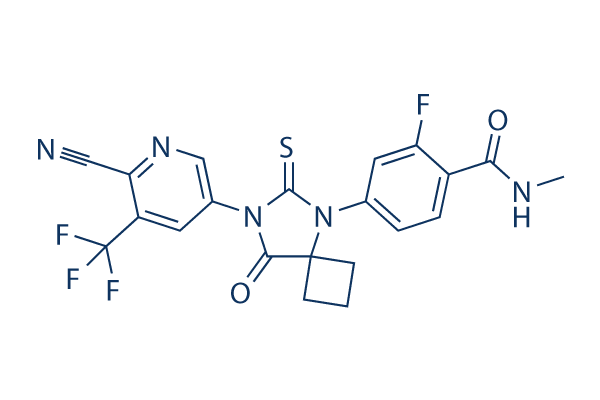
Struttura chimica
Peso molecolare: 477.43
Controllo Qualità (Quality Control)
| Target correlati | Adrenergic Receptor Estrogen/progestogen Receptor GPR Glucocorticoid Receptor ACE RAAS Progesterone Receptor Opioid Receptor THR PGES |
|---|---|
| Altro Androgen Receptor Inibitori | Bavdegalutamide (ARV-110) RU58841 EPI-001 Galeterone Cyproterone Acetate 3,3'-Diindolylmethane Ailanthone JNJ-63576253 (TRC-253) Proxalutamide (GT0918) AZD3514 |
Coltura cellulare, trattamento e concentrazione di lavoro
(Cell Culture, Treatment & Working Concentration)
| Linee cellulari | Tipo di saggio | Concentrazione | Tempo di incubazione | Formulazione | Descrizione dell'attività | PMID |
|---|---|---|---|---|---|---|
| LNCAP cells | Proliferation assay | 3 days | Antiproliferative activity against human LNCAP cells after 3 days, IC50=0.174 μM | 26046313 | ||
| PSN1 cells | Cytotoxicity assay | 96 h | Cytotoxicity against human PSN1 cells after 96 hrs by ATP-lite luminescence assay, IC50=0.06 μM | 22247788 | ||
| PSN1 cells | Function assay | 30 nM | 24 h | Induction of cell cycle arrest in human PSN1 cells assessed as accumulation at G2/M phase cells at 30 nM after 24 hrs by flow cytometry | 22247788 | |
| LNCaP | Function assay | 30 mins | Displacement of [3H]-R1881 from AR in human LNCaP cells preincubated for 30 mins followed by [3H]-R1881 addition measured after 30 mins by microbeta scintillation counter method, IC50 = 0.01625 μM. | 28478926 | ||
| U-2 OS | qHTS assay | qHTS of pediatric cancer cell lines to identify multiple opportunities for drug repurposing: Primary screen for U-2 OS cells | 29435139 | |||
| A673 | qHTS assay | qHTS of pediatric cancer cell lines to identify multiple opportunities for drug repurposing: Primary screen for A673 cells | 29435139 | |||
| DAOY | qHTS assay | qHTS of pediatric cancer cell lines to identify multiple opportunities for drug repurposing: Primary screen for DAOY cells | 29435139 | |||
| BT-37 | qHTS assay | qHTS of pediatric cancer cell lines to identify multiple opportunities for drug repurposing: Primary screen for BT-37 cells | 29435139 | |||
| RD | qHTS assay | qHTS of pediatric cancer cell lines to identify multiple opportunities for drug repurposing: Primary screen for RD cells | 29435139 | |||
| SK-N-SH | qHTS assay | qHTS of pediatric cancer cell lines to identify multiple opportunities for drug repurposing: Primary screen for SK-N-SH cells | 29435139 | |||
| BT-12 | qHTS assay | qHTS of pediatric cancer cell lines to identify multiple opportunities for drug repurposing: Primary screen for BT-12 cells | 29435139 | |||
| MG 63 (6-TG R) | qHTS assay | qHTS of pediatric cancer cell lines to identify multiple opportunities for drug repurposing: Primary screen for MG 63 (6-TG R) cells | 29435139 | |||
| NB1643 | qHTS assay | qHTS of pediatric cancer cell lines to identify multiple opportunities for drug repurposing: Primary screen for NB1643 cells | 29435139 | |||
| Fibroblast cells | qHTS assay | qHTS of pediatric cancer cell lines to identify multiple opportunities for drug repurposing: Primary screen for control Hh wild type fibroblast cells | 29435139 | |||
| Rh41 | qHTS assay | qHTS of pediatric cancer cell lines to identify multiple opportunities for drug repurposing: Primary screen for Rh41 cells | 29435139 | |||
| Rh30 | qHTS assay | qHTS of pediatric cancer cell lines to identify multiple opportunities for drug repurposing: Primary screen for Rh30 cells | 29435139 | |||
| SJ-GBM2 | qHTS assay | qHTS of pediatric cancer cell lines to identify multiple opportunities for drug repurposing: Primary screen for SJ-GBM2 cells | 29435139 | |||
| SK-N-MC | qHTS assay | qHTS of pediatric cancer cell lines to identify multiple opportunities for drug repurposing: Primary screen for SK-N-MC cells | 29435139 | |||
| NB-EBc1 | qHTS assay | qHTS of pediatric cancer cell lines to identify multiple opportunities for drug repurposing: Primary screen for NB-EBc1 cells | 29435139 | |||
| LAN-5 | qHTS assay | qHTS of pediatric cancer cell lines to identify multiple opportunities for drug repurposing: Primary screen for LAN-5 cells | 29435139 | |||
| Rh18 | qHTS assay | qHTS of pediatric cancer cell lines to identify multiple opportunities for drug repurposing: Primary screen for Rh18 cells | 29435139 | |||
| Clicca per visualizzare più dati sperimentali sulle linee cellulari | ||||||
Informazioni chimiche, conservazione e stabilità (Chemical Information, Storage & Stability)
| Peso molecolare | 477.43 | Formula | C21H15F4N5O2S |
Conservazione (Dalla data di ricezione) | |
|---|---|---|---|---|---|
| N. CAS | 956104-40-8 | Scarica SDF | Conservazione delle soluzioni stock |
|
|
| Sinonimi | N/A | Smiles | CNC(=O)C1=C(C=C(C=C1)N2C(=S)N(C(=O)C23CCC3)C4=CC(=C(N=C4)C#N)C(F)(F)F)F | ||
Solubilità (Solubility)
|
In vitro |
DMSO
: 95 mg/mL
(198.98 mM)
Ethanol : 7 mg/mL Water : Insoluble |
Calcolatore di Molarità
|
In vivo |
|||||
Calcolatore di formulazione in vivo (Soluzione chiara)
Passo 1: Inserire le informazioni di seguito (Consigliato: Un animale aggiuntivo per tenere conto della perdita durante l'esperimento)
Passo 2: Inserire la formulazione in vivo (Questo è solo il calcolatore, non la formulazione. Contattateci prima se non c'è una formulazione in vivo nella sezione Solubilità.)
Risultati del calcolo:
Concentrazione di lavoro: mg/ml;
Metodo per preparare il liquido master di DMSO: mg farmaco predissolto in μL DMSO ( Concentrazione del liquido master mg/mL, Vi preghiamo di contattarci prima se la concentrazione supera la solubilità del DMSO del lotto del farmaco. )
Metodo per preparare la formulazione in vivo: Prendere μL DMSO liquido master, quindi aggiungereμL PEG300, mescolare e chiarire, quindi aggiungereμL Tween 80, mescolare e chiarire, quindi aggiungere μL ddH2O, mescolare e chiarire.
Metodo per preparare la formulazione in vivo: Prendere μL DMSO liquido master, quindi aggiungere μL Olio di mais, mescolare e chiarire.
Nota: 1. Si prega di assicurarsi che il liquido sia limpido prima di aggiungere il solvente successivo.
2. Assicurarsi di aggiungere il/i solvente/i in ordine. È necessario assicurarsi che la soluzione ottenuta, nell'aggiunta precedente, sia una soluzione limpida prima di procedere all'aggiunta del solvente successivo. Metodi fisici come il vortex, gli ultrasuoni o il bagno d'acqua calda possono essere utilizzati per facilitare la dissoluzione.
Meccanismo d'azione (Mechanism of Action)
| Targets/IC50/Ki |
Androgen Receptor
(Cell-free assay) 16 nM
|
|---|---|
| In vitro |
Apalutamide (ARN-509) (< 10 μM) inhibits androgen-mediated induction or repression of mRNA expression levels for 13 endogenous genes including PSA and TMPRSS2 in the LNCaP/AR prostate cancer cell line. It also inhibits the proliferative effect of R1881 (30 pM) in the same cell line. At 10 μM, this compound impairs AR nuclear localization and thus reduces the concentration of AR available to bind androgen response elements (ARE) in LNCaP cells expressing AR-EYFP. It is able to effectively compete with R1881 (1 nM) and prevent AR from binding to promoter regions. Additionally, it inhibits R1881-induced VP16-AR–mediated transcription with IC50 of 0.2 μM in Hep-G2 cells expressing a VP16-AR fusion protein and an ARE-driven luciferase reporter. |
| In vivo |
Apalutamide (ARN-509) (10 mg/kg/d, oral) inhibits tumor growth with decreased proliferative index and increased apoptotic rate in castrate male immunodeficient mice harboring LNCaP/AR-luc xenograft tumors. This compound dose dependently inhibits tumor growth with highest efficacy at dose of 30 mg/kg/day in castrate male immunodeficient mice harboring LNCaP/AR-luc xenograft tumors. It dosed at 10 mg/kg/d for 28 days results in a 3-fold reduction in prostates weight associated with lacking glandular secretory activity and 1.7-fold reduction in epididymis weight in adult male dogs. The compound (10 mg/kg/d, oral) inhibits cell proliferation of prostate tissues in adult male dogs. It is safe and well tolerated in 24 patients with metastatic CRPC who has progressed on prior treatments and peak plasma concentrations occurred 2 to 3 hours after administration. This agent results in durable PSA declines at doses ranging from 30 to 300 mg in patients with metastatic CRPC. It shows powerful anti-cancer activity and induces durable remissions long after therapy completion in castrate resistant prostate cancer mouse models. |
Riferimenti |
|
Informazioni sullo studio clinico (Clinical Trial Information)
(dati da https://clinicaltrials.gov, aggiornato il 2026-08-17)
| Numero NCT | Reclutamento | Condizioni | Sponsor/Collaboratori | Data di inizio | Fasi |
|---|---|---|---|---|---|
| NCT04513717 | ACTIVE_NOT_RECRUITING | Prostate Adenocarcinoma; Stage III Prostate Cancer AJCC v8; Stage IVA Prostate Cancer AJCC v8 |
NRG Oncology |
2021-01-21 | PHASE3 |
| NCT04423211 | RECRUITING | Biochemically Recurrent Prostate Carcinoma; Metastatic Prostate Carcinoma; Prostate Adenocarcinoma; Stage IVB Prostate Cancer AJCC v8 |
ECOG-ACRIN Cancer Research Group |
2020-10-08 | PHASE3 |
| NCT06931340 | RECRUITING | Castration-Sensitive Prostate Carcinoma; Metastatic Prostate Adenocarcinoma; Stage IVB Prostate Cancer AJCC v8 |
Alliance for Clinical Trials in Oncology |
2025-12-01 | PHASE3 |
| NCT05367440 | ACTIVE_NOT_RECRUITING | Metastatic Prostate Cancer |
AstraZeneca |
2022-06-02 | PHASE1; PHASE2 |
| NCT06592924 | RECRUITING | Prostate Cancer (Adenocarcinoma) |
Canadian Cancer Trials Group |
2025-05-28 | PHASE3 |
| NCT06378866 | RECRUITING | Recurrent Castration-Sensitive Prostate Carcinoma; Recurrent Prostate Cancer; Castration-resistant Prostate Cancer; Biochemically Recurrent Prostate Carcinoma |
Mayo Clinic |
2024-06-03 | PHASE2 |

I prodotti sono solo per uso di ricerca. Non per uso umano. Non vendiamo a pazienti.
©Copyright 2013 Selleck Chemicals. Tutti i diritti riservati.