
solo per uso di ricerca
Ispinesib (SB-715992) Kinesin inibitore
N. Cat.S1452
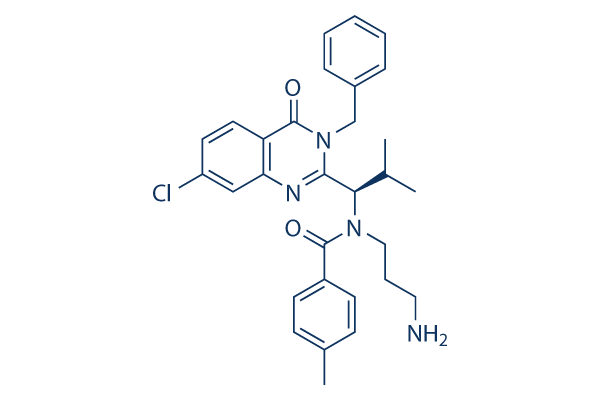
Struttura chimica
Peso molecolare: 517.06
Controllo Qualità
| Target correlati | Akt Wnt/beta-catenin PKC HSP ROCK Microtubule Associated Integrin Bcr-Abl Actin FAK |
|---|---|
| Altro Kinesin Inibitori | GSK923295 SB743921 HCl Monastrol ARQ 621 K 858 BTB-1 VLS-1488(KIF18A-IN-6 ) H-Cys(Trt)-OH Filanesib hydrochloride GW406108X |
Coltura cellulare, trattamento e concentrazione di lavoro
| Linee cellulari | Tipo di saggio | Concentrazione | Tempo di incubazione | Formulazione | Descrizione dellattività | PMID |
|---|---|---|---|---|---|---|
| HCT116 | Antiproliferative assay | 72 hrs | Antiproliferative activity against human HCT116 cells after 72 hrs by Alamar blue assay, GI50=0.025μM | 22248262 | ||
| hTERT-HME1 | Antiproliferative assay | 72 hrs | Antiproliferative activity against human hTERT-HME1 cells after 72 hrs by Alamar blue assay, GI50=0.032μM | 22248262 | ||
| K562 | Antiproliferative assay | 72 hrs | Antiproliferative activity against human K562 cells after 72 hrs by Alamar blue assay, GI50=0.071μM | 22248262 | ||
| BxPC3 | Antiproliferative assay | 72 hrs | Antiproliferative activity against human BxPC3 cells after 72 hrs by Alamar blue assay, GI50=0.08μM | 22248262 | ||
| NCI-H1299 | Antiproliferative assay | 72 hrs | Antiproliferative activity against human NCI-H1299 cells after 72 hrs by Alamar blue assay, GI50=0.082μM | 22248262 | ||
| LNCAP | Growth inhibition assay | 72 hrs | Growth inhibition of human LNCAP cells after 72 hrs by Alamar blue assay, GI50=0.022μM | 23394180 | ||
| HCT116 | Growth inhibition assay | 72 hrs | Growth inhibition of human HCT116 cells after 72 hrs by Alamar blue assay, GI50=0.025μM | 23394180 | ||
| PC3 | Growth inhibition assay | 72 hrs | Growth inhibition of human PC3 cells after 72 hrs by Alamar blue assay, GI50=0.05μM | 23394180 | ||
| BxPC3 | Growth inhibition assay | 72 hrs | Growth inhibition of human BxPC3 cells after 72 hrs by Alamar blue assay, GI50=0.08μM | 23394180 | ||
| NCI-H1299 | Growth inhibition assay | 72 hrs | Growth inhibition of human NCI-H1299 cells after 72 hrs by Alamar blue assay, GI50=0.082μM | 23394180 | ||
| LXFS 538 | Antitumor assay | 6 mg/kg | Antitumor activity against human LXFS 538 cells xenografted in NMRI nu/nu mouse assessed as tumor regression at 6 mg/kg, ip measured on day 13 | 23394180 | ||
| HeLa | Antiproliferative assay | 48 hrs | Antiproliferative activity against human HeLa cells after 48 hrs by MTT assay, IC50=1μM | 24184776 | ||
| MCF7 | Antiproliferative assay | 48 hrs | Antiproliferative activity against human MCF7 cells after 48 hrs by MTT assay, IC50=1.3μM | 24184776 | ||
| HCT116 | Growth inhibition assay | 72 hrs | Growth inhibition of human HCT116 cells after 72 hrs by MTS assay, IC50=0.0011μM | 26396688 | ||
| TC32 | qHTS assay | qHTS of pediatric cancer cell lines to identify multiple opportunities for drug repurposing: Primary screen for TC32 cells | 29435139 | |||
| DAOY | qHTS assay | qHTS of pediatric cancer cell lines to identify multiple opportunities for drug repurposing: Primary screen for DAOY cells | 29435139 | |||
| SJ-GBM2 | qHTS assay | qHTS of pediatric cancer cell lines to identify multiple opportunities for drug repurposing: Primary screen for SJ-GBM2 cells | 29435139 | |||
| A673 | qHTS assay | qHTS of pediatric cancer cell lines to identify multiple opportunities for drug repurposing: Primary screen for A673 cells | 29435139 | |||
| SK-N-MC | qHTS assay | qHTS of pediatric cancer cell lines to identify multiple opportunities for drug repurposing: Primary screen for SK-N-MC cells | 29435139 | |||
| NB-EBc1 | qHTS assay | qHTS of pediatric cancer cell lines to identify multiple opportunities for drug repurposing: Primary screen for NB-EBc1 cells | 29435139 | |||
| Saos-2 | qHTS assay | qHTS of pediatric cancer cell lines to identify multiple opportunities for drug repurposing: Primary screen for Saos-2 cells | 29435139 | |||
| LAN-5 | qHTS assay | qHTS of pediatric cancer cell lines to identify multiple opportunities for drug repurposing: Primary screen for LAN-5 cells | 29435139 | |||
| BT-12 | qHTS assay | qHTS of pediatric cancer cell lines to identify multiple opportunities for drug repurposing: Primary screen for BT-12 cells | 29435139 | |||
| OHS-50 | qHTS assay | qHTS of pediatric cancer cell lines to identify multiple opportunities for drug repurposing: Primary screen for OHS-50 cells | 29435139 | |||
| A673 | qHTS assay | qHTS of pediatric cancer cell lines to identify multiple opportunities for drug repurposing: Confirmatory screen for A673 cells) | 29435139 | |||
| SK-N-MC | qHTS assay | qHTS of pediatric cancer cell lines to identify multiple opportunities for drug repurposing: Confirmatory screen for SK-N-MC cells | 29435139 | |||
| BT-12 | qHTS assay | qHTS of pediatric cancer cell lines to identify multiple opportunities for drug repurposing: Confirmatory screen for BT-12 cells | 29435139 | |||
| DAOY | qHTS assay | qHTS of pediatric cancer cell lines to identify multiple opportunities for drug repurposing: Confirmatory screen for DAOY cells | 29435139 | |||
| BT-37 | qHTS assay | qHTS of pediatric cancer cell lines to identify multiple opportunities for drug repurposing: Confirmatory screen for BT-37 cells | 29435139 | |||
| TC32 | qHTS assay | qHTS of pediatric cancer cell lines to identify multiple opportunities for drug repurposing: Confirmatory screen for TC32 cells | 29435139 | |||
| MG 63 (6-TG R) | qHTS assay | qHTS of pediatric cancer cell lines to identify multiple opportunities for drug repurposing: Confirmatory screen for MG 63 (6-TG R) cells | 29435139 | |||
| U-2 OS | qHTS assay | qHTS of pediatric cancer cell lines to identify multiple opportunities for drug repurposing: Confirmatory screen for U-2 OS cells | 29435139 | |||
| Rh41 | qHTS assay | qHTS of pediatric cancer cell lines to identify multiple opportunities for drug repurposing: Confirmatory screen for Rh41 cells | 29435139 | |||
| RD | qHTS assay | qHTS of pediatric cancer cell lines to identify multiple opportunities for drug repurposing: Confirmatory screen for RD cells | 29435139 | |||
| Rh30 | qHTS assay | qHTS of pediatric cancer cell lines to identify multiple opportunities for drug repurposing: Confirmatory screen for Rh30 cells | 29435139 | |||
| Saos-2 | qHTS assay | qHTS of pediatric cancer cell lines to identify multiple opportunities for drug repurposing: Confirmatory screen for Saos-2 cells | 29435139 | |||
| SK-N-SH | qHTS assay | qHTS of pediatric cancer cell lines to identify multiple opportunities for drug repurposing: Confirmatory screen for SK-N-SH cells | 29435139 | |||
| Clicca per visualizzare più dati sperimentali sulle linee cellulari | ||||||
Informazioni chimiche, conservazione e stabilità
| Peso molecolare | 517.06 | Formula | C30H33ClN4O2 |
Conservazione (Dalla data di ricezione) | |
|---|---|---|---|---|---|
| N. CAS | 336113-53-2 | Scarica SDF | Conservazione delle soluzioni stock |
|
|
| Sinonimi | CK0238273 | Smiles | CC1=CC=C(C=C1)C(=O)N(CCCN)C(C2=NC3=C(C=CC(=C3)Cl)C(=O)N2CC4=CC=CC=C4)C(C)C | ||
Solubilità
|
In vitro |
DMSO
: 103 mg/mL
(199.2 mM)
Ethanol : 103 mg/mL Water : Insoluble |
Calcolatore di Molarità
|
In vivo |
|||||
Calcolatore di formulazione in vivo (Soluzione chiara)
Passo 1: Inserire le informazioni di seguito (Consigliato: Un animale aggiuntivo per tenere conto della perdita durante lesperimento)
Passo 2: Inserire la formulazione in vivo (Questo è solo il calcolatore, non la formulazione. Contattateci prima se non cè una formulazione in vivo nella sezione Solubilità.)
Risultati del calcolo:
Concentrazione di lavoro: mg/ml;
Metodo per preparare il liquido master di DMSO: mg farmaco predissolto in μL DMSO ( Concentrazione del liquido master mg/mL, Vi preghiamo di contattarci prima se la concentrazione supera la solubilità del DMSO del lotto del farmaco. )
Metodo per preparare la formulazione in vivo: Prendere μL DMSO liquido master, quindi aggiungereμL PEG300, mescolare e chiarire, quindi aggiungereμL Tween 80, mescolare e chiarire, quindi aggiungere μL ddH2O, mescolare e chiarire.
Metodo per preparare la formulazione in vivo: Prendere μL DMSO liquido master, quindi aggiungere μL Olio di mais, mescolare e chiarire.
Nota: 1. Si prega di assicurarsi che il liquido sia limpido prima di aggiungere il solvente successivo.
2. Assicurarsi di aggiungere il/i solvente/i in ordine. È necessario assicurarsi che la soluzione ottenuta, nellaggiunta precedente, sia una soluzione limpida prima di procedere allaggiunta del solvente successivo. Metodi fisici come il vortex, gli ultrasuoni o il bagno dacqua calda possono essere utilizzati per facilitare la dissoluzione.
Meccanismo dazione
| Caratteristiche |
An allosteric, potent, specific, and reversible inhibitor of the mitotic kinesin spindle protein (KSP) (HsEg5).
|
|---|---|
| Targets/IC50/Ki |
KSP (HsEg5)
(Cell-free assay) 1.7 nM(Ki app)
|
| In vitro |
Ispinesib (SB-715992) è un potente inibitore allosterico, reversibile e specifico di KSP, che modifica la proprietà di legame di KSP ai microtubuli e ne disturba il movimento inibendo il rilascio di ADP senza alterare il rilascio del complesso KSP-ADP dal microtubulo. Questo composto mostra una potente attività citotossica in un panel di linee cellulari tumorali, tra cui Colo205, Colo201, HT-29, M5076, Madison-109 e MX-1, con IC50 da 1,2 nM a 9,5 nM. Nelle cellule di carcinoma prostatico PC-3, esso (15 nM e 30 nM) blocca la proliferazione cellulare e induce l'apoptosi regolando i livelli di espressione dei geni che controllano l'apoptosi, la proliferazione cellulare, il ciclo cellulare e la segnalazione cellulare, come EGFR, p27, p15 e IL-11. In un panel di 53 linee cellulari mammarie, Ispinesib (7,4 nM–600 nM) dimostra un'ampia attività inibitoria. Nelle cellule BT-474 e MDA-MB-468, esso (150 nM) induce l'apoptosi, come rivelato da una maggiore proporzione di cellule apoptotiche, un livello più basso di Bcl-XL antiapoptotico e livelli più alti di Bax e Bid proapoptotici. |
| Saggio chinasico |
Analisi Cinetica allo Stato Stazionario dell'Attività ATPasica della KSP Umana e Inibizione da parte di Ispinesib
|
|
L'analisi della specificità della Kinesin viene eseguita utilizzando un sistema di rilevamento piruvato chinasi-lattato deidrogenasi che accoppia la produzione di ADP all'ossidazione del NADH. I cambiamenti di assorbanza sono monitorati a 340 nm. Studi allo stato stazionario che utilizzano concentrazioni nanomolari di KSP vengono eseguiti utilizzando un saggio sensibile basato sulla fluorescenza che impiega un sistema di rilevamento accoppiato piruvato chinasi, piruvato ossidasi e perossidasi di rafano (HRP) che accoppia la generazione di ADP all'ossidazione di Amplex Red a resorufina fluorescente. La generazione di resorufina è monitorata tramite fluorescenza (λeccitazione = 520 nm e λemissione = 580 nm). Gli esperimenti biochimici allo stato stazionario vengono eseguiti in tampone PEM25 [25 mM Pipes-K+ (pH 6,8), 2 mM MgCl2, 1 mM EGTA] per esperimenti che coinvolgono i microtubuli. L'IC50 per l'inibizione allo stato stazionario è determinata a 500 µM ATP, 5 µM Microtubuli e 1 nM KSP in tampone PEM25. I valori di Ki app (costante di dissociazione apparente dell'inibitore) di Ispinesib (SB-715992) vengono estratti dalle curve dose-risposta, con correzione esplicita per la concentrazione enzimatica utilizzando l'equazione di Morrison. La modalità dell'inibitore (ad esempio, competitivo, non competitivo, inibitore acompetitivo o misto) in condizioni di stato stazionario viene determinata misurando l'effetto della sua concentrazione sulla velocità iniziale in funzione delle concentrazioni di substrato. I dati vengono adattati utilizzando equazioni in GraFit alle equazioni di velocità per le varie modalità di inibizione.
|
|
| In vivo |
Ispinesib (SB-715992) (4,5 mg/kg–15 mg/kg) mostra effetti inibitori contro Colo205, Colo201, HT-29, ma non contro le cellule MX-1, in modelli di xenotrapianto murini. Questo composto (6 mg/kg–10 mg/kg) inibisce anche i tumori solidi murini, tra cui il carcinoma polmonare Madison 109, il sarcoma M5076, così come le leucemie L1210 e P388. In modelli di xenotrapianto murini di cellule di cancro al seno MCF-7, HCC1954, MDA-MB-468 e KPL4, esso (8 mg/kg–10 mg/kg) inibisce la crescita tumorale. |
Riferimenti |
|
Informazioni sullo studio clinico
(dati da https://clinicaltrials.gov, aggiornato il 2024-05-22)
| Numero NCT | Reclutamento | Condizioni | Sponsor/Collaboratori | Data di inizio | Fasi |
|---|---|---|---|---|---|
| NCT00607841 | Terminated | Breast Neoplasms |
Cytokinetics |
December 2007 | Phase 1 |
| NCT00354250 | Completed | Recurrent Renal Cell Cancer|Stage III Renal Cell Cancer|Stage IV Renal Cell Cancer |
National Cancer Institute (NCI) |
May 2006 | Phase 2 |
| NCT00097409 | Completed | Ovarian Cancer |
GlaxoSmithKline |
December 2004 | Phase 2 |
| NCT00119171 | Completed | Solid Tumor Cancer |
GlaxoSmithKline |
November 2004 | Phase 1 |
Supporto tecnico
Istruzioni per la manipolazione
Tel: +1-832-582-8158 Ext:3
Per qualsiasi altra domanda, si prega di lasciare un messaggio.

I prodotti sono solo per uso di ricerca. Non per uso umano. Non vendiamo a pazienti.
©Copyright 2013 Selleck Chemicals. Tutti i diritti riservati.