
solo per uso di ricerca
KU-0063794 mTOR inibitore
N. Cat.S1226
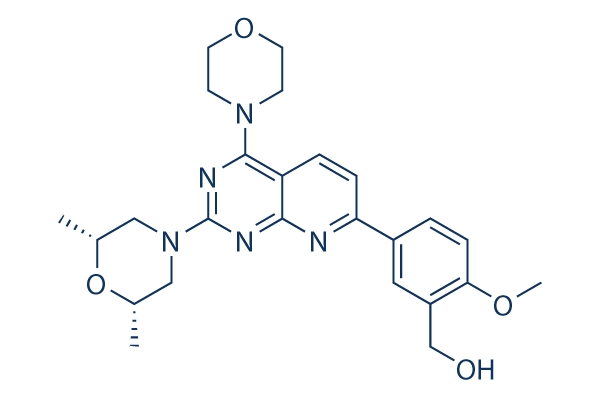
Struttura chimica
Peso molecolare: 465.54
Controllo Qualità
| Target correlati | PI3K Akt GSK-3 ATM/ATR DNA-PK AMPK PDPK1 PTEN PP2A PDK |
|---|---|
| Altro mTOR Inibitori | Torin 1 Torin 2 AZD8055 Ridaforolimus (Deforolimus, MK-8669) Sapanisertib (MLN0128, INK-128) Torkinib (PP242) MHY1485 Vistusertib (AZD2014) OSI-027 WYE-354 |
Coltura cellulare, trattamento e concentrazione di lavoro
| Linee cellulari | Tipo di saggio | Concentrazione | Tempo di incubazione | Formulazione | Descrizione dellattività | PMID |
|---|---|---|---|---|---|---|
| HepG2 | Cell Viability Assay | 0.1–50 μM | 72 h | decreases cell viability in a dose dependent manner | 26278819 | |
| HepG2 | Colony Formation Assay | 1–50 μM | 10 d | decreases the number of viable HepG2 colonies significantly | 26278819 | |
| HepG2 | Apoptosis Assay | 0.1–50 μM | 48 h | induces apoptosis in a dose dependent manner | 26278819 | |
| HepG2 | Function Assay | 5/10 μM | 24 h | dramatically inhibits phosphorylation of AKT at Ser-473 | 26278819 | |
| HepG2 | Function Assay | 5/10 μM | 24 h | downregulates the levels HIF1α and cyclin D1 | 26278819 | |
| HepG2 | Function Assay | 0.1–50 μM | 24 h | induces p62 downregulation, Beclin-1 expression and LC3B-I to LC3B-II conversion in a dose dependent manner | 26278819 | |
| HepG3 | Function Assay | 0.1–50 μM | 48 h | induces cell autophagy in a dose dependent manner | 26278819 | |
| AGS | Growth Inhibition Assay | IC50=15.0 ± 2.91 μM | 24597478 | |||
| HGC27 | Growth Inhibition Assay | IC50=15.0 ± 4.82 μM | 24597478 | |||
| MKN45 | Growth Inhibition Assay | IC50=0.82 ± 0.01 μM | 24597478 | |||
| NUGC4 | Growth Inhibition Assay | IC50=2.93 ± 0.31 μM | 24597478 | |||
| PC9 | Growth Inhibition Assay | 72 h | IC50=10.15±0.62 nM | 23874880 | ||
| PC9GR | Growth Inhibition Assay | 72 h | IC50=6.21±1.30 nM | 23874880 | ||
| H1650 | Growth Inhibition Assay | 72 h | IC50=7.61±0.62 nM | 23874880 | ||
| H1975 | Growth Inhibition Assay | 72 h | IC50=11.15±0.93 nM | 23874880 | ||
| PC9 | Function Assay | 10.15 nM | 72 h | inhibits mTOR phosphorylation status | 23874880 | |
| PC9GR | Function Assay | 6.21 nM | 72 h | inhibits mTOR phosphorylation status | 23874880 | |
| H1650 | Function Assay | 7.61 nM | 72 h | inhibits mTOR phosphorylation status | 23874880 | |
| H1975 | Function Assay | 11.15 nM | 72 h | inhibits mTOR phosphorylation status | 23874880 | |
| PC9 | Function Assay | 10.15 nM | 72 h | inhibits phosphorylation of p70S6K | 23874880 | |
| PC9GR | Function Assay | 6.21 nM | 72 h | inhibits phosphorylation of p70S6K | 23874880 | |
| H1650 | Function Assay | 7.61 nM | 72 h | inhibits phosphorylation of p70S6K | 23874880 | |
| H1975 | Function Assay | 11.15 nM | 72 h | inhibits phosphorylation of p70S6K | 23874880 | |
| LNCaP | Cell Viability Assay | 0-10 μM | 24 h | decreases cell viability in a dose dependent manner | 23840605 | |
| PC-3 | Cell Viability Assay | 0-10 μM | 24 h | decreases cell viability in a dose dependent manner | 23840605 | |
| MDA-MB-468 | Cell Viability Assay | 0-10 μM | 24 h | decreases cell viability in a dose dependent manner | 23840605 | |
| LNCaP | Function Assay | 200–800 nM | 24 h | decreases the phosphorylation level of p70S6K in a dose dependent manner | 23840605 | |
| PC-3 | Function Assay | 200–800 nM | 24 h | decreases the phosphorylation level of p70S6K in a dose dependent manner | 23840605 | |
| MDA-MB-468 | Function Assay | 200–800 nM | 24 h | decreases the phosphorylation level of p70S6K in a dose dependent manner | 23840605 | |
| Caki-1 | Function Assay | 100-2000 nM | 10-180 min | DMSO | inhibits both mTORC1 and mTORC2 as indicated by the decrease in phosphorylation of downstream effectors | 23349989 |
| 786-O | Function Assay | 100-2000 nM | 10-180 min | DMSO | inhibits both mTORC1 and mTORC2 as indicated by the decrease in phosphorylation of downstream effectors | 23349989 |
| Caki-1 | Cell Viability Assay | 300-4000 nM | 24-96 h | DMSO | suppresses the cell viability in both time and dose dependent manner | 23349989 |
| 786-O | Cell Viability Assay | 300-4000 nM | 24-96 h | DMSO | suppresses the cell viability in both time and dose dependent manner | 23349989 |
| Caki-1 | Function Assay | 2 µM | 72 h | DMSO | induces G1 cell cycle arrest and autophagy | 23349989 |
| 786-O | Function Assay | 2 µM | 72 h | DMSO | induces G1 cell cycle arrest and autophagy | 23349989 |
| HEK293 | Function assay | 2 hrs | Inhibition of recombinant FLAG-tagged mTOR expressed in HEK293 cells using biotinylated p70S6K substrate after 2 hrs by alphascreen competition assay, IC50=0.003μM | 19762236 | ||
| HBCx-10 | Function assay | 5 mg/kg | Potentiation of irinotecan-induced tumor regression against human HBCx-10 cells xenografted in immunocompromised mouse at 5 mg/kg, po qd administered on days 1 to 3 of weekly cycle | 19762236 | ||
| U87MG | Function assay | 2 hrs | Inhibition of mTORC1 in human U87MG cells assessed as phosphorylated S6 ribosomal protein (Ser235/236) level after 2 hrs by Western blotting, IC50=0.1μM | 19762236 | ||
| U87MG | Function assay | 2 hrs | Inhibition of mTORC2 in human U87MG cells assessed as phosphorylated AKT (Ser473) level after 2 hrs by Western blotting, IC50=0.15μM | 19762236 | ||
| T47D | Antiproliferative assay | 120 hrs | Antiproliferative activity against human T47D cells after 120 hrs by SRB assay, GI50=0.35μM | 19762236 | ||
| HEK293 | Function assay | Inhibition of recombinant FLAG-tagged mTOR (1362 to 2549) (unknown origin) expressed in HEK293 cells, IC50=0.0025μM | 23375793 | |||
| MDA-MB-468 | Function assay | 2 hrs | Inhibition of mTORC2 in human MDA-MB-468 cells assessed as reduction of AKT phosphorylation at Ser473 after 2 hrs, IC50=0.24μM | 23375793 | ||
| MDA-MB-468 | Function assay | 2 hrs | Inhibition of mTORC1 in human MDA-MB-468 cells assessed as reduction of pS6 phosphorylation at Ser235/236 after 2 hrs, IC50=0.66μM | 23375793 | ||
| HEK293 | Function assay | 30 mins | Inhibition of mTORC1 in HEK293 cells using GST-tagged S6K1 or Akt1 as substrate after 30 mins by immunoblotting assay, IC50=0.01μM | 29211480 | ||
| PC3 | Function assay | 100 mg/kg | Inhibition of Akt phosphorylation at Ser473 in PTEN-deficient human PC3 cells xenograft mouse model at 100 mg/kg, po single dose measured up to 8 hrs | 29211480 | ||
| PC3 | Antitumor assay | 30 mg/kg | Antitumor activity against human PC3 cells xenograft mouse model assessed as inhibition of tumor growth at 30 mg/kg, po bid in presence of 1-aminobenzotriazole | 29211480 | ||
| PC3 | Antitumor assay | 60 mg/kg | Antitumor activity against human PC3 cells xenograft mouse model assessed as inhibition of tumor growth at 60 mg/kg, po bid in presence of 1-aminobenzotriazole | 29211480 | ||
| HEK293 | Function assay | 30 mins | Inhibition of mTORC2 in HEK293 cells using GST-tagged S6K1 or Akt1 as substrate after 30 mins by immunoblotting assay, IC50=0.01μM | 29211480 | ||
| SW620 | Function assay | 20 mg/kg | Potentiation of irinotecan-induced tumor regression against human SW620 cells xenografted in immunocompromised mouse at 20 mg/kg, po qd administered on days 2 to 4 of weekly cycle | 29211480 | ||
| SJ-GBM2 | qHTS assay | qHTS of pediatric cancer cell lines to identify multiple opportunities for drug repurposing: Primary screen for SJ-GBM2 cells | 29435139 | |||
| A673 | qHTS assay | qHTS of pediatric cancer cell lines to identify multiple opportunities for drug repurposing: Primary screen for A673 cells | 29435139 | |||
| SK-N-MC | qHTS assay | qHTS of pediatric cancer cell lines to identify multiple opportunities for drug repurposing: Primary screen for SK-N-MC cells | 29435139 | |||
| BT-37 | qHTS assay | qHTS of pediatric cancer cell lines to identify multiple opportunities for drug repurposing: Primary screen for BT-37 cells | 29435139 | |||
| NB-EBc1 | qHTS assay | qHTS of pediatric cancer cell lines to identify multiple opportunities for drug repurposing: Primary screen for NB-EBc1 cells | 29435139 | |||
| OHS-50 | qHTS assay | qHTS of pediatric cancer cell lines to identify multiple opportunities for drug repurposing: Primary screen for OHS-50 cells | 29435139 | |||
| MG 63 (6-TG R) | qHTS assay | qHTS of pediatric cancer cell lines to identify multiple opportunities for drug repurposing: Primary screen for MG 63 (6-TG R) cells | 29435139 | |||
| Rh41 | qHTS assay | qHTS of pediatric cancer cell lines to identify multiple opportunities for drug repurposing: Primary screen for Rh41 cells | 29435139 | |||
| A673 | qHTS assay | qHTS of pediatric cancer cell lines to identify multiple opportunities for drug repurposing: Confirmatory screen for A673 cells) | 29435139 | |||
| BT-12 | qHTS assay | qHTS of pediatric cancer cell lines to identify multiple opportunities for drug repurposing: Confirmatory screen for BT-12 cells | 29435139 | |||
| DAOY | qHTS assay | qHTS of pediatric cancer cell lines to identify multiple opportunities for drug repurposing: Confirmatory screen for DAOY cells | 29435139 | |||
| SJ-GBM2 | qHTS assay | qHTS of pediatric cancer cell lines to identify multiple opportunities for drug repurposing: Confirmatory screen for SJ-GBM2 cells | 29435139 | |||
| U-2 OS | qHTS assay | qHTS of pediatric cancer cell lines to identify multiple opportunities for drug repurposing: Confirmatory screen for U-2 OS cells | 29435139 | |||
| Rh41 | qHTS assay | qHTS of pediatric cancer cell lines to identify multiple opportunities for drug repurposing: Confirmatory screen for Rh41 cells | 29435139 | |||
| RD | qHTS assay | qHTS of pediatric cancer cell lines to identify multiple opportunities for drug repurposing: Confirmatory screen for RD cells | 29435139 | |||
| Rh18 | qHTS assay | qHTS of pediatric cancer cell lines to identify multiple opportunities for drug repurposing: Confirmatory screen for Rh18 cells | 29435139 | |||
| Rh30 | qHTS assay | qHTS of pediatric cancer cell lines to identify multiple opportunities for drug repurposing: Confirmatory screen for Rh30 cells | 29435139 | |||
| SK-N-SH | qHTS assay | qHTS of pediatric cancer cell lines to identify multiple opportunities for drug repurposing: Confirmatory screen for SK-N-SH cells | 29435139 | |||
| Clicca per visualizzare più dati sperimentali sulle linee cellulari | ||||||
Informazioni chimiche, conservazione e stabilità
| Peso molecolare | 465.54 | Formula | C25H31N5O4 |
Conservazione (Dalla data di ricezione) | |
|---|---|---|---|---|---|
| N. CAS | 938440-64-3 | Scarica SDF | Conservazione delle soluzioni stock |
|
|
| Sinonimi | N/A | Smiles | CC1CN(CC(O1)C)C2=NC3=C(C=CC(=N3)C4=CC(=C(C=C4)OC)CO)C(=N2)N5CCOCC5 | ||
Solubilità
|
In vitro |
DMSO
: 16 mg/mL
(34.36 mM)
Ethanol : 5 mg/mL Water : Insoluble |
Calcolatore di Molarità
|
In vivo |
|||||
Calcolatore di formulazione in vivo (Soluzione chiara)
Passo 1: Inserire le informazioni di seguito (Consigliato: Un animale aggiuntivo per tenere conto della perdita durante lesperimento)
Passo 2: Inserire la formulazione in vivo (Questo è solo il calcolatore, non la formulazione. Contattateci prima se non cè una formulazione in vivo nella sezione Solubilità.)
Risultati del calcolo:
Concentrazione di lavoro: mg/ml;
Metodo per preparare il liquido master di DMSO: mg farmaco predissolto in μL DMSO ( Concentrazione del liquido master mg/mL, Vi preghiamo di contattarci prima se la concentrazione supera la solubilità del DMSO del lotto del farmaco. )
Metodo per preparare la formulazione in vivo: Prendere μL DMSO liquido master, quindi aggiungereμL PEG300, mescolare e chiarire, quindi aggiungereμL Tween 80, mescolare e chiarire, quindi aggiungere μL ddH2O, mescolare e chiarire.
Metodo per preparare la formulazione in vivo: Prendere μL DMSO liquido master, quindi aggiungere μL Olio di mais, mescolare e chiarire.
Nota: 1. Si prega di assicurarsi che il liquido sia limpido prima di aggiungere il solvente successivo.
2. Assicurarsi di aggiungere il/i solvente/i in ordine. È necessario assicurarsi che la soluzione ottenuta, nellaggiunta precedente, sia una soluzione limpida prima di procedere allaggiunta del solvente successivo. Metodi fisici come il vortex, gli ultrasuoni o il bagno dacqua calda possono essere utilizzati per facilitare la dissoluzione.
Meccanismo dazione
| Targets/IC50/Ki |
mTORC1
(Cell-free assay) ~10 nM
mTORC2
(Cell-free assay) ~10 nM
|
|---|---|
| In vitro |
Rispetto all'inibitore di mTOR PP242, KU-0063794 mostra una maggiore specificità per mTOR, essendo inattivo contro PI3K o altre 76 chinasi. Nelle cellule HEK-293, questo composto a 30 nM è sufficiente per ablare rapidamente l'attività di S6K1 bloccando la fosforilazione del motivo idrofobico (Thr389) e successivamente la fosforilazione del residuo del T-loop (Thr229). In caso di stimolazione con IGF1 di cellule HEK-293 private di siero, sono necessari 300 nM di questo composto per inibire l'attività di S6K1 di circa il 90%. Questa sostanza chimica a 100-300 nM inibisce anche completamente la fosforilazione indotta da aminoacidi di S6K1 e della proteina S6. Similmente a S6K1, inibisce la fosforilazione di mTORC1 a Ser2448 e di mTORC2 a Ser2481 in modo dose-dipendente e tempo-dipendente. In presenza di siero o a seguito di stimolazione con IGF1, questo composto induce un'inibizione dose-dipendente dell'attività e della fosforilazione di Akt a Ser473 e dell'inattesa Thr308, nonché la fosforilazione dei substrati di Akt PRAS40 a Thr246, GSK3α/GSK3β a Ser21/Ser9 e Foxo-1/3a a Thr24/Thr32. Questo composto, ma non la rapamicina, inibisce l'attività di SGK1 e la fosforilazione di Ser422, così come il suo substrato fisiologico NDGR1 in modo dose-dipendente, nella stessa misura della fosforilazione di S6K1 e Akt, mentre non inibisce la fosforilazione di ERK o RSK indotta da estere di forbolo e l'attivazione di RSK. Rispetto alla rapamicina, questo composto chimico mostra una potenza più significativa nell'indurre la completa defosforilazione di 4E-BP1 a Thr37, Thr46 e Ser65. Inibisce la crescita cellulare sia dei MEF wild-type che di quelli deficienti in mLST8 e induce un arresto del ciclo cellulare in fase G1, in modo più significativo rispetto alla rapamicina. |
| Saggio chinasico |
Saggi chinasici dei complessi di mTOR
|
|
Le cellule HEK-293 vengono lisate fresche in tampone di lisi Hepes. Il lisato (1-4 mg) viene pre-chiarificato incubando con 5-20 μL di Proteina G-Sepharose coniugata a IgG pre-immune. Gli estratti del lisato vengono quindi incubati con 5-20 μL di Proteina G-Sepharose coniugata a 5-20 μg di anticorpo anti-Rictor o anti-Raptor, o IgG pre-immune. Tutti gli anticorpi sono coniugati covalentemente a Proteina G-Sepharose. Le immunoprecipitazioni vengono eseguite per 1 ora a 4 °C su una piattaforma vibrante. Gli immunoprecipitati vengono lavati quattro volte con tampone di lisi Hepes, seguiti da due lavaggi con tampone chinasico Hepes. Per gli immunoprecipitati di Raptor utilizzati per fosforilare S6K1, per i due passaggi di lavaggio iniziali il tampone include 0.5 M NaCl per garantire un'attività chinasica ottimale. GST-Akt1 è isolata da cellule HEK-293 private di siero incubate con PI-103 (1 μM per 1 ora). GST-S6K1 è purificata da cellule HEK-293 private di siero incubate con rapamicina (0.1 μM per 1 ora). Le reazioni di mTOR vengono avviate aggiungendo 0.1 mM ATP e 10 mM MgCl2 in presenza di varie concentrazioni di KU-0063794 e GST-Akt1 (0.5 μg) o GST-S6K1 (0.5 μg). Le reazioni vengono eseguite per 30 minuti a 30 °C su una piattaforma vibrante e interrotte con l'aggiunta di tampone SDS per campioni. Le miscele di reazione vengono quindi filtrate attraverso un filtro Spin-X con pori da 0.22 μm e i campioni vengono sottoposti a elettroforesi e analisi di immunoblotting con gli anticorpi indicati.
|
|
| In vivo |
Ku0063794 inibisce la crescita tumorale e la segnalazione mTOR in un modello preclinico di carcinoma a cellule renali. Tuttavia, questo composto non è stato più efficace nello studio animale. Una possibile spiegazione per la mancanza di maggiore attività in vivo per questa sostanza chimica. |
Riferimenti |
|
Applicazioni
| Metodi | Biomarcatori | Immagini | PMID |
|---|---|---|---|
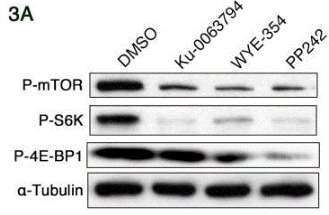
| Western blot | p-mTOR p-S6K / S6K / p-4E-BP1 / E7 / E6 / p53 |
|
24262658 |
Supporto tecnico
Istruzioni per la manipolazione
Tel: +1-832-582-8158 Ext:3
Per qualsiasi altra domanda, si prega di lasciare un messaggio.

I prodotti sono solo per uso di ricerca. Non per uso umano. Non vendiamo a pazienti.
©Copyright 2013 Selleck Chemicals. Tutti i diritti riservati.