
solo per uso di ricerca
MPEP GluR antagonista
N. Cat.S2809
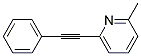
Struttura chimica
Peso molecolare: 193.24
Controllo Qualità
- Citato in Nature Medicine per la sua qualità superiore
- COA
- NMR
- HPLC
- SDS
- Scheda tecnica
Informazioni chimiche, conservazione e stabilità
| Peso molecolare | 193.24 | Formula | C14H11N |
Conservazione (Dalla data di ricezione) | |
|---|---|---|---|---|---|
| N. CAS | 96206-92-7 | Scarica SDF | Conservazione delle soluzioni stock |
|
|
| Sinonimi | N/A | Smiles | CC1=NC(=CC=C1)C#CC2=CC=CC=C2 | ||
Solubilità
|
In vitro |
DMSO
: 39 mg/mL
(201.82 mM)
Ethanol : 39 mg/mL Water : Insoluble |
Calcolatore di Molarità
|
In vivo |
|||||
Calcolatore di formulazione in vivo (Soluzione chiara)
Passo 1: Inserire le informazioni di seguito (Consigliato: Un animale aggiuntivo per tenere conto della perdita durante lesperimento)
Passo 2: Inserire la formulazione in vivo (Questo è solo il calcolatore, non la formulazione. Contattateci prima se non cè una formulazione in vivo nella sezione Solubilità.)
Risultati del calcolo:
Concentrazione di lavoro: mg/ml;
Metodo per preparare il liquido master di DMSO: mg farmaco predissolto in μL DMSO ( Concentrazione del liquido master mg/mL, Vi preghiamo di contattarci prima se la concentrazione supera la solubilità del DMSO del lotto del farmaco. )
Metodo per preparare la formulazione in vivo: Prendere μL DMSO liquido master, quindi aggiungereμL PEG300, mescolare e chiarire, quindi aggiungereμL Tween 80, mescolare e chiarire, quindi aggiungere μL ddH2O, mescolare e chiarire.
Metodo per preparare la formulazione in vivo: Prendere μL DMSO liquido master, quindi aggiungere μL Olio di mais, mescolare e chiarire.
Nota: 1. Si prega di assicurarsi che il liquido sia limpido prima di aggiungere il solvente successivo.
2. Assicurarsi di aggiungere il/i solvente/i in ordine. È necessario assicurarsi che la soluzione ottenuta, nellaggiunta precedente, sia una soluzione limpida prima di procedere allaggiunta del solvente successivo. Metodi fisici come il vortex, gli ultrasuoni o il bagno dacqua calda possono essere utilizzati per facilitare la dissoluzione.
Meccanismo dazione
| Caratteristiche |
Inactive against other group I/II/III metabotropic glutamate receptors.
|
|---|---|
| Targets/IC50/Ki |
mGluR5
36 nM
|
| In vitro |
MPEP non ha attività agonista o antagonista apprezzabile sul recettore mGlu1b umano ricombinante strettamente correlato espresso in cellule CHO-K1 o su un purinorecettore espresso endogenamente in cellule L(tk-) fino a concentrazioni di 100 μM. Inoltre, questo composto non mostra attività agonista o antagonista apprezzabile in saggi di accumulo di cAMP o di legame di [35S]-GTPγS sui recettori metabotropici umani ricombinanti di gruppo II e III (mGlu2, -3, -4a, -6, -7b, -8a umani) così come sui sottotipi di recettori NMDA umani (NMDAR1A/2A, -1A/2B), AMPA di ratto (GluR3) e kainato umano (GluR6). In fette di ippocampo, striato e corteccia neonatale di ratto, ma non del cervelletto, inibisce l'idrolisi di PI stimolata da DHPG con IC50 di 8,0 nM, 20,5 nM e 17,9 nM, rispettivamente. Questa sostanza chimica modula positivamente il hmGluR4 in un sistema di espressione ricombinante, e l'effetto è completamente dipendente dall'attivazione dell'agonista ortosterico L-AP4.
|
| In vivo |
Quando applicato microiontoforeticamente nel cervello di ratti, MPEP riduce le eccitazioni indotte da DHPG ma non quelle indotte da AMPA. A seguito di somministrazione endovenosa, questo composto produce un'inibizione dose-dipendente delle eccitazioni indotte da DHPG ma non da AMPA, con un rapido inizio d'azione. La somministrazione orale di questa sostanza chimica mostra anche un'eccellente attività anti-iperalgesica nei modelli di dolore infiammatorio con Complete Freund's Adjuvant e trementina. Esso (1-30 mg/kg) induce effetti ansiolitici nel test di consumo in conflitto e nel test del labirinto a croce elevato nei ratti, nonché nel test delle quattro piastre nei topi. Questo composto (1-20 mg/kg) accorcia il tempo di immobilità in un test di sospensione della coda nei topi, ma è inattivo nel test di disperazione comportamentale nei ratti. Non ha effetti sull'attività locomotoria o sulla coordinazione motoria. Questa sostanza chimica riduce significativamente le entrate e la durata nel quadrato centrale per fmr1 ma non per il tipo selvatico. Nei test in campo aperto, riduce il comportamento nel campo centrale di fmr1tm1Cgr a uno indistinguibile dal tipo selvatico. Produce una significativa riduzione dell'attività locomotoria totale in tre dei quattro gruppi testati, sia a 10 mg/kg che a 30 mg/kg.
|
Riferimenti |
|
Supporto tecnico
Istruzioni per la manipolazione
Tel: +1-832-582-8158 Ext:3
Per qualsiasi altra domanda, si prega di lasciare un messaggio.

I prodotti sono solo per uso di ricerca. Non per uso umano. Non vendiamo a pazienti.
©Copyright 2013 Selleck Chemicals. Tutti i diritti riservati.