
solo per uso di ricerca
Mirabegron Adrenergic Receptor Agonista
N. Cat.: S4009
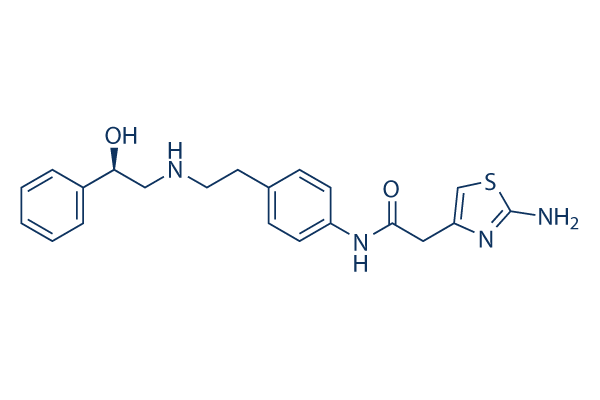
Struttura chimica
Peso molecolare: 396.51
Controllo Qualità (Quality Control)
- Citato in Nature Medicine per la sua qualità superiore
- COA
- NMR
- SDS
- Scheda tecnica
| Target correlati | AChR 5-HT Receptor COX Calcium Channel Histamine Receptor Dopamine Receptor GABA Receptor TRP Channel Cholinesterase (ChE) GluR |
|---|---|
| Altro Adrenergic Receptor Inibitori | ICI 118551 Hydrochloride (Zenidolol) L755507 Yohimbine HCl Atipamezole Adrenalone HCl Medetomidine HCl Noradrenaline bitartrate monohydrate Naftopidil Detomidine HCl L-Adrenaline |
Informazioni chimiche, conservazione e stabilità (Chemical Information, Storage & Stability)
| Peso molecolare | 396.51 | Formula | C21H24N4O2S |
Conservazione (Dalla data di ricezione) | |
|---|---|---|---|---|---|
| N. CAS | 223673-61-8 | Scarica SDF | Conservazione delle soluzioni stock |
|
|
| Sinonimi | YM 178 | Smiles | C1=CC=C(C=C1)C(CNCCC2=CC=C(C=C2)NC(=O)CC3=CSC(=N3)N)O | ||
Solubilità (Solubility)
|
In vitro |
DMSO
: 79 mg/mL
(199.23 mM)
Ethanol : 8 mg/mL Water : Insoluble |
Calcolatore di Molarità
|
In vivo |
|||||
Calcolatore di formulazione in vivo (Soluzione chiara)
Passo 1: Inserire le informazioni di seguito (Consigliato: Un animale aggiuntivo per tenere conto della perdita durante l'esperimento)
Passo 2: Inserire la formulazione in vivo (Questo è solo il calcolatore, non la formulazione. Contattateci prima se non c'è una formulazione in vivo nella sezione Solubilità.)
Risultati del calcolo:
Concentrazione di lavoro: mg/ml;
Metodo per preparare il liquido master di DMSO: mg farmaco predissolto in μL DMSO ( Concentrazione del liquido master mg/mL, Vi preghiamo di contattarci prima se la concentrazione supera la solubilità del DMSO del lotto del farmaco. )
Metodo per preparare la formulazione in vivo: Prendere μL DMSO liquido master, quindi aggiungereμL PEG300, mescolare e chiarire, quindi aggiungereμL Tween 80, mescolare e chiarire, quindi aggiungere μL ddH2O, mescolare e chiarire.
Metodo per preparare la formulazione in vivo: Prendere μL DMSO liquido master, quindi aggiungere μL Olio di mais, mescolare e chiarire.
Nota: 1. Si prega di assicurarsi che il liquido sia limpido prima di aggiungere il solvente successivo.
2. Assicurarsi di aggiungere il/i solvente/i in ordine. È necessario assicurarsi che la soluzione ottenuta, nell'aggiunta precedente, sia una soluzione limpida prima di procedere all'aggiunta del solvente successivo. Metodi fisici come il vortex, gli ultrasuoni o il bagno d'acqua calda possono essere utilizzati per facilitare la dissoluzione.
Meccanismo d'azione (Mechanism of Action)
| Targets/IC50/Ki |
β3-adrenoceptor
22.4 nM(EC50)
|
|---|---|
| In vitro |
Mirabegron concentration-dependently increases the accumulation of cAMP in CHO cells expressing human 3-adrenoceptors (ARs) with I.A. of 0.8. This compound has little agonistic effect on 1- and 2-ARs. It concentration-dependently relaxes rat and Human bladder smooth muscle strips precontracted with 10-6 M or 10-7 M carbachol with EC50 values of 5.1 μM and 0.78 μM, respectively. The maximal relaxant effects of this chemical are 94.0 % and 89.4% that of carbachol, respectively.
It is a time-dependent inhibitor of CYP2D6 in the presence of NADPH as the IC50 value in human liver microsomes decreased from 13 to 4.3 μM after 30 min preincubation. This compound acts partly as an irreversible or quasi-irreversible metabolism-dependent inhibitor of CYP2D6.
|
| In vivo |
Mirabegron produces a dose-dependent decrease in the frequency of rhythmic bladder contraction in anesthetized rats. 3 mg/kg i.v. this compound suppresses the frequency to 2 counts/10 min. It does not decrease the amplitude of rhythmic bladder contraction.
This chemical decreases primary bladder afferent activity and bladder microcontractions in rats. It (0.3 and 1 mg/kg) inhibits mechanosensitive single-unit afferent activities (SAAs) of Aδ fibers in response to bladder filling. SAAs of C-fibers decrease only at 1 mg/kg this compound treatment. Its administration suppresses the mean bladder pressure and the number of microcontractions during an isovolumetric condition of the bladder.
It is efficient on facilitation of bladder storage. This compound dose-dependently decreases the resting intravesical pressure. It dose dependently decreases the frequency of nonvoiding contractions, considered an index of abnormal response in bladder storage. It exhibits no significant effects on the amplitude of nonvoiding contractions, micturition pressure, threshold pressure, voided volume, residual volume, or bladder capacity.
|
Riferimenti |
|
Informazioni sullo studio clinico (Clinical Trial Information)
(dati da https://clinicaltrials.gov, aggiornato il 2026-07-22)
| Numero NCT | Reclutamento | Condizioni | Sponsor/Collaboratori | Data di inizio | Fasi |
|---|---|---|---|---|---|
| NCT07187466 | NOT_YET_RECRUITING | Overactive Bladder; Parkinson Disease |
VA Office of Research and Development |
2026-10-01 | PHASE4 |
| NCT05713799 | NOT_YET_RECRUITING | Insulin Resistance; Obesity |
National Institute of Diabetes and Digestive and Kidney Diseases (NIDDK) |
2026-09-09 | PHASE2 |
| NCT07310797 | RECRUITING | Ureteral Calculi |
Taipei Tzu Chi Hospital, Buddhist Tzu Chi Medical Foundation |
2026-02-13 | PHASE4 |
| NCT07114640 | NOT_YET_RECRUITING | Urinary Bladder, Overactive |
Far Eastern Memorial Hospital |
2025-08-07 | PHASE3 |
| NCT07566208 | NOT_YET_RECRUITING | Ventricular Arrhythmias and Cardiac Arrest |
Cedars-Sinai Medical Center |
2026-05 | PHASE2 |
| NCT07585513 | NOT_YET_RECRUITING | Postural Orthostatic Tachycardia Syndrome (POTS) |
Cedars-Sinai Medical Center |
2026-05 | PHASE2 |

I prodotti sono solo per uso di ricerca. Non per uso umano. Non vendiamo a pazienti.
©Copyright 2013 Selleck Chemicals. Tutti i diritti riservati.