
solo per uso di ricerca
Ipriflavone (Osteofix) AGEs inibitore
N. Cat.S2422
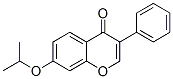
Struttura chimica
Peso molecolare: 280.32
Controllo Qualità
| Target correlati | Dehydrogenase HSP Transferase P450 (e.g. CYP17) PDE phosphatase PPAR Vitamin Carbohydrate Metabolism Mitochondrial Metabolism |
|---|---|
| Altro AGEs Inibitori | Azeliragon (TTP488) |
Informazioni chimiche, conservazione e stabilità
| Peso molecolare | 280.32 | Formula | C18H16O3 |
Conservazione (Dalla data di ricezione) | |
|---|---|---|---|---|---|
| N. CAS | 35212-22-7 | Scarica SDF | Conservazione delle soluzioni stock |
|
|
Solubilità
|
In vitro |
DMSO
: 56 mg/mL
(199.77 mM)
Ethanol : 2 mg/mL Water : Insoluble |
Calcolatore di Molarità
|
In vivo |
|||||
Calcolatore di formulazione in vivo (Soluzione chiara)
Passo 1: Inserire le informazioni di seguito (Consigliato: Un animale aggiuntivo per tenere conto della perdita durante lesperimento)
Passo 2: Inserire la formulazione in vivo (Questo è solo il calcolatore, non la formulazione. Contattateci prima se non cè una formulazione in vivo nella sezione Solubilità.)
Risultati del calcolo:
Concentrazione di lavoro: mg/ml;
Metodo per preparare il liquido master di DMSO: mg farmaco predissolto in μL DMSO ( Concentrazione del liquido master mg/mL, Vi preghiamo di contattarci prima se la concentrazione supera la solubilità del DMSO del lotto del farmaco. )
Metodo per preparare la formulazione in vivo: Prendere μL DMSO liquido master, quindi aggiungereμL PEG300, mescolare e chiarire, quindi aggiungereμL Tween 80, mescolare e chiarire, quindi aggiungere μL ddH2O, mescolare e chiarire.
Metodo per preparare la formulazione in vivo: Prendere μL DMSO liquido master, quindi aggiungere μL Olio di mais, mescolare e chiarire.
Nota: 1. Si prega di assicurarsi che il liquido sia limpido prima di aggiungere il solvente successivo.
2. Assicurarsi di aggiungere il/i solvente/i in ordine. È necessario assicurarsi che la soluzione ottenuta, nellaggiunta precedente, sia una soluzione limpida prima di procedere allaggiunta del solvente successivo. Metodi fisici come il vortex, gli ultrasuoni o il bagno dacqua calda possono essere utilizzati per facilitare la dissoluzione.
Meccanismo dazione
| Targets/IC50/Ki |
advanced glycation end products (AGE)
|
|---|---|
| In vitro |
Ipriflavone (Osteofix) regola la differenziazione e le proprietà biosintetiche delle cellule osteoprogenitrici stromali del midollo osseo umano (BMC) migliorando l'espressione di alcune importanti proteine della matrice e facilitando il processo di mineralizzazione. Il trattamento a 10 μM inibisce significativamente il riassorbimento osseo potenziato dai prodotti finali di glicazione avanzata (AGE) in cellule ossee di topo non frazionate coltivate. Inoltre, potenzia potentemente l'assorbimento di calcio da parte delle cellule duodenali. Questo composto inibisce la proliferazione e la sintesi del DNA delle cellule MDA-231 in modo dose-dipendente e blocca la fosforilazione di Tyr845 dell'EGFR indotta dal ligando. Il trattamento a 50 μM non induce apoptosi delle cellule MDA-231.
|
| In vivo |
La somministrazione orale di Ipriflavone (Osteofix) a 12 mg ma non a 6 mg inibisce significativamente lo sviluppo di nuove metastasi ossee osteolitiche di cellule MDA-231, sopprime la progressione delle lesioni osteolitiche stabilite e riduce il numero di osteoclasti adiacenti alle cellule tumorali nelle metastasi ossee. Coerentemente con l'attività in vitro, il trattamento con questo composto a 6 o 12 mg/die inibisce significativamente la crescita tumorale di xenotrapianti MDA-231 con riduzioni del 25% e 45% in volume e del 47% e 63% in peso, rispettivamente, rispetto ai topi non trattati, e prolunga la vita dei topi portatori di tumore. DL50: Topi >2,5 g/kg (i.p.), >5 g/kg (s.c.), >10 g/kg (i.g.); Ratti >2,5 g/kg (i.p.), >5 g/kg (s.c.), >10 g/kg (i.g.)
|
Riferimenti |
|
Supporto tecnico
Istruzioni per la manipolazione
Tel: +1-832-582-8158 Ext:3
Per qualsiasi altra domanda, si prega di lasciare un messaggio.

I prodotti sono solo per uso di ricerca. Non per uso umano. Non vendiamo a pazienti.
©Copyright 2013 Selleck Chemicals. Tutti i diritti riservati.