
solo per uso di ricerca
BMS-309403 Inibitore di FABP4
N. Cat.S6622
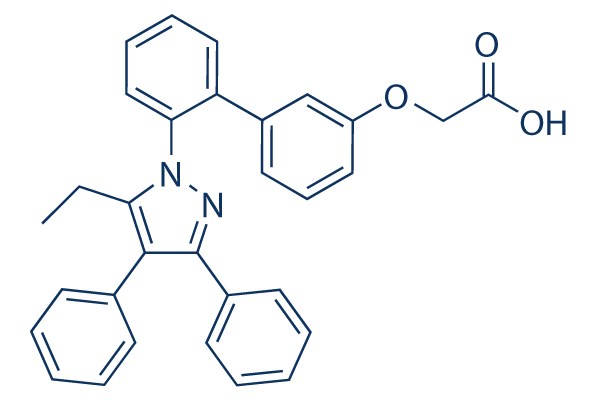
Struttura chimica
Peso molecolare: 474.55
Controllo Qualità
| Target correlati | Dehydrogenase HSP Transferase P450 (e.g. CYP17) PDE phosphatase PPAR Vitamin Carbohydrate Metabolism Mitochondrial Metabolism |
|---|---|
| Altro FABP Inibitori | SBFI-26 ART26.12 |
Coltura cellulare, trattamento e concentrazione di lavoro
| Linee cellulari | Tipo di saggio | Concentrazione | Tempo di incubazione | Formulazione | Descrizione dellattività | PMID |
|---|---|---|---|---|---|---|
| BL21(DE3) | Function assay | Displacement of 1,8-ANS from His6-tagged FABP4 (unknown origin) expressed in Escherichia coli BL21(DE3) cells by fluorescence assay, Ki=0.22μM | 27460668 | |||
| BL21(DE3) | Function assay | Direct binding to His6-tagged FABP4 (unknown origin) expressed in Escherichia coli BL21(DE3) cells by isothermal titration calorimetry, Kd=2.05μM | 27460668 | |||
| aP2+/+ macrophage cells | Function assay | 24 hrs | Decrease in MCP1 production in mouse aP2+/+ macrophage cells after 24 hrs | 17554340 | ||
| aP2-/-R macrophage cells | Function assay | 24 hrs | Decrease in MCP1 production in mouse aP2-/-R macrophage cells (re-expression of aP2) after 24 hrs | 17554340 | ||
| THP1 | Function assay | 25 uM | 3 days | Reduction of transformation of human THP1 cells to foam cells at 25 uM after 3 days relative to control | 17554340 | |
| aP2+/+ macrophage cells | Function assay | 25 uM | Reduction in total cholesterol ester content in mouse aP2+/+ macrophage cells at 25 uM relative to control | 17554340 | ||
| aP2-/-R macrophage cells | Function assay | 25 uM | Reduction in total cholesterol ester content in mouse aP2-/-R macrophage cells (re-expression of aP2) at 25 uM relative to control | 17554340 | ||
| THP1 | Function assay | 25 uM | Increase in APOA1-mediated cholesterol in human THP1 cells at 25 uM relative to control | 17554340 | ||
| THP1 | Function assay | 25 uM | Increase in ABCA1 mRNA level in human THP1 cells at 25 uM relative to control | 17554340 | ||
| THP1 | Function assay | 25 uM | Increase in ABCA1 protein level in human THP1 cells at 25 uM relative to control | 17554340 | ||
| aP2+/+ macrophage cells | Function assay | 25 uM | Increase in cholesterol efflux in mouse aP2+/+ macrophage cells at 25 uM relative to control | 17554340 | ||
| aP2-/-R macrophage cells | Function assay | 25 uM | Increase in cholesterol efflux in mouse aP2-/-R macrophage cells (re-expression of aP2) at 25 uM relative to control | 17554340 | ||
| THP1 | Function assay | Reduction of Mcp1 expression in human THP1 cells expressing aP2 relative to control | 17554340 | |||
| aP2+/+ macrophage cells | Function assay | Reduction of Mcp1 expression mouse aP2+/+ macrophage cells relative to control | 17554340 | |||
| aP2-/-R macrophage cells | Function assay | Reduction of Mcp1 expression mouse aP2-/-R macrophage cells (re-expression of aP2) relative to control | 17554340 | |||
| THP1 | Function assay | Reduction of IL1-beta expression in human THP1 cells expressing aP2 relative to control | 17554340 | |||
| aP2+/+ macrophage cells | Function assay | Reduction of IL1-beta expressed in mouse aP2+/+ macrophage cells relative to control | 17554340 | |||
| aP2-/-R macrophage cells | Function assay | Reduction of IL1-beta expressed in mouse aP2-/-R macrophage cells (re-expression of aP2) relative to control | 17554340 | |||
| THP1 | Function assay | Reduction of IL6 expression in human THP1 cells expressing aP2 relative to control | 17554340 | |||
| aP2+/+ macrophage cells | Function assay | Reduction of IL6 expression mouse aP2+/+ macrophage cells relative to control | 17554340 | |||
| aP2-/-R macrophage cells | Function assay | Reduction of IL6 expression mouse aP2-/-R macrophage cells (re-expression of aP2) relative to control | 17554340 | |||
| THP1 | Function assay | Reduction of TNF expression in human THP1 cells expressing aP2 relative to control | 17554340 | |||
| aP2+/+ macrophage cells | Function assay | Reduction of TNF expression in mouse aP2+/+ macrophage cells relative to control | 17554340 | |||
| aP2-/-R macrophage cells | Function assay | Reduction of TNF expression mouse aP2-/-R macrophage cells (re-expression of aP2) relative to control | 17554340 | |||
| Clicca per visualizzare più dati sperimentali sulle linee cellulari | ||||||
Informazioni chimiche, conservazione e stabilità
| Peso molecolare | 474.55 | Formula | C31H26N2O3 |
Conservazione (Dalla data di ricezione) | 3 years -20°C powder |
|---|---|---|---|---|---|
| N. CAS | 300657-03-8 | -- | Conservazione delle soluzioni stock |
|
|
| Sinonimi | N/A | Smiles | CCC1=C(C(=NN1C2=CC=CC=C2C3=CC(=CC=C3)OCC(=O)O)C4=CC=CC=C4)C5=CC=CC=C5 | ||
Solubilità
|
In vitro |
DMSO
: 95 mg/mL
(200.18 mM)
Ethanol : 18 mg/mL Water : Insoluble |
Calcolatore di Molarità
|
In vivo |
|||||
Calcolatore di formulazione in vivo (Soluzione chiara)
Passo 1: Inserire le informazioni di seguito (Consigliato: Un animale aggiuntivo per tenere conto della perdita durante lesperimento)
Passo 2: Inserire la formulazione in vivo (Questo è solo il calcolatore, non la formulazione. Contattateci prima se non cè una formulazione in vivo nella sezione Solubilità.)
Risultati del calcolo:
Concentrazione di lavoro: mg/ml;
Metodo per preparare il liquido master di DMSO: mg farmaco predissolto in μL DMSO ( Concentrazione del liquido master mg/mL, Vi preghiamo di contattarci prima se la concentrazione supera la solubilità del DMSO del lotto del farmaco. )
Metodo per preparare la formulazione in vivo: Prendere μL DMSO liquido master, quindi aggiungereμL PEG300, mescolare e chiarire, quindi aggiungereμL Tween 80, mescolare e chiarire, quindi aggiungere μL ddH2O, mescolare e chiarire.
Metodo per preparare la formulazione in vivo: Prendere μL DMSO liquido master, quindi aggiungere μL Olio di mais, mescolare e chiarire.
Nota: 1. Si prega di assicurarsi che il liquido sia limpido prima di aggiungere il solvente successivo.
2. Assicurarsi di aggiungere il/i solvente/i in ordine. È necessario assicurarsi che la soluzione ottenuta, nellaggiunta precedente, sia una soluzione limpida prima di procedere allaggiunta del solvente successivo. Metodi fisici come il vortex, gli ultrasuoni o il bagno dacqua calda possono essere utilizzati per facilitare la dissoluzione.
Meccanismo dazione
| Targets/IC50/Ki |
FABP4
(Cell-free assay) 4 nM(Kd)
|
|---|---|
| In vitro |
Il trattamento con BMS309403 (inibitore di FABP4) combinato con SSO (inibitore di CD36) diminuisce significativamente la vitalità, le capacità proliferative, migratorie e invasive delle cellule di carcinoma mammario in 72 h. L'inibizione con uno dei due alle concentrazioni raccomandate non diminuisce significativamente la vitalità delle cellule di carcinoma mammario in 72 h. Il trattamento con SSO e questo composto determina un raggruppamento delle cellule e un aumento del contenuto lipidico, indicando un'incapacità di metabolizzare i lipidi, che potrebbe potenzialmente portare all'apoptosi indotta da lipotossicità. |
| In vivo |
Il trattamento con BMS309403 o SSO da soli diminuisce il tasso di formazione del tumore e la combinazione di questo composto e SSO ha diminuito significativamente il tasso di formazione del tumore. |
Riferimenti |
|
Supporto tecnico
Istruzioni per la manipolazione
Tel: +1-832-582-8158 Ext:3
Per qualsiasi altra domanda, si prega di lasciare un messaggio.

I prodotti sono solo per uso di ricerca. Non per uso umano. Non vendiamo a pazienti.
©Copyright 2013 Selleck Chemicals. Tutti i diritti riservati.