
solo per uso di ricerca
Betahistine 2HCl Histamine Receptor inibitore
N. Cat.S3176
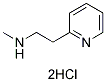
Struttura chimica
Peso molecolare: 209.12
Controllo Qualità
| Target correlati | Adrenergic Receptor AChR 5-HT Receptor COX Calcium Channel Dopamine Receptor GABA Receptor TRP Channel Cholinesterase (ChE) GluR |
|---|---|
| Altro Histamine Receptor Inibitori | GSK2879552 Dihydrochloride JNJ-7777120 Ebastine Ciproxifan Maleate Mianserin HCl Astemizole Lafutidine Mizolastine Rupatadine Fumarate Levodropropizine |
Informazioni chimiche, conservazione e stabilità
| Peso molecolare | 209.12 | Formula | C8H12N2.2HCl |
Conservazione (Dalla data di ricezione) | |
|---|---|---|---|---|---|
| N. CAS | 5579-84-0 | Scarica SDF | Conservazione delle soluzioni stock |
|
|
| Sinonimi | PT-9 | Smiles | CNCCC1=CC=CC=N1.Cl.Cl | ||
Solubilità
|
In vitro |
DMSO
: 38 mg/mL
(181.71 mM)
Water : 38 mg/mL Ethanol : 38 mg/mL |
Calcolatore di Molarità
|
In vivo |
|||||
Calcolatore di formulazione in vivo (Soluzione chiara)
Passo 1: Inserire le informazioni di seguito (Consigliato: Un animale aggiuntivo per tenere conto della perdita durante lesperimento)
Passo 2: Inserire la formulazione in vivo (Questo è solo il calcolatore, non la formulazione. Contattateci prima se non cè una formulazione in vivo nella sezione Solubilità.)
Risultati del calcolo:
Concentrazione di lavoro: mg/ml;
Metodo per preparare il liquido master di DMSO: mg farmaco predissolto in μL DMSO ( Concentrazione del liquido master mg/mL, Vi preghiamo di contattarci prima se la concentrazione supera la solubilità del DMSO del lotto del farmaco. )
Metodo per preparare la formulazione in vivo: Prendere μL DMSO liquido master, quindi aggiungereμL PEG300, mescolare e chiarire, quindi aggiungereμL Tween 80, mescolare e chiarire, quindi aggiungere μL ddH2O, mescolare e chiarire.
Metodo per preparare la formulazione in vivo: Prendere μL DMSO liquido master, quindi aggiungere μL Olio di mais, mescolare e chiarire.
Nota: 1. Si prega di assicurarsi che il liquido sia limpido prima di aggiungere il solvente successivo.
2. Assicurarsi di aggiungere il/i solvente/i in ordine. È necessario assicurarsi che la soluzione ottenuta, nellaggiunta precedente, sia una soluzione limpida prima di procedere allaggiunta del solvente successivo. Metodi fisici come il vortex, gli ultrasuoni o il bagno dacqua calda possono essere utilizzati per facilitare la dissoluzione.
Meccanismo dazione
| Targets/IC50/Ki |
Histamine H3 receptor
1.9 μM
|
|---|---|
| In vitro |
La Betahistine aumenta progressivamente la formazione di cAMP con un effetto massimo, osservato fino a 10 nM, nelle cellule CHO(H3R) incubate con 3 μM di forskolina. Al contrario, a concentrazioni superiori a 10 nM, la Betahistine inibisce progressivamente la formazione di cAMP nelle cellule CHO(H3R) incubate con 3 μM di forskolina. La Betahistine riduce progressivamente il rilascio di acido [3H]arachidonico evocato da A23187 (EC50=0,1 nM) con un effetto massimo, osservato fino a 30 nM, del rilascio di acido [3H]arachidonico evocato da A23187 dalle cellule CHO(H3R). La Betahistine ha progressivamente aumentato il rilascio di acido [3H]arachidonico evocato da A23187 dalle cellule CHO(H3R) a concentrazioni superiori a 30 nM.
|
| In vivo |
Betahistine (< 30 mg/kg) aumenta i livelli di t-MeHA in modo dose-dipendente con un ED50 di 2 mg/kg e un effetto massimo di circa il 35% raggiunto a 30 mg/kg nel cervello di topo. Betahistine (16 mg due volte al giorno per 3 mesi) ha un effetto significativo sulla frequenza, intensità e durata degli attacchi di vertigine; i sintomi associati e la qualità della vita sono anch'essi significativamente migliorati nei pazienti con malattia di Menière. Il dicloridrato di Betahistine (16 mg tre volte al giorno e 48 mg tre volte al giorno) mostra che il numero di attacchi al mese è diminuito in entrambe le dosi nel tempo nella malattia di Menière. Il trattamento con Betahistine (50 mg/kg) induce cambiamenti simmetrici con l'up-regulation dell'mRNA della istidina decarbossilasi nel nucleo tuberomammillare e la riduzione dell'etichettatura con [3H]N-alfa-metilhistamina sia nel nucleo tuberomammillare, nel complesso dei nuclei vestibolari e nei nuclei dell'oliva inferiore in sezioni cerebrali di gatti.
|
Riferimenti |
|
Informazioni sullo studio clinico
(dati da https://clinicaltrials.gov, aggiornato il 2024-05-22)
| Numero NCT | Reclutamento | Condizioni | Sponsor/Collaboratori | Data di inizio | Fasi |
|---|---|---|---|---|---|
| NCT00852956 | Completed | Healthy |
OBEcure Ltd. |
February 2009 | Phase 1 |
| NCT00585585 | Terminated | Recurrent Major Depressive Disorder With Atypical Features |
University of Cincinnati |
July 2007 | Phase 2 |
| NCT00459992 | Completed | Obesity|Overweight|Overnutrition |
Eunice Kennedy Shriver National Institute of Child Health and Human Development (NICHD)|National Institutes of Health Clinical Center (CC) |
April 10 2007 | Phase 1 |
Supporto tecnico
Istruzioni per la manipolazione
Tel: +1-832-582-8158 Ext:3
Per qualsiasi altra domanda, si prega di lasciare un messaggio.

I prodotti sono solo per uso di ricerca. Non per uso umano. Non vendiamo a pazienti.
©Copyright 2013 Selleck Chemicals. Tutti i diritti riservati.