
solo per uso di ricerca
Neomycin sulfate Antineoplastic and Immunosuppressive Antibiotics inibitore
N. Cat.S2568
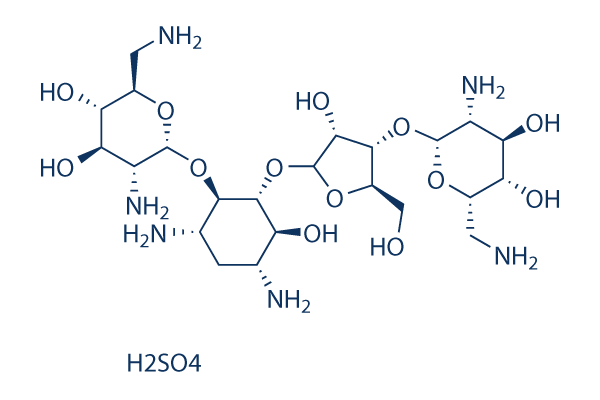
Struttura chimica
Peso molecolare: 712.72
Controllo Qualità
- Citato su Nature Medicine per la sua qualità superiore
- COA
- NMR
-
Perché la microanalisi?
- Scheda dati
- SDS
- Citato su Nature Medicine per la sua qualità superiore
- COA
- NMR
- Scheda dati
- SDS
- Citato su Nature Medicine per la sua qualità superiore
- COA
- NMR
- Scheda dati
- SDS
- Citato su Nature Medicine per la sua qualità superiore
- COA
- Scheda dati
- SDS
| Target correlati | Integrase Bacterial Antibiotics Anti-infection Fungal Antiviral COVID-19 Parasite Reverse Transcriptase HIV |
|---|---|
| Altro Antineoplastic and Immunosuppressive Antibiotics Inibitori | Staurosporine (STS) Cyclosporin A Oligomycin A (MCH 32) Puromycin Dihydrochloride Nigericin sodium salt Geldanamycin (NSC 122750) Honokiol Streptozotocin (STZ) Sodium Monensin (NSC 343257) Cephalomannine |
Informazioni chimiche, conservazione e stabilità
| Peso molecolare | 712.72 | Formula | C23H46N6O13.H2SO4 |
Conservazione (Dalla data di ricezione) | |
|---|---|---|---|---|---|
| N. CAS | 28002-70-2 ,1405-10-3 | Scarica SDF | Conservazione delle soluzioni stock |
|
|
| Sinonimi | Framycin sulfate | Smiles | C1C(C(C(C(C1N)OC2C(C(C(C(O2)CN)O)O)N)OC3C(C(C(O3)CO)OC4C(C(C(C(O4)CN)O)O)N)O)O)N.OS(=O)(=O)O | ||
Solubilità
|
In vitro |
Water : 100 mg/mL
DMSO
: Insoluble
Ethanol : Insoluble |
Calcolatore di Molarità
|
In vivo |
|||||
Calcolatore di formulazione in vivo (Soluzione chiara)
Passo 1: Inserire le informazioni di seguito (Consigliato: Un animale aggiuntivo per tenere conto della perdita durante lesperimento)
Passo 2: Inserire la formulazione in vivo (Questo è solo il calcolatore, non la formulazione. Contattateci prima se non cè una formulazione in vivo nella sezione Solubilità.)
Risultati del calcolo:
Concentrazione di lavoro: mg/ml;
Metodo per preparare il liquido master di DMSO: mg farmaco predissolto in μL DMSO ( Concentrazione del liquido master mg/mL, Vi preghiamo di contattarci prima se la concentrazione supera la solubilità del DMSO del lotto del farmaco. )
Metodo per preparare la formulazione in vivo: Prendere μL DMSO liquido master, quindi aggiungereμL PEG300, mescolare e chiarire, quindi aggiungereμL Tween 80, mescolare e chiarire, quindi aggiungere μL ddH2O, mescolare e chiarire.
Metodo per preparare la formulazione in vivo: Prendere μL DMSO liquido master, quindi aggiungere μL Olio di mais, mescolare e chiarire.
Nota: 1. Si prega di assicurarsi che il liquido sia limpido prima di aggiungere il solvente successivo.
2. Assicurarsi di aggiungere il/i solvente/i in ordine. È necessario assicurarsi che la soluzione ottenuta, nellaggiunta precedente, sia una soluzione limpida prima di procedere allaggiunta del solvente successivo. Metodi fisici come il vortex, gli ultrasuoni o il bagno dacqua calda possono essere utilizzati per facilitare la dissoluzione.
Meccanismo dazione
| In vitro |
La neomicina interagisce preferenzialmente con il complesso ribozima-substrato e questa interazione porta a una riduzione della velocità di scissione stabilizzando lo stato fondamentale del complesso e destabilizzando lo stato di transizione della fase di scissione. La neomicina provoca un cambiamento conformazionale nella struttura della regione trans-attivante (TAR) che può essere rilevato mediante spettroscopia di dicroismo circolare. La neomicina agisce come un inibitore non competitivo che può legarsi al complesso Tat-TAR e aumentare la costante di velocità (koff) per la dissociazione del peptide dall'RNA. La neomicina è l'aminoglicoside (legante di solco) più efficace nello stabilizzare una tripla elica di DNA. La neomicina stabilizza i triplex TAT, così come i triplex di DNA a base mista, meglio dei noti leganti del solco minore del DNA (che di solito destabilizzano il triplex) e delle poliamine. La neomicina mostra una preferenza per la stabilizzazione dei triplette TAT ma può anche accogliere triplette CGC(+). La neomicina induce un blocco parziale dipendente dalla concentrazione e dal voltaggio da entrambe le facce citosolica e luminale del canale. La neomicina ha una maggiore affinità per il sito di interazione luminale rispetto al sito citosolico: le costanti di dissociazione a tensione zero (Kb(0)) sono rispettivamente 210,20 nM e 589,70 nM per il blocco luminale e citosolico. La neomicina mostra anche un sollievo del blocco dipendente dal voltaggio a potenziali di mantenimento >+60 mV. |
Riferimenti |
|
|---|
Informazioni sullo studio clinico
(dati da https://clinicaltrials.gov, aggiornato il 2024-05-22)
| Numero NCT | Reclutamento | Condizioni | Sponsor/Collaboratori | Data di inizio | Fasi |
|---|---|---|---|---|---|
| NCT05593601 | Recruiting | Colonization Asymptomatic |
Mahidol University |
November 24 2022 | Phase 4 |
| NCT00795951 | Completed | Dermatitis Contact |
Allerderm |
November 2008 | Phase 4 |
| NCT00058617 | Completed | Epstein-Barr Virus-Related Hodgkin Lymphoma|Epstein-Barr Virus-Related Non-Hodgkin Lymphoma|EBV Positive Plasma Cell Neoplasm |
Baylor College of Medicine|The Methodist Hospital Research Institute|Center for Cell and Gene Therapy Baylor College of Medicine |
January 1996 | Phase 1 |
Supporto tecnico
Istruzioni per la manipolazione
Tel: +1-832-582-8158 Ext:3
Per qualsiasi altra domanda, si prega di lasciare un messaggio.

I prodotti sono solo per uso di ricerca. Non per uso umano. Non vendiamo a pazienti.
©Copyright 2013 Selleck Chemicals. Tutti i diritti riservati.