
solo per uso di ricerca
Maraviroc (UK-427857) Antagonista del CCR5
N. Cat.S2003
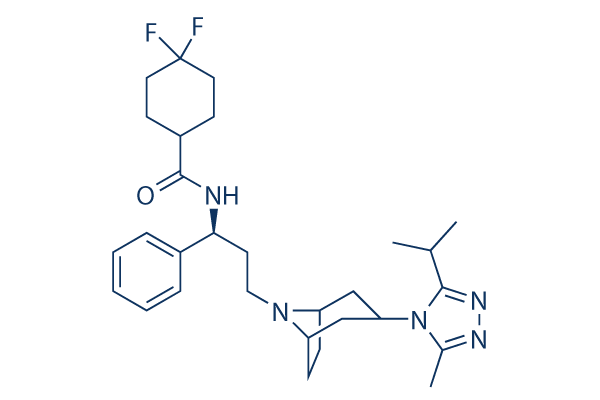
Struttura chimica
Peso molecolare: 513.67
Controllo Qualità
Prodotti spesso usati con Maraviroc (UK-427857)
| Target correlati | Integrase Bacterial Antibiotics Anti-infection Fungal Antiviral COVID-19 Parasite Reverse Transcriptase HIV |
|---|---|
| Altro CCR Inibitori | Cenicriviroc INCB3344 Adaptavir (DAPTA) ZK756326 2HCl BMS-813160 SB-297006 RS102895 BX471 (ZK-811752) AZD2098 R243 |
Coltura cellulare, trattamento e concentrazione di lavoro
| Linee cellulari | Tipo di saggio | Concentrazione | Tempo di incubazione | Formulazione | Descrizione dellattività | PMID |
|---|---|---|---|---|---|---|
| HeLa-P4 | Function assay | Antagonist activity at human recombinant CCR5 expressed in human HeLa-P4 cells assessed as inhibition of human HeLa-P4 cells binding to HIV1 gp160 expressing CHO cells by cell-cell fusion assay, IC50 = 0.0002 μM. | 19171484 | |||
| HeLa-P4 | Function assay | 20 hrs | Antagonist activity at CCR5 receptor expressed in HeLa-P4 cells co-expressing CD4 assessed as inhibition of infusion to HIV gp120 expressed in CHO-tat10 cells after 20 hrs by cell-cell fusion assay, IC50 = 0.0002 μM. | 21128663 | ||
| TZM-bl | Function assay | 3 days | Inhibition of CCR5 in human TZM-bl cells infected with HIV1 Bal R5 assessed as antiviral activity by measuring reduction in viral infection pre-incubated with cells followed by viral infection measured after 3 days by luciferase reporter gene assay, IC50 = 0.0002 μM. | 28082070 | ||
| TZM-bl | Function assay | 48 hrs | Antagonist activity against CCR5 receptor in human TZM-bl cells assessed as inhibition of HIV-1 MGC26-induced cell-cell fusion between viral envelope protein expressing human HEK293 cells to TZM-bl cells after 48 hrs by luciferase reporter gene assay, IC50 = 0.00037 μM. | 24563723 | ||
| TZM-bl | Function assay | 48 hrs | Antagonist activity against CCR5 receptor in human TZM-bl cells assessed as inhibition of HIV-1 YU2-induced cell-cell fusion between viral envelope protein expressing human HEK293 cells to TZM-bl cells after 48 hrs by luciferase reporter gene assay, IC50 = 0.00043 μM. | 24563723 | ||
| PM1 | Antiviral assay | Antiviral activity against HIV1 Bal infected in human PM1 cells assessed as inhibition of viral replication, IC90 = 0.0007 μM. | 19171484 | |||
| PM1 | Antiviral assay | 5 days | Antiviral activity against CCR5-dependent HIV1 Ba-L infected in human PM1 cells assessed as reduction in virus infection measured after 5 days by luciferase reporter gene assay, IC50 = 0.001 μM. | 30234300 | ||
| SupT1 | Antiviral assay | 48 hrs | Antiviral activity against HIV-1 infected in human SupT1 cells assessed as inhibition of viral infectivity after 48 hrs by luciferase reporter gene assay, IC50 = 0.0011 μM. | 24316669 | ||
| TZM-bl | Function assay | 48 hrs | Antagonist activity against CCR5 receptor in human TZM-bl cells assessed as inhibition of HIV-1 92RW-induced cell-cell fusion between viral envelope protein expressing human HEK293 cells to TZM-bl cells after 48 hrs by luciferase reporter gene assay, IC50 = 0.0013 μM. | 24563723 | ||
| CHO | Function assay | 2 hrs | Displacement of [128I]RANTES from human CCR5 receptor coexpressed with Galphai6 in CHO cells after 2 hrs by scintillation counting, IC50 = 0.0014 μM. | 20137937 | ||
| TZM-bl | Function assay | 48 hrs | Antagonist activity against CCR5 receptor in human TZM-bl cells assessed as inhibition of HIV-1 JR-FL-induced cell-cell fusion between viral envelope protein expressing human HEK293 cells to TZM-bl cells after 48 hrs by luciferase reporter gene assay, IC50 = 0.0016 μM. | 24563723 | ||
| HOS | Antiviral assay | 5 days | Antiviral activity against CCR5-dependent HIV1 Ba-L infected in human HOS cells assessed as reduction in virus infection measured after 5 days by luciferase reporter gene assay, IC50 = 0.0019 μM. | 30234300 | ||
| HOS | Antiviral assay | Antiviral activity against HIV1 Ba-L infected in HOS cells assessed as inhibition of viral infection, IC50 = 0.002 μM. | 19664920 | |||
| MOLT4 | Function assay | 15 mins | Antagonist activity at CCR5 in Gqi5 transfected human MOLT4 cells assessed as inhibition of RANTES-stimulated Ca2+ influx preincubated for 15 mins followed by DAMGO challenge, IC50 = 0.0022 μM. | 23682308 | ||
| JC53-BL | Antiviral assay | 3 days | Antiviral activity against CCR5-tropic recombinant HIV1 NLBal virus infected in JC53-BL cells assessed as inhibition of viral replication after 3 days by luciferase reporter gene assay, IC50 = 0.0028 μM. | 20137937 | ||
| JC53-BL | Antiviral assay | 3 days | Antiviral activity against HIV1 NL4-3 infected in human JC53-BL cells assessed as luciferase activity after 3 days post infection, IC50 = 0.003 μM. | 20417098 | ||
| HOS | Antiviral assay | 5 days | Antiviral activity against CCR5-dependent HIV1 SF162 infected in human HOS cells assessed as reduction in virus infection measured after 5 days by luciferase reporter gene assay, IC50 = 0.0047 μM. | 30234300 | ||
| NIH/3T3 | Function assay | 1 hr | Displacement of [125I]-RANTES from CCR5 in mouse NIH/3T3 cells after 1 hr, IC50 = 0.0052 μM. | 29425816 | ||
| SupT1 | Antiviral assay | 48 hrs | Antiviral activity against HIV1 infected in human SupT1 cells exposed to supernatant from HIV1 infected human 293T cells incubated for 48 hrs by firefly luciferase assay based single-cycle HIV1 replication assay, IC50 = 0.0055 μM. | 25638498 | ||
| TZM-bl | Antiviral assay | 48 hrs | Antiviral activity against CCR5-dependent HIV1 SF162 infected in human TZM-bl cells assessed as reduction in virus infection measured after 48 hrs post infection by luciferase reporter gene assay, IC50 = 0.0067 μM. | 30234300 | ||
| HEK293 | Function assay | 10 mins | Antagonist activity at CCR5 (unknown origin) expressed in HEK293 cells co-expressing Galpha16 assessed as inhibition of RANTES-induced calcium flux preincubated for 10 mins followed by RANTES addition by fluo-4AM-based fluorescence assay, IC50 = 0.008 μM. | 30234300 | ||
| CHO | Function assay | 10 mins | Antagonist activity against CCR5 (unknown origin) expressed in CHO cells co-expressing Galpha16 incubated for 10 mins assessed as inhibition of RANTES-induced calcium mobilization, IC50 = 0.0131 μM. | 25638498 | ||
| CHO | Function assay | 10 mins | Inhibition of CCR5 (unknown origin) expressed in CHO cells assessed as inhibition of RANTES-induced intracellular Ca2+ mobilization after 10 mins by Fluo-4 AM staining-based fluorescence assay, IC50 = 0.02543 μM. | 24316669 | ||
| HEK293 | Function assay | 1.5 mins | Inhibition of human MATE1-mediated ASP+ uptake expressed in HEK293 cells after 1.5 mins by fluorescence assay, IC50 = 17.3 μM. | 23241029 | ||
| A673 | qHTS assay | qHTS of pediatric cancer cell lines to identify multiple opportunities for drug repurposing: Primary screen for A673 cells | 29435139 | |||
| NB1643 | qHTS assay | qHTS of pediatric cancer cell lines to identify multiple opportunities for drug repurposing: Primary screen for NB1643 cells | 29435139 | |||
| NB-EBc1 | qHTS assay | qHTS of pediatric cancer cell lines to identify multiple opportunities for drug repurposing: Confirmatory screen for NB-EBc1 cells | 29435139 | |||
| Rh30 | qHTS assay | qHTS of pediatric cancer cell lines to identify multiple opportunities for drug repurposing: Confirmatory screen for Rh30 cells | 29435139 | |||
| RD | qHTS assay | qHTS of pediatric cancer cell lines to identify multiple opportunities for drug repurposing: Confirmatory screen for RD cells | 29435139 | |||
| SK-N-MC | qHTS assay | qHTS of pediatric cancer cell lines to identify multiple opportunities for drug repurposing: Primary screen for SK-N-MC cells | 29435139 | |||
| NB1643 | qHTS assay | qHTS of pediatric cancer cell lines to identify multiple opportunities for drug repurposing: Confirmatory screen for NB1643 cells | 29435139 | |||
| SK-N-MC | qHTS assay | qHTS of pediatric cancer cell lines to identify multiple opportunities for drug repurposing: Confirmatory screen for SK-N-MC cells | 29435139 | |||
| SJ-GBM2 | qHTS assay | qHTS of pediatric cancer cell lines to identify multiple opportunities for drug repurposing: Confirmatory screen for SJ-GBM2 cells | 29435139 | |||
| Rh18 | qHTS assay | qHTS of pediatric cancer cell lines to identify multiple opportunities for drug repurposing: Confirmatory screen for Rh18 cells | 29435139 | |||
| Clicca per visualizzare più dati sperimentali sulle linee cellulari | ||||||
Informazioni chimiche, conservazione e stabilità
| Peso molecolare | 513.67 | Formula | C29H41F2N5O |
Conservazione (Dalla data di ricezione) | |
|---|---|---|---|---|---|
| N. CAS | 376348-65-1 | Scarica SDF | Conservazione delle soluzioni stock |
|
|
| Sinonimi | UK-427857 | Smiles | CC1=NN=C(N1C2CC3CCC(C2)N3CCC(C4=CC=CC=C4)NC(=O)C5CCC(CC5)(F)F)C(C)C | ||
Solubilità
|
In vitro |
DMSO
: 100 mg/mL
(194.67 mM)
Ethanol : 100 mg/mL Water : Insoluble |
Calcolatore di Molarità
|
In vivo |
|||||
Calcolatore di formulazione in vivo (Soluzione chiara)
Passo 1: Inserire le informazioni di seguito (Consigliato: Un animale aggiuntivo per tenere conto della perdita durante lesperimento)
Passo 2: Inserire la formulazione in vivo (Questo è solo il calcolatore, non la formulazione. Contattateci prima se non cè una formulazione in vivo nella sezione Solubilità.)
Risultati del calcolo:
Concentrazione di lavoro: mg/ml;
Metodo per preparare il liquido master di DMSO: mg farmaco predissolto in μL DMSO ( Concentrazione del liquido master mg/mL, Vi preghiamo di contattarci prima se la concentrazione supera la solubilità del DMSO del lotto del farmaco. )
Metodo per preparare la formulazione in vivo: Prendere μL DMSO liquido master, quindi aggiungereμL PEG300, mescolare e chiarire, quindi aggiungereμL Tween 80, mescolare e chiarire, quindi aggiungere μL ddH2O, mescolare e chiarire.
Metodo per preparare la formulazione in vivo: Prendere μL DMSO liquido master, quindi aggiungere μL Olio di mais, mescolare e chiarire.
Nota: 1. Si prega di assicurarsi che il liquido sia limpido prima di aggiungere il solvente successivo.
2. Assicurarsi di aggiungere il/i solvente/i in ordine. È necessario assicurarsi che la soluzione ottenuta, nellaggiunta precedente, sia una soluzione limpida prima di procedere allaggiunta del solvente successivo. Metodi fisici come il vortex, gli ultrasuoni o il bagno dacqua calda possono essere utilizzati per facilitare la dissoluzione.
Meccanismo dazione
| Targets/IC50/Ki |
CCR5
(Cell-free assay) MIP-1α
(Cell-free assay) 3.3 nM
RANTES
(Cell-free assay) 5.2 nM
MIP-1β
(Cell-free assay) 7.2 nM
|
|---|---|
| In vitro |
Maraviroc inibisce il legame del γ-S-GTP stimolato da MIP-1β alle membrane delle cellule HEK-293, indicando la sua capacità di inibire la stimolazione chemiochina-dipendente dello scambio GDP-GTP al complesso CCR5/proteina G. Questo composto inibisce anche l'evento a valle della ridistribuzione intracellulare del calcio indotta da chemiochine, con IC50 che vanno da 7 a 30 nM ottenute contro MIP-1β, MIP-1α e RANTES. Negli stessi esperimenti, non innesca il rilascio di calcio intracellulare a concentrazioni fino a 10 μM, indicando che è privo di attività agonista del CCR5. Coerentemente con ciò, questa sostanza chimica non riesce a indurre l'internalizzazione del CCR5. È attiva a basse concentrazioni nanomolari contro HIV-1 Ba-L. Questo composto inibisce tutti i 200 virus pseudotipati con una IC90 media geometrica di 13,7 nM. A concentrazioni >1000 volte la concentrazione inibitoria del 50%, non ha inibito altri recettori delle chemiochine (CCR1, 2, 3, 4, 7 e 8; CXCR1 e 2) in misura clinicamente rilevante. |
| Saggio chinasico |
Inibizione del legame delle chemiochine al CCR5
|
|
Il legame di MIP-1α, MIP-1β e RANTES marcati con 125I al CCR5 viene misurato utilizzando cellule HEK-293 intatte che esprimono stabilmente il recettore o preparazioni di membrana di esse. In breve, le cellule vengono risospese in tampone di legame (50 mM HEPES contenente 1 mM CaCl2, 5 mM MgCl2 e 0,5% di albumina di siero bovino [BSA] e aggiustato a pH 7,4) a una densità di 2 × 10⁶ cellule/ml. Per le preparazioni di membrana, le cellule lavate con soluzione salina tamponata con fosfato (PBS) vengono risospese in tampone di lisi (20 mM HEPES, 1 mM CaCl2, 1 compressa COMPLETE per 50 mL, pH 7,4) prima dell'omogeneizzazione in un omogeneizzatore portatile Polytron, ultracentrifugazione (40.000× g per 30 min) e risospensione in tampone di legame a una concentrazione proteica di 0,25 mg/mL (12,5 μg di proteina di membrana viene utilizzata in ogni pozzetto di una piastra a 96 pozzetti). MIP-1α, MIP-1β e RANTES radiomarcati con 125I vengono preparati e diluiti in tampone di legame a una concentrazione finale di 400 pM nel saggio. Le diluizioni di questo composto vengono aggiunte a ogni pozzetto per un volume finale di 100 μL, le piastre del saggio incubano per 1 ora e i contenuti vengono filtrati attraverso piastre Unifilter pre-bloccate e lavate che vengono contate dopo essiccazione notturna.
|
|
| In vivo |
I valori di emivita di Maraviroc sono di 0,9 ore nel ratto e 2,3 ore nel cane. Dopo somministrazione orale (2 mg/kg) al cane, il Cmax (256 ng/ml) si è verificato 1,5 ore dopo la dose e la biodisponibilità è del 40%. Per il ratto, circa il 30% della dose somministrata viene assorbita dal tratto intestinale. Femmine di topi RAG-hu vengono sfidate vaginalmente con HIV-1 un'ora dopo l'applicazione intravaginale del gel composto. Questi topi trattati con gel sono completamente protetti contro la sfida vaginale da HIV-1, a differenza dei topi trattati con gel placebo che sono tutti diventati infetti. La somministrazione vaginale di questo composto protegge completamente i topi contro la sfida vaginale da HIV-1. Mentre c'è un chiaro schema di declino delle cellule T CD4 nei topi trattati con gel placebo e sfidati viralmente, i loro livelli sono stabili nei topi che ricevono questo gel chimico. |
Riferimenti |
|
Applicazioni
| Metodi | Biomarcatori | Immagini | PMID |
|---|---|---|---|
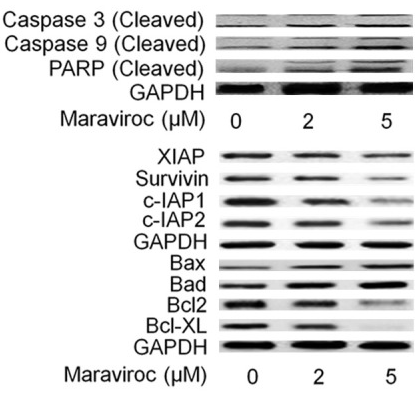
| Western blot | cleaved caspase-3 / cleaved caspase-9 / cleaved PARP / XIAP / Survivin / c-IAP1 / c-IAP2 / Bax / Bad / Bcl2 / Bcl-xl |
|
28469959 |
Informazioni sullo studio clinico
(dati da https://clinicaltrials.gov, aggiornato il 2024-05-22)
| Numero NCT | Reclutamento | Condizioni | Sponsor/Collaboratori | Data di inizio | Fasi |
|---|---|---|---|---|---|
| NCT04966429 | Recruiting | Post Stroke Cognitive Impairment |
Tel-Aviv Sourasky Medical Center|Hadassah Medical Organization|Soroka University Medical Center |
May 1 2021 | Phase 2 |
| NCT04710199 | Completed | Virus Diseases |
Fundación Pública Andaluza para la gestión de la Investigación en Sevilla |
February 23 2021 | Phase 2 |
| NCT02881762 | Completed | Hepatitis C|Human Immunodeficiency Virus |
University of Maryland Baltimore|ViiV Healthcare |
June 1 2017 | Phase 4 |
| NCT02778204 | Completed | HIV Infections |
National Institute of Allergy and Infectious Diseases (NIAID)|Eunice Kennedy Shriver National Institute of Child Health and Human Development (NICHD)|ViiV Healthcare|GlaxoSmithKline |
June 5 2017 | Phase 1 |
| NCT02741323 | Completed | HIV Infections|Kidney Diseases |
National Institute of Allergy and Infectious Diseases (NIAID) |
January 1 2017 | Phase 2 |
Supporto tecnico
Istruzioni per la manipolazione
Tel: +1-832-582-8158 Ext:3
Per qualsiasi altra domanda, si prega di lasciare un messaggio.
Domande Frequenti
Domanda 1:
What vehicle do you recommend to dissolve it for in vivo experiments?
Risposta:
It can be dissolved in 5% DMSO/castor oil at 62 mg/ml as suspension for oral administration. As to a clear solution for injection, following three vehicles at 10mg/ml will help: 1. 2% DMSO/castor oil; 2. 2%DMSO/sunflower oil; 3. 2%DMSO/30%PEG 300/ddH2O.

I prodotti sono solo per uso di ricerca. Non per uso umano. Non vendiamo a pazienti.
©Copyright 2013 Selleck Chemicals. Tutti i diritti riservati.