
solo per uso di ricerca
Valproic Acid sodium HDAC inibitore
N. Cat.S1168
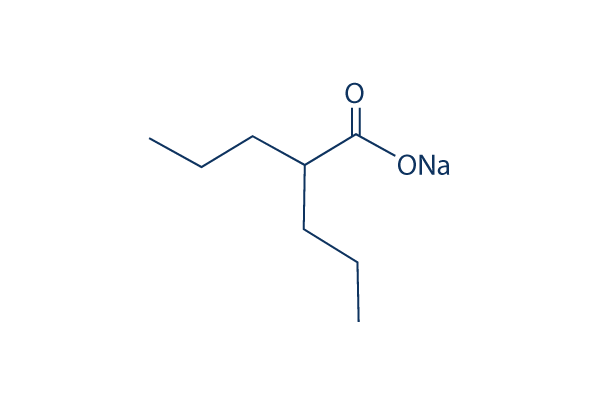
Struttura chimica
Peso molecolare: 166.19
Controllo Qualità
Coltura cellulare, trattamento e concentrazione di lavoro
| Linee cellulari | Tipo di saggio | Concentrazione | Tempo di incubazione | Formulazione | Descrizione dellattività | PMID |
|---|---|---|---|---|---|---|
| HEK293 | Function assay | 1 mM | Increase in protein disulfide isomerase level in HEK293 cells at 1 mM by immunoblot | 17566732 | ||
| HEK293 | Function assay | 1 mM | Increase in GRP78 protein level in HEK293 cells at 1 mM by immunoblot | 17566732 | ||
| A549 | Function assay | 150 uM | 24 hrs | Inhibition of human HDAC in A549 cells assessed as increase in histone-H4 acetylation at 150 uM after 24 hrs by Western blot | 18294844 | |
| GM15850 | Function assay | 400 uM | 12 hrs | Inhibition of HDAC in human GM15850 cells assessed as increase in total acetylated histone level at 400 uM after 12 hrs by Western blot analysis | 16921367 | |
| PC12 | Function assay | 1 uM | 24 hrs | Induction of autophagy in rat stable inducible PC12 cells expressing A53T alpha-synuclein assessed as A53T alpha-synuclein clearance at 1 uM after 24 hrs by densitometric analysis | 18391949 | |
| PC12 | Function assay | 1 uM | 96 hrs | Induction of autophagy in rat stable inducible PC12 cells expressing EGFP-HDQ74 assessed as soluble EGFP-HDQ74 clearance at 1 uM after 96 hrs by densitometric analysis | 18391949 | |
| SK-N-MC | Function assay | 1 mM | 48 hrs | Induction of autophagy in human SK-N-MC cells expressing EGFP-HDQ74 assessed as reduction in EGFP-HDQ74 aggregation at 1 uM after 48 hrs by densitometric analysis | 18391949 | |
| HL60 | Function assay | 1 mM | 24 hrs | Inhibition of HDAC in human HL60 cells assessed as increase in histone H3 acetylation at 1 mM after 24 hrs by Western blotting method | 25304896 | |
| Clicca per visualizzare più dati sperimentali sulle linee cellulari | ||||||
Informazioni chimiche, conservazione e stabilità
| Peso molecolare | 166.19 | Formula | C8H15NaO2 |
Conservazione (Dalla data di ricezione) | |
|---|---|---|---|---|---|
| N. CAS | 1069-66-5 | Scarica SDF | Conservazione delle soluzioni stock |
|
|
| Sinonimi | Sodium valproate,NSC 93819,2-Propylpentanoic Acid | Smiles | CCCC(CCC)C(=O)[O-].[Na+] | ||
Solubilità
|
In vitro |
Water : 100 mg/mL
DMSO
: 33 mg/mL
(198.56 mM)
Ethanol : 33 mg/mL |
Calcolatore di Molarità
|
In vivo |
|||||
Calcolatore di formulazione in vivo (Soluzione chiara)
Passo 1: Inserire le informazioni di seguito (Consigliato: Un animale aggiuntivo per tenere conto della perdita durante lesperimento)
Passo 2: Inserire la formulazione in vivo (Questo è solo il calcolatore, non la formulazione. Contattateci prima se non cè una formulazione in vivo nella sezione Solubilità.)
Risultati del calcolo:
Concentrazione di lavoro: mg/ml;
Metodo per preparare il liquido master di DMSO: mg farmaco predissolto in μL DMSO ( Concentrazione del liquido master mg/mL, Vi preghiamo di contattarci prima se la concentrazione supera la solubilità del DMSO del lotto del farmaco. )
Metodo per preparare la formulazione in vivo: Prendere μL DMSO liquido master, quindi aggiungereμL PEG300, mescolare e chiarire, quindi aggiungereμL Tween 80, mescolare e chiarire, quindi aggiungere μL ddH2O, mescolare e chiarire.
Metodo per preparare la formulazione in vivo: Prendere μL DMSO liquido master, quindi aggiungere μL Olio di mais, mescolare e chiarire.
Nota: 1. Si prega di assicurarsi che il liquido sia limpido prima di aggiungere il solvente successivo.
2. Assicurarsi di aggiungere il/i solvente/i in ordine. È necessario assicurarsi che la soluzione ottenuta, nellaggiunta precedente, sia una soluzione limpida prima di procedere allaggiunta del solvente successivo. Metodi fisici come il vortex, gli ultrasuoni o il bagno dacqua calda possono essere utilizzati per facilitare la dissoluzione.
Meccanismo dazione
| Targets/IC50/Ki |
HDAC
(Cell-free assay) Autophagy
(Cell-free assay) GABA receptor
(Cell-free assay) notch1
|
|---|---|
| In vitro |
L'acido valproico agisce attraverso un percorso distinto che implica l'inibizione diretta dell'istone deacetilasi (IC(50) per HDAC1 = 0,4 mM). L'acido valproico mima l'inibitore dell'istone deacetilasi tricostatina A, causando iperacetilazione degli istoni nelle cellule coltivate. L'acido valproico, come la tricostatina A, attiva anche la trascrizione da diversi promotori esogeni ed endogeni. L'acido valproico e la tricostatina A hanno effetti teratogeni notevolmente simili negli embrioni di vertebrati, mentre gli analoghi non teratogeni dell'acido valproico non inibiscono l'istone deacetilasi e non attivano la trascrizione. L'acido valproico induce la proliferazione dei perossisomi nel fegato di roditori. L'acido valproico a una concentrazione di 1 mM induce il sollievo di questa repressione da parte delle fusioni Gal4 di N-CoR, TR o PPARδ in una linea cellulare che esprime il dominio di legame al ligando di PPARδ fuso al dominio di legame al DNA del recettore dei glucocorticoidi (GR) insieme a un gene reporter controllato da GR. L'acido valproico induce l'accumulo di istone iperacetilato e inibisce l'attività HDAC. L'acido valproico induce un tipo specifico di differenziazione caratterizzato da ridotta proliferazione, alterazioni morfologiche, espressione di geni marcatori e in particolare l'accumulo del fattore di trascrizione AP-2 come potenziale marcatore di differenziazione simile a cellule neuronali o della cresta neurale nelle cellule di teratocarcinoma F9. L'acido valproico compromette la proliferazione o la sopravvivenza cellulare come indicato dalla diminuzione dell'incorporazione di [3H]timidina nelle cellule di teratocarcinoma F9 e P19. |
| In vivo |
L'acido valproico ritarda la crescita dei tumori primari nel modello di cancro al seno di ratto MT-450. |
Riferimenti |
|
Applicazioni
| Metodi | Biomarcatori | Immagini | PMID |
|---|---|---|---|
| Western blot | Acetyl Histone H3 Active caspase-3 / PARP / Cleaved PARP acetyl-H4 |

|
28542253 |
| Growth inhibition assay | Cell viability |

|
28498322 |
Informazioni sullo studio clinico
(dati da https://clinicaltrials.gov, aggiornato il 2024-05-22)
| Numero NCT | Reclutamento | Condizioni | Sponsor/Collaboratori | Data di inizio | Fasi |
|---|---|---|---|---|---|
| NCT03919292 | Recruiting | Solid Tumor Adult |
Virginia Commonwealth University|Puma Biotechnology Inc. |
May 1 2019 | Phase 1|Phase 2 |
| NCT03681158 | Completed | Epilepsy |
Sanofi |
October 5 2018 | Phase 1 |
| NCT03112889 | Completed | Glycogen Storage Disease Type V|McArdle Disease |
University College London |
January 2015 | Phase 2 |
| NCT00139074 | Terminated | Bipolar Disorder |
AstraZeneca |
July 2005 | Phase 4 |
Supporto tecnico
Istruzioni per la manipolazione
Tel: +1-832-582-8158 Ext:3
Per qualsiasi altra domanda, si prega di lasciare un messaggio.

I prodotti sono solo per uso di ricerca. Non per uso umano. Non vendiamo a pazienti.
©Copyright 2013 Selleck Chemicals. Tutti i diritti riservati.