IκBs are a family of related proteins that have an N-terminal regulatory domain, followed by six or more ankyrin repeats and a PEST domain near their C terminus. IκBα is the best-studied and major IκB protein. [show the full text]

IκB/IKK
| N. Cat. | Nome del prodotto | Informazioni | Citazioni di utilizzo del prodotto | Validazioni del prodotto |
|---|---|---|---|---|
| S8922 | TBK1/IKKε-IN-5 | TBK1/IKK -IN-5 (composto 1) è un doppio inibitore della TANK-binding chinasi 1 (TBK1) e della I B chinasi- (IKK /IKK-i) con IC50 di 1,0 nM e 5,6 nM per TBK1 e IKK , rispettivamente. L'inibizione di TBK1/IKK migliora la risposta al blocco di PD-1, il che predice efficacemente la risposta tumorale in vivo. |
|
|
| S9042 | Wedelolactone | Wedelolactone, un composto naturale derivato da piante medicinali, è un inibitore di IKK, fondamentale per l'attivazione di NF-κB mediando la fosforilazione e la degradazione di IκBα. Questo composto è anche un inibitore della caspase-11. |
|
|
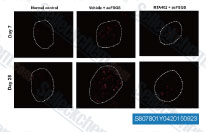
| S8078 | Bardoxolone Methyl (RTA 402) | Bardoxolone Methyl (RTA 402, TP-155, NSC 713200, CDDO Methyl Ester, CDDO-Me) è un inibitore dell'IKK, che mostra potenti attività proapoptotiche e antinfiammatorie; è anche un potente attivatore di Nrf2 e un inibitore del fattore nucleare-κB (NF-κB). Bardoxolone Methyl abroga la ferroptosis. Il Bardoxolone Methyl induce l'apoptosi e l'autofagia nelle cellule tumorali. |
|
|
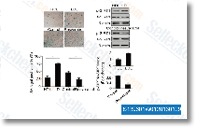
| S1396 | Resveratrol (trans-Resveratrol) | Il Resveratrol ha un ampio spettro di bersagli tra cui le cicloossigenasi (cioè COX, IC50=1.1 μM), le lipoossigenasi (LOX, IC50=2.7 μM), le chinasi, le sirtuine e altre proteine. Ha effetti antitumorali, antinfiammatori, ipoglicemizzanti e altri effetti cardiovascolari benefici. Il Resveratrol induce mitofagia/autofagia e apoptosi dipendente dall'autofagia. |
|
|
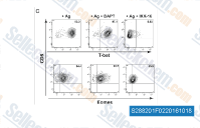
| S2882 | IKK-16 | IKK-16 è un inibitore selettivo della chinasi IκB (IKK) per IKK-2, IKK complex e IKK-1 con IC50 di 40 nM, 70 nM e 200 nM in saggi acellulari, rispettivamente. IKK-16 inibisce anche la fosforilazione di LRRK2 Ser935 nelle cellule e l'attività chinasica di LRRK2 in vitro con IC50 di 50 nM. |
|
|
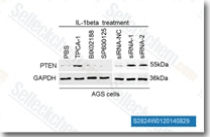
| S2824 | TPCA-1 | TPCA-1 (GW683965) è un inibitore di IKK-2 con IC50 di 17,9 nM in un saggio senza cellule, inibisce la via NF-κB, e presenta una selettività 22 volte superiore rispetto a IKK-1. TPCA-1 è anche un inibitore di STAT3 e aumenta l'apoptosis. |
|
|
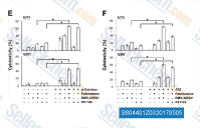
| S8044 | BMS-345541 | BMS-345541 è un inibitore altamente selettivo delle subunità catalitiche di IKK-2 e IKK-1 con IC50 di 0,3 μM e 4 μM in saggi senza cellule, rispettivamente. |
|
|
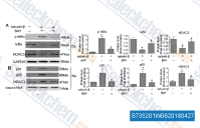
| S7352 | Bay 11-7085 | BAY 11-7085 (Bay 11-7083) un inibitore irreversibile della fosforilazione di I B indotta da TNF con IC50 di 10 M. |
|
|
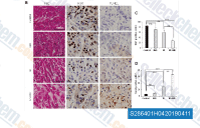
| S2864 | IMD 0354 | IMD-0354 (IKK2 Inhibitor V) è un inibitore di IKKβ e blocca la fosforilazione di IκBα nella via NF-κB. |
|
|
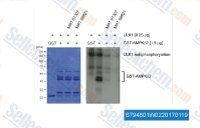
| S7948 | MRT67307 HCl | MRT67307 è un potente e duplice inibitore di IKKϵ e TBK1 con IC50 di 160 e 19 nM, rispettivamente. MRT67307 inibisce potentemente ULK1 e ULK2 e blocca l'autophagy. |
|
|
IκB (Inhibitor of κB) functions as a primary inhibitor of NF-κB activation, with an N-terminal regulatory domain, followed by six or more ankyrin repeats and a PEST domain near their C terminus. [1] IκB family contains eight known members, IκBα, IκBβ, IκBε, Bcl-3 (B-cell lymphoma 3), IκBζ, and IκBns (NF-κBδ), as well as the precursor Rel proteins p100 (NF-κB2) and p105 (NF-κB1) due to the presence of multiple ankyrin repeats in their C-terminal halves. IκBα and IκBβ are broadly expressed in all type of cells, whereas IκBε is expressed only in hematopoietic cells. Bcl-3, IκBζ and IkBNS are atypical IκB proteins that exhibit limited expression following NF-κB activation. The regulation of IκB proteins varies by protein type, and each IκB moiety exhibits a unique affinity for NF-κB complexes. [2]
In unstimulated cells, the IκBα proteins mask the nuclear localization signals (NLS) of NF-κB proteins, keeping them sequestered in an inactive state in the cytoplasm. In response to stimuli, IκB kinase (IKK) phosphorylates IκBα leading to the degradation of IκBα, and subsequent NF-κB activation. IκBα expression can be activated by NF-κB to generate a negative feedback loop. Similar to IκBα, IκBβ acts by sequestering p65- and c-Rel-containing complexes in the cytoplasm. However, nuclear localized IκBβ also binds to p65:c-Rel heterodimers, promoting continued binding to specific κB sites, and augmenting late transcription of select target genes (i.e. TNF and IL-1β). IκBε is induced slowly, and selectively regulates p65 homodimers and c-Rel:p65 heterodimers. Bcl-3 functions as a transcriptional co-activator that may both inhibit and facilitate NF-κB-dependent transcription in a context-specific manner. Like Bcl-3, IκBζ can enhance transcription in association with p50 NF-κB dimmers despite the prescence of distinct mechanisms. IκBns selectively inhibits NF-κB-dependent pro-inflammatory gene expression by stabilizing p50 homodimers at κB sites. In addition to exclusively stabilizing RelB dimers, p100 itself can act more broadly in inhibiting NF-κB dimers. The p105 also acts like a typical IκB protein, and is additionally associated with the activation of the MAPK-ERK signaling pathway through the binding of MAP3K8 (TPL2). Moreover, the functions of individual IκB family members are quite heterogeneous and are not limited to this particular role in regulating NF-κB signaling. [2]
In oncology, the direct activation of NF-κB complexes through the loss of the inhibitory proteins IκBα and IκBε has been observed in Hodgkin’s lymphoma. Since the NF-κB signal pathway plays a critical role in tumorigenesis bv way of abberant IκB activity, a variety of compounds targeting IKK and its associated enzymes are in clinical development. [3] For instance, the proteasome inhibitor Bortezomib (Velcade®) has been approved by the FDA for use in haematological malignancies. [4] In addition, Bortezomib is currently being explored in clinical development for its efficacy against solid tumors (clinicaltrials.gov; NCT00479128).

I prodotti sono solo per uso di ricerca. Non per uso umano. Non vendiamo a pazienti.
©Copyright 2013 Selleck Chemicals. Tutti i diritti riservati.