
solo per uso di ricerca
Thalidomide E3 ligase Ligand Chimico
N. Cat.: S1193
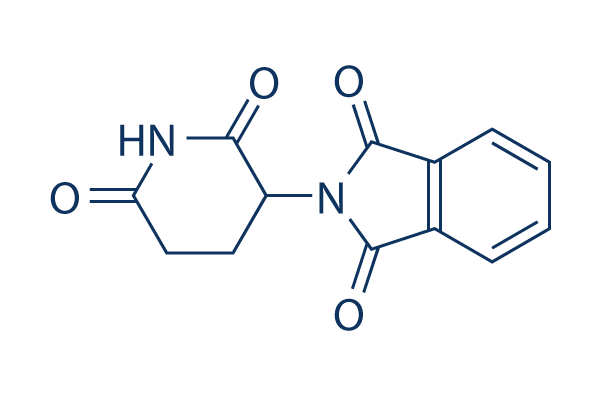
Struttura chimica
Peso molecolare: 258.23
Controllo Qualità (Quality Control)
| Target correlati | Proteasome E1 Activating E3 Ligase DUB SUMO p97 E2 conjugating |
|---|---|
| Altro E3 ligase Ligand Inibitori | CC-99282 |
Coltura cellulare, trattamento e concentrazione di lavoro
(Cell Culture, Treatment & Working Concentration)
| Linee cellulari | Tipo di saggio | Concentrazione | Tempo di incubazione | Formulazione | Descrizione dell'attività | PMID |
|---|---|---|---|---|---|---|
| HeLa | Function assay | Inhibition of IL-1-alpha-induced NF-kappaB activation in HeLa cells assessed as blocking of p50/p65 nuclear translocation, IC50=2.04μM | 17845850 | |||
| RAW264.7 | Antiinflammatory assay | 10 uM | 3 hrs | Antiinflammatory activity in mouse LPS-activated RAW264.7 cells assessed as ROS scavenging activity at 10 uM pretreated for 3 hrs before LPS challenge measured by decrease in fluorescent intensity by confocal microscopy | 18723357 | |
| RAW264.7 | Function assay | 1 uM | 3 hrs | Reduction in iNOS expression in LPS-activated mouse RAW264.7 cells at 1 uM pretreated for 3 hrs before LPS challenge assessed after 24 hrs by Western blot | 18723357 | |
| RAW264.7 | Function assay | 10 uM | 3 hrs | Reduction in iNOS expression in LPS-activated mouse RAW264.7 cells at 10 uM pretreated for 3 hrs before LPS challenge assessed after 24 hrs by Western blot | 18723357 | |
| RAW264.7 | Function assay | 10 uM | 3 hrs | Reduction in pERK1/2 expression in LPS-activated mouse RAW264.7 cells at 10 uM pretreated for 3 hrs before LPS challenge assessed after 24 hrs by Western blot | 18723357 | |
| Ehrlich ascites carcinoma cells | Toxicity assay | 1.25 mM/kg | 7 days | Toxicity in Swiss albino mouse bearing mouse Ehrlich ascites carcinoma cells assessed as focal degeneration of hepatocytes treated after 7 days post-tumor implantation at 1.25 mM/kg, sc for 5 days by histopathological analysis | 18951804 | |
| Ehrlich ascites carcinoma cells | Toxicity assay | 1.25 mM/kg | 7 days | Toxicity in Swiss albino mouse bearing mouse Ehrlich ascites carcinoma cells assessed as focal necrosis of hepatocytes treated after 7 days post-tumor implantation at 1.25 mM/kg, sc for 5 days by histopathological analysis | 18951804 | |
| BTI-TN-5B1-4 | Function assay | 30 mins | Binding affinity to human CRBN (1 to 442 residues)/N-terminal 6His-tagged human DDB1 (1 to 1140 residues) expressed in baculovirus infected BTI-TN-5B1-4 insect cells after 30 mins by cy5 probe based fluorescence polarization assay, Kd=0.25μM | 31117518 | ||
| Clicca per visualizzare più dati sperimentali sulle linee cellulari | ||||||
Informazioni chimiche, conservazione e stabilità (Chemical Information, Storage & Stability)
| Peso molecolare | 258.23 | Formula | C13H10N2O4 |
Conservazione (Dalla data di ricezione) | |
|---|---|---|---|---|---|
| N. CAS | 50-35-1 | Scarica SDF | Conservazione delle soluzioni stock |
|
|
| Sinonimi | K17 | Smiles | C1CC(=O)NC(=O)C1N2C(=O)C3=CC=CC=C3C2=O | ||
Solubilità (Solubility)
|
In vitro |
DMSO
: 150 mg/mL
(580.87 mM)
Riscaldato con bagno d'acqua a 60°C;
Sonicato;
Water : Insoluble Ethanol : Insoluble |
Calcolatore di Molarità
|
In vivo |
|||||
Calcolatore di formulazione in vivo (Soluzione chiara)
Passo 1: Inserire le informazioni di seguito (Consigliato: Un animale aggiuntivo per tenere conto della perdita durante l'esperimento)
Passo 2: Inserire la formulazione in vivo (Questo è solo il calcolatore, non la formulazione. Contattateci prima se non c'è una formulazione in vivo nella sezione Solubilità.)
Risultati del calcolo:
Concentrazione di lavoro: mg/ml;
Metodo per preparare il liquido master di DMSO: mg farmaco predissolto in μL DMSO ( Concentrazione del liquido master mg/mL, Vi preghiamo di contattarci prima se la concentrazione supera la solubilità del DMSO del lotto del farmaco. )
Metodo per preparare la formulazione in vivo: Prendere μL DMSO liquido master, quindi aggiungereμL PEG300, mescolare e chiarire, quindi aggiungereμL Tween 80, mescolare e chiarire, quindi aggiungere μL ddH2O, mescolare e chiarire.
Metodo per preparare la formulazione in vivo: Prendere μL DMSO liquido master, quindi aggiungere μL Olio di mais, mescolare e chiarire.
Nota: 1. Si prega di assicurarsi che il liquido sia limpido prima di aggiungere il solvente successivo.
2. Assicurarsi di aggiungere il/i solvente/i in ordine. È necessario assicurarsi che la soluzione ottenuta, nell'aggiunta precedente, sia una soluzione limpida prima di procedere all'aggiunta del solvente successivo. Metodi fisici come il vortex, gli ultrasuoni o il bagno d'acqua calda possono essere utilizzati per facilitare la dissoluzione.
Meccanismo d'azione (Mechanism of Action)
| Targets/IC50/Ki |
E3 Ligase
(Cell-free assay) TNF-alpha
(Cell-free assay) |
|---|---|
| In vitro |
Thalidomide must be metabolized by the liver to form an epoxide that may be the active teratogenic metabolite. This compound selectively inhibits the production of human monocyte tumor necrosis factor alpha (TNF-alpha) when human monocytes are triggered with lipopolysaccharide and other agonists in culture. It exerts its inhibitory action on tumor necrosis factor alpha by enhancing mRNA degradation. This chemical acts directly, by inducing apoptosis or G1 growth arrest, in MM cell lines and in patient MM cells that are resistant to melphalan, doxorubicin, and dexamethasone (Dex). It enhances the anti-MM activity of Dex and, conversely, are inhibited by interleukin 6. This agent is a potent costimulator of primary human T cells in vitro, synergizing with stimulation via the T cell receptor complex to increase interleukin 2-mediated T cell proliferation and interferon gamma production. It also increases the primary CD8+ cytotoxic T cell response induced by allogeneic dendritic cells in the absence of CD4+ T cells. |
| In vivo |
Thalidomide (200 mg/kg) results in an inhibition of the area of vascularized cornea of rabbits that ranged from 30% to 51% in three experiments with a median inhibition of 36%. |
Riferimenti |
|
Applicazioni (Applications)
| Metodi | Biomarcatori | Immagini | PMID |
|---|---|---|---|
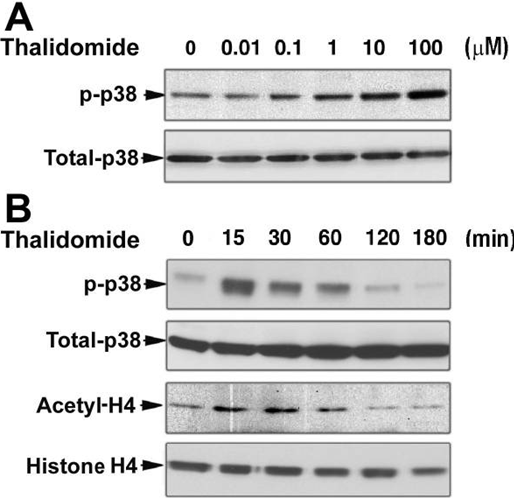
| Western blot | p-p38 / p38 / Acetyl-H4 |
|
17620452 |
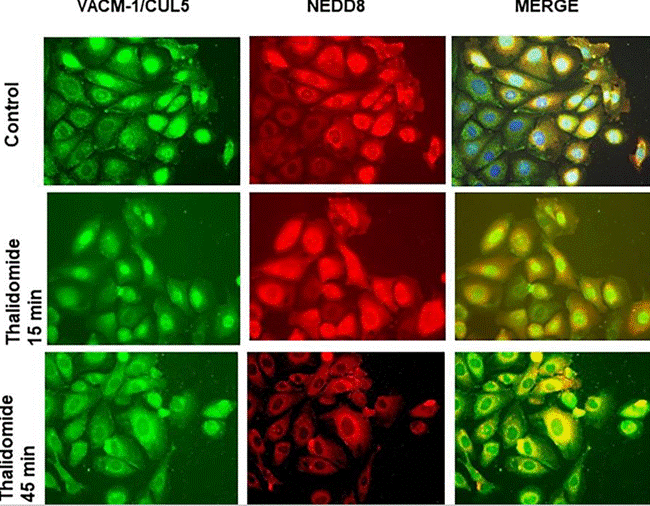
| Immunofluorescence | VCAM-1/CUL5 / NEDD8 bFGF |
|
29746508 |
Informazioni sullo studio clinico (Clinical Trial Information)
(dati da https://clinicaltrials.gov, aggiornato il 2025-12-30)
| Numero NCT | Reclutamento | Condizioni | Sponsor/Collaboratori | Data di inizio | Fasi |
|---|---|---|---|---|---|
| NCT07309419 | NOT_YET_RECRUITING | Hepatocellular Carcinoma |
Shanghai Zhongshan Hospital |
2025-12-22 | PHASE2; PHASE3 |
| NCT01356290 | RECRUITING | Medulloblastoma Recurrent; Ependymoma Recurrent; ATRT Recurrent; Rare CNS Tumor Recurrent |
Medical University of Vienna |
2014-04 | PHASE2 |
| NCT07671534 | RECRUITING | Solid Tumor Cancer |
Sarcoma Oncology Research Center, LLC |
2026-06 | PHASE2 |
| NCT06617182 | RECRUITING | Radiation Enteritis |
Yongquan Shi |
2024-09-30 | PHASE2 |
| NCT07746245 | NOT_YET_RECRUITING | Peripheral T-Cell Lymphoma |
The First Affiliated Hospital with Nanjing Medical University |
2026-08-01 | PHASE2 |
| NCT07195799 | RECRUITING | Non-Hodgkin Lymphoma |
The First Affiliated Hospital with Nanjing Medical University |
2024-12-31 | PHASE2 |

I prodotti sono solo per uso di ricerca. Non per uso umano. Non vendiamo a pazienti.
©Copyright 2013 Selleck Chemicals. Tutti i diritti riservati.