
solo per uso di ricerca
Azithromycin Antibiotics for Mammalian Cell Culture inibitore
N. Cat.S1835
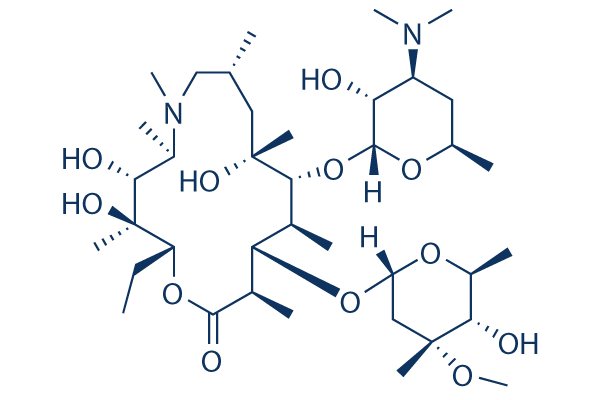
Struttura chimica
Peso molecolare: 748.98
Controllo Qualità
- Citato su Nature Medicine per la sua qualità superiore
- COA
- NMR
- Scheda dati
- SDS
- Citato su Nature Medicine per la sua qualità superiore
- COA
- NMR
- Scheda dati
- SDS
- Citato su Nature Medicine per la sua qualità superiore
- COA
- NMR
- Scheda dati
- SDS
- Citato su Nature Medicine per la sua qualità superiore
- COA
- Scheda dati
- SDS
- Citato su Nature Medicine per la sua qualità superiore
- COA
- Scheda dati
- SDS
Coltura cellulare, trattamento e concentrazione di lavoro
| Linee cellulari | Tipo di saggio | Concentrazione | Tempo di incubazione | Formulazione | Descrizione dellattività | PMID |
|---|---|---|---|---|---|---|
| HeLa 299 | Antichlamydial assay | 44 to 48 hrs | Antichlamydial activity against Chlamydia trachomatis serovar L2 infected in human HeLa 299 cells assessed as reduction in number of inclusion bodies measured after 44 to 48 hrs by DAPI staining-based HCS assay, IC50=0.727μM. | 29232584 | ||
| THP1 | Function assay | 30 mins | Drug uptake in human THP1 cells at pH 6 to 7 after 30 mins | 19564365 | ||
| THP1 | Function assay | 24 hrs | Drug uptake in human THP1 cells after 24 hrs in presence of verapamil | 19564365 | ||
| THP1 | Function assay | 24 hrs | Drug uptake in human THP1 cells after 24 hrs in presence of gemfibrozil | 19564365 | ||
| Hep2 | Antichlamydial assay | 4 ug/ml | 8 hrs | Anti-Chlamydial activity against Chlamydia trachomatis Serovar LGV-L2 infected in Hep2 cells assessed as reduction in size and number of chlamydial inclusion at 4 ug/ml treated at 8 hrs post-infection and 24 hrs later re-infecting fresh Hep2 cells monolay | 32227948 | |
| Vero E6 | Antiviral assay | 2 days | Antiviral efficacy against SARS-CoV-2 (strain BavPat1) in Vero E6 cells assessed by inhibition of viral RNA replication measured by RT-PCR after 2 days, EC50=2.12μM. | ChEMBL | ||
| Vero E6 | Antiviral assay | 2 days | Antiviral efficacy against SARS-CoV-2 (strain BavPat1) in Vero E6 cells assessed by inhibition of viral RNA replication measured by RT-PCR after 2 days, EC90=8.65μM. | ChEMBL | ||
| Clicca per visualizzare più dati sperimentali sulle linee cellulari | ||||||
Informazioni chimiche, conservazione e stabilità
| Peso molecolare | 748.98 | Formula | C38H72N2O12 |
Conservazione (Dalla data di ricezione) | |
|---|---|---|---|---|---|
| N. CAS | 83905-01-5 | Scarica SDF | Conservazione delle soluzioni stock |
|
|
| Sinonimi | XZ-450,CP-62993 | Smiles | CCC1C(C(C(N(CC(CC(C(C(C(C(C(=O)O1)C)OC2CC(C(C(O2)C)O)(C)OC)C)OC3C(C(CC(O3)C)N(C)C)O)(C)O)C)C)C)O)(C)O | ||
Solubilità
|
In vitro |
DMSO
: 100 mg/mL
(133.51 mM)
Ethanol : 100 mg/mL Water : Insoluble |
Calcolatore di Molarità
|
In vivo |
|||||
Calcolatore di formulazione in vivo (Soluzione chiara)
Passo 1: Inserire le informazioni di seguito (Consigliato: Un animale aggiuntivo per tenere conto della perdita durante lesperimento)
Passo 2: Inserire la formulazione in vivo (Questo è solo il calcolatore, non la formulazione. Contattateci prima se non cè una formulazione in vivo nella sezione Solubilità.)
Risultati del calcolo:
Concentrazione di lavoro: mg/ml;
Metodo per preparare il liquido master di DMSO: mg farmaco predissolto in μL DMSO ( Concentrazione del liquido master mg/mL, Vi preghiamo di contattarci prima se la concentrazione supera la solubilità del DMSO del lotto del farmaco. )
Metodo per preparare la formulazione in vivo: Prendere μL DMSO liquido master, quindi aggiungereμL PEG300, mescolare e chiarire, quindi aggiungereμL Tween 80, mescolare e chiarire, quindi aggiungere μL ddH2O, mescolare e chiarire.
Metodo per preparare la formulazione in vivo: Prendere μL DMSO liquido master, quindi aggiungere μL Olio di mais, mescolare e chiarire.
Nota: 1. Si prega di assicurarsi che il liquido sia limpido prima di aggiungere il solvente successivo.
2. Assicurarsi di aggiungere il/i solvente/i in ordine. È necessario assicurarsi che la soluzione ottenuta, nellaggiunta precedente, sia una soluzione limpida prima di procedere allaggiunta del solvente successivo. Metodi fisici come il vortex, gli ultrasuoni o il bagno dacqua calda possono essere utilizzati per facilitare la dissoluzione.
Meccanismo dazione
| Targets/IC50/Ki |
protein synthesis
|
|---|---|
| In vitro |
L'Azithromycin riduce di circa il 40% l'mRNA di IL-8 e l'espressione proteica nelle cellule di fibrosi cistica (CF) raggiungendo i livelli delle cellule non-CF. Questo composto determina una riduzione del 50% e del 70% del legame al DNA di NF-kappaB e AP-1, rispettivamente, portando ai livelli delle cellule non-CF. Aumenta significativamente l'intensità di una molecola co-stimolatoria, CD80, sulle DC ma non CD86 e CD40 nelle cellule dendritiche (DC). Questo macrolide aumenta significativamente la produzione di IL-10 e la Clarithromycin (CAM) inibisce significativamente la produzione di IL-6 da parte delle DC. Aumenta l'IL-10 e la CAM diminuisce significativamente le produzioni di IL-2, quando le cellule T naive derivate dalla milza sono co-coltivate con DC trattate in anticipo con LPS e questi macrolidi. Questo agente inibisce selettivamente l'endocitosi in fase fluida della perossidasi di rafano e del giallo lucifer nelle macrofagi murine J774. Ritarda il sequestro della transferrina legata al recettore e dei complessi immuni perossidasi-anti-perossidasi in fossette e vescicole endocitiche della superficie cellulare. Questa sostanza chimica down-regola i recettori della transferrina sulla superficie cellulare, ma non i recettori Fc gamma, causando un ritardo significativo nell'accessibilità dei recettori della transferrina internalizzati alla via di riciclaggio, senza rallentare il successivo efflusso, con conseguente ridistribuzione del pool di superficie a un pool intracellulare. Si inserisce nel doppio strato lipidico DOPC, in modo da diminuirne la coesione e facilitare la fusione di DPPC nella matrice fluida DOPC.
|
Riferimenti |
|
Informazioni sullo studio clinico
(dati da https://clinicaltrials.gov, aggiornato il 2024-05-22)
| Numero NCT | Reclutamento | Condizioni | Sponsor/Collaboratori | Data di inizio | Fasi |
|---|---|---|---|---|---|
| NCT05972772 | Not yet recruiting | Infectious Disease|Therapeutics |
Lao-Oxford-Mahosot Hospital Wellcome Trust Research Unit|Mahidol Oxford Tropical Medicine Research Unit |
March 20 2024 | Phase 2|Phase 3 |
| NCT05796362 | Not yet recruiting | Infectious Disease|Drug Effect|Clinical Infection |
Brigham and Women''s Hospital|Bill and Melinda Gates Foundation |
April 2023 | Phase 1 |
Supporto tecnico
Istruzioni per la manipolazione
Tel: +1-832-582-8158 Ext:3
Per qualsiasi altra domanda, si prega di lasciare un messaggio.

I prodotti sono solo per uso di ricerca. Non per uso umano. Non vendiamo a pazienti.
©Copyright 2013 Selleck Chemicals. Tutti i diritti riservati.