
solo per uso di ricerca
Minocycline Hydrochloride Antibiotico
N. Cat.: S4226
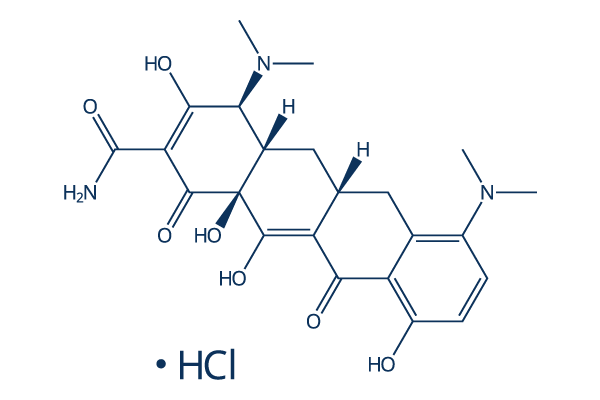
Struttura chimica
Peso molecolare: 493.94
Controllo Qualità (Quality Control)
| Target correlati | Integrase Bacterial Anti-infection Fungal Antiviral COVID-19 Parasite Reverse Transcriptase HIV HCV Protease |
|---|---|
| Altro Antibiotics Inibitori | Puromycin G418 Sulfate (Geneticin) Nanchangmycin Sitafloxacin Hydrate Nadifloxacin Spiramycin Trovafloxacin Mesylate G-418 Thiamphenicol Kitasamycin |
Coltura cellulare, trattamento e concentrazione di lavoro
(Cell Culture, Treatment & Working Concentration)
| Linee cellulari | Tipo di saggio | Concentrazione | Tempo di incubazione | Formulazione | Descrizione dell'attività | PMID |
|---|---|---|---|---|---|---|
| Jurkat cells | Cell viability assay | 10-200 µM | 24 h | reduces cell viability and induces DNA fragmentation and dissipation of the mitochondrial membrane potential in Jurkat cells but is harmless to human peripheral blood lymphocyte cells (hPBLCs) | ||
| hPBLCs | Cell viability assay | 10-200 µM | 24 h | reduces cell viability and induces DNA fragmentation and dissipation of the mitochondrial membrane potential in Jurkat cells but is harmless to human peripheral blood lymphocyte cells (hPBLCs) | ||
| Clicca per visualizzare più dati sperimentali sulle linee cellulari | ||||||
Informazioni chimiche, conservazione e stabilità (Chemical Information, Storage & Stability)
| Peso molecolare | 493.94 | Formula | C23H27N3O7.HCl |
Conservazione (Dalla data di ricezione) | |
|---|---|---|---|---|---|
| N. CAS | 13614-98-7 | Scarica SDF | Conservazione delle soluzioni stock |
|
|
| Sinonimi | CL 59806 | Smiles | CN(C)C1C2CC3CC4=C(C=CC(=C4C(=C3C(=O)C2(C(=C(C1=O)C(=O)N)O)O)O)O)N(C)C.Cl | ||
Solubilità (Solubility)
|
In vitro |
Water : 6 mg/mL
DMSO
: Insoluble
Ethanol : Insoluble |
Calcolatore di Molarità
|
In vivo |
|||||
Calcolatore di formulazione in vivo (Soluzione chiara)
Passo 1: Inserire le informazioni di seguito (Consigliato: Un animale aggiuntivo per tenere conto della perdita durante l'esperimento)
Passo 2: Inserire la formulazione in vivo (Questo è solo il calcolatore, non la formulazione. Contattateci prima se non c'è una formulazione in vivo nella sezione Solubilità.)
Risultati del calcolo:
Concentrazione di lavoro: mg/ml;
Metodo per preparare il liquido master di DMSO: mg farmaco predissolto in μL DMSO ( Concentrazione del liquido master mg/mL, Vi preghiamo di contattarci prima se la concentrazione supera la solubilità del DMSO del lotto del farmaco. )
Metodo per preparare la formulazione in vivo: Prendere μL DMSO liquido master, quindi aggiungereμL PEG300, mescolare e chiarire, quindi aggiungereμL Tween 80, mescolare e chiarire, quindi aggiungere μL ddH2O, mescolare e chiarire.
Metodo per preparare la formulazione in vivo: Prendere μL DMSO liquido master, quindi aggiungere μL Olio di mais, mescolare e chiarire.
Nota: 1. Si prega di assicurarsi che il liquido sia limpido prima di aggiungere il solvente successivo.
2. Assicurarsi di aggiungere il/i solvente/i in ordine. È necessario assicurarsi che la soluzione ottenuta, nell'aggiunta precedente, sia una soluzione limpida prima di procedere all'aggiunta del solvente successivo. Metodi fisici come il vortex, gli ultrasuoni o il bagno d'acqua calda possono essere utilizzati per facilitare la dissoluzione.
Meccanismo d'azione (Mechanism of Action)
| In vitro |
Minocycline is a second-generation tetracycline used in humans, which effectively crosses the blood−brain barrier. It inhibits the activity of caspase-1, caspase-3, inducible form of nitric oxide synthetase (iNOS) and p38 mitogen-activated protein kinase (MAPK). After experimental ischemia, minocycline inhibits caspase-1 and inducible nitric oxide synthetase (iNOS) upregulation, and decreases infarct size. Minocycline inhibits mitochondrial permeability-transition-mediated cytochrome c release. Minocycline-mediated inhibition of cytochrome c release is demonstrated in vivo, in cells, and in isolated mitochondria. |
|---|---|
| In vivo |
Minocycline is a semi-synthetic tetracycline derivative which is well absorbed and distributed in body tissues and is suitable for twice daily administration. Minocycline's effects are related to the inhibition of protein synthesis. Although minocycline's broader spectrum of activity, compared to other members of the group, includes activity against Neisseria meningitidis, its use as a prophylaxis is no longer recomended because of side effects (dizziness and vertigo). Minocycline is remarkable neuroprotective qualities in models of cerebral ischaemia, traumatic brain injury, and Huntington's and Parkinson's disease. The neuroprotective action of minocycline may include its inhibitory effect on 5-lipoxygenase, an inflammatory enzyme associated with brain aging. |
Riferimenti |
|
Applicazioni (Applications)
| Metodi | Biomarcatori | Immagini | PMID |
|---|---|---|---|
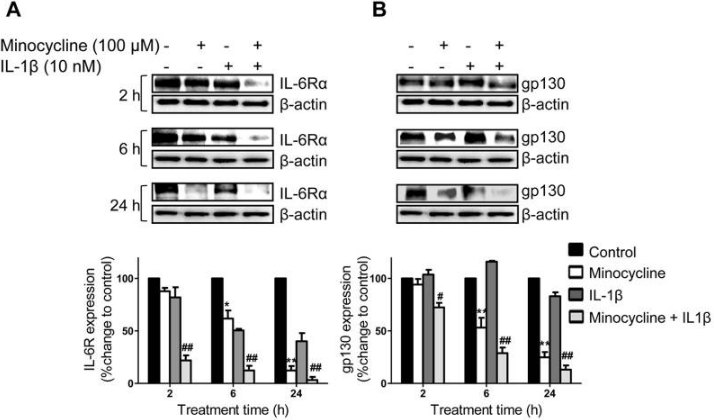
| Western blot | IL-6Rα / gp130 p-STAT3 / STAT3 / Mcl-1 / p-ERK / ERK |
|
23593315 |
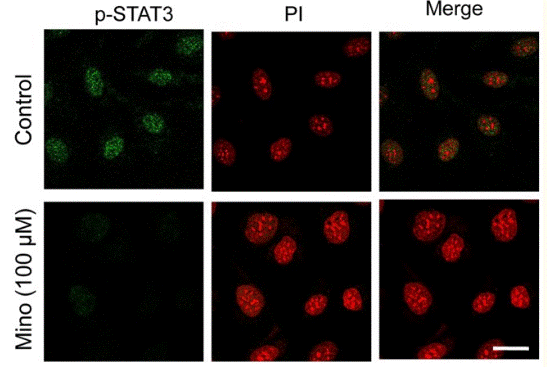
| Immunofluorescence | p-STAT3 STAT3 |
|
23593315 |
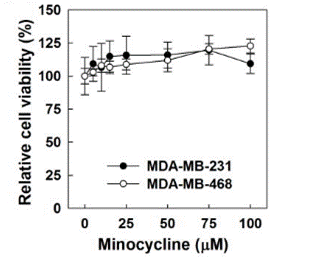
| Growth inhibition assay | Cell viability |
|
27555377 |
Informazioni sullo studio clinico (Clinical Trial Information)
(dati da https://clinicaltrials.gov, aggiornato il 2026-07-30)
| Numero NCT | Reclutamento | Condizioni | Sponsor/Collaboratori | Data di inizio | Fasi |
|---|---|---|---|---|---|
| NCT07735819 | NOT_YET_RECRUITING | Low Grade Glioma; Glioblastoma |
Barbara Ann Karmanos Cancer Institute |
2026-09 | PHASE2 |
| NCT06699966 | NOT_YET_RECRUITING | Major Depressive Disorder |
Stony Brook University |
2027-06 | PHASE4 |
| NCT07305896 | NOT_YET_RECRUITING | Intracerebral Hemorrhage |
The First Hospital of Jilin University |
2025-12-31 | |
| NCT07526987 | RECRUITING | Ischaemic Stroke |
Beijing Tiantan Hospital |
2026-06-05 | PHASE3 |
| NCT07237048 | RECRUITING | Stroke; Ischemia Stroke; Hemorrhagic Strokes; Mortality; Morbidity; Cerebrovascular Accident (Stroke); Intracerebral Haemorrhage (ICH) |
Joyce Chen |
2026-02-02 | PHASE2; PHASE3 |
| NCT07594301 | RECRUITING | Acute Ischemic Stroke; Endovascular Thrombectomy; Minocycline; Posterior Circulation; Arterial Occlusion |
Xiang Luo |
2026-05-19 | PHASE2; PHASE3 |

I prodotti sono solo per uso di ricerca. Non per uso umano. Non vendiamo a pazienti.
©Copyright 2013 Selleck Chemicals. Tutti i diritti riservati.