
solo per uso di ricerca
Ritonavir HIV Protease Inibitore
N. Cat.: S1185
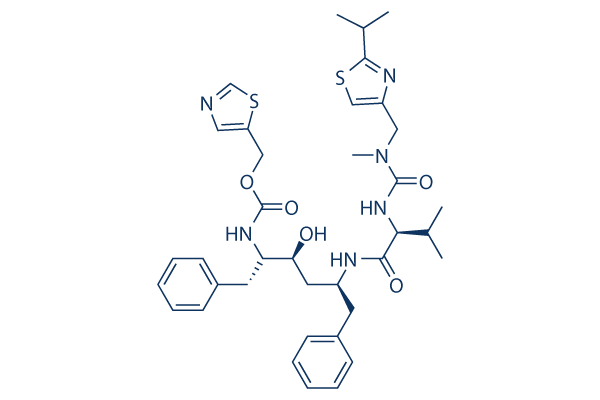
Struttura chimica
Peso molecolare: 720.94
Controllo Qualità (Quality Control)
| Target correlati | HDAC Caspase Proteasome Secretase MMP HCV Protease Cysteine Protease Tyrosinase DPP Serine Protease |
|---|---|
| Altro HIV Protease Inibitori | Pepstatin A Limonin Temsavir (BMS-626529) Dextran sulfate sodium (DSS) Bevirimat NBD-556 GS-6207 (Lenacapavir) Rosamultin Mericitabine Azvudine |
Informazioni chimiche, conservazione e stabilità (Chemical Information, Storage & Stability)
| Peso molecolare | 720.94 | Formula | C37H48N6O5S2 |
Conservazione (Dalla data di ricezione) | |
|---|---|---|---|---|---|
| N. CAS | 155213-67-5 | Scarica SDF | Conservazione delle soluzioni stock |
|
|
| Sinonimi | ABT-538,A 84538, RTV | Smiles | CC(C)C(NC(=O)N(C)CC1=CSC(=N1)C(C)C)C(=O)NC(CC(O)C(CC2=CC=CC=C2)NC(=O)OCC3=CN=CS3)CC4=CC=CC=C4 | ||
Solubilità (Solubility)
|
In vitro |
DMSO
: 100 mg/mL
(138.7 mM)
Ethanol : 100 mg/mL Water : Insoluble |
Calcolatore di Molarità
|
In vivo |
|||||
Calcolatore di formulazione in vivo (Soluzione chiara)
Passo 1: Inserire le informazioni di seguito (Consigliato: Un animale aggiuntivo per tenere conto della perdita durante l'esperimento)
Passo 2: Inserire la formulazione in vivo (Questo è solo il calcolatore, non la formulazione. Contattateci prima se non c'è una formulazione in vivo nella sezione Solubilità.)
Risultati del calcolo:
Concentrazione di lavoro: mg/ml;
Metodo per preparare il liquido master di DMSO: mg farmaco predissolto in μL DMSO ( Concentrazione del liquido master mg/mL, Vi preghiamo di contattarci prima se la concentrazione supera la solubilità del DMSO del lotto del farmaco. )
Metodo per preparare la formulazione in vivo: Prendere μL DMSO liquido master, quindi aggiungereμL PEG300, mescolare e chiarire, quindi aggiungereμL Tween 80, mescolare e chiarire, quindi aggiungere μL ddH2O, mescolare e chiarire.
Metodo per preparare la formulazione in vivo: Prendere μL DMSO liquido master, quindi aggiungere μL Olio di mais, mescolare e chiarire.
Nota: 1. Si prega di assicurarsi che il liquido sia limpido prima di aggiungere il solvente successivo.
2. Assicurarsi di aggiungere il/i solvente/i in ordine. È necessario assicurarsi che la soluzione ottenuta, nell'aggiunta precedente, sia una soluzione limpida prima di procedere all'aggiunta del solvente successivo. Metodi fisici come il vortex, gli ultrasuoni o il bagno d'acqua calda possono essere utilizzati per facilitare la dissoluzione.
Meccanismo d'azione (Mechanism of Action)
| Targets/IC50/Ki |
CYP3A4
HIV
|
|---|---|
| In vitro |
Ritonavir is a very potent inhibitor of CYP3A4 mediated testosterone 6β-hydroxylation with mean Ki of 19 nM and also inhibits tolbutamide hydroxylation with IC50 of 4.2 μM. This compound is found to be a potent inhibitor of CYP3A-mediated biotransformations (nifedipine oxidation with IC50 of 0.07 mM, 17alpha-ethynylestradiol 2-hydroxylation with IC50 of 2 mM; terfenadine hydroxylation with IC50 of 0.14 mM). It is also found to be an inhibitor of the reactions mediated by CYP2D6 (IC50 = 2.5 mM) and CYP2C9/10 (IC50 = 8.0 mM). This agent results in an increase in cell viability in uninfected human PBMC cultures. It markedly decreases the susceptibility of PBMCs to apoptosis correlated with lower levels of caspase-1 expression, decreases in annexin V staining, and reduces caspase-3 activity in uninfected human PBMC cultures. The compound inhibits induction of tumor necrosis factor (TNF) production by PBMCs and monocytes in a time- and dose-dependent manner at nontoxic concentrations. It inhibits p-glycoprotein-mediated extrusion of saquinavir with an IC50 of 0.2 μM, indicating a high affinity of ritonavir for p-glycoprotein. This chemical inhibits human liver microsomal metabolism of ABT-378 potently with Ki of 13 nM. When combined with ABT-378 (at 3:1 and 29:1 ratios), it inhibits CYP3A (IC50 = 1.1 and 4.6 μM), albeit less potently than Ritonavir (IC50 = 0.14 μM). |
Riferimenti |
|
Informazioni sullo studio clinico (Clinical Trial Information)
(dati da https://clinicaltrials.gov, aggiornato il 2026-06-10)
| Numero NCT | Reclutamento | Condizioni | Sponsor/Collaboratori | Data di inizio | Fasi |
|---|---|---|---|---|---|
| NCT06337032 | RECRUITING | HIV-1-infection |
Gilead Sciences |
2024-08-27 | PHASE4 |
| NCT07792096 | NOT_YET_RECRUITING | HIV Infection |
University College, London |
2026-11 | PHASE3 |
| NCT04381936 | RECRUITING | Pneumonia |
University of Oxford |
2020-03-19 | PHASE3 |
| NCT02140255 | RECRUITING | HIV Infection |
National Institute of Allergy and Infectious Diseases (NIAID) |
2015-01-23 | PHASE1; PHASE2 |
| NCT07601074 | RECRUITING | Human Papilloma Virus (HPV); High-risk Human Papillomavirus Infection |
Daré Bioscience, Inc. |
2026-07-17 | PHASE2 |
| NCT05334004 | RECRUITING | High-Grade Anal Intraepithelial Neoplasia |
University of Wisconsin, Madison |
2023-12-19 | PHASE1 |

I prodotti sono solo per uso di ricerca. Non per uso umano. Non vendiamo a pazienti.
©Copyright 2013 Selleck Chemicals. Tutti i diritti riservati.